Bastick Alex N, Belo Janneke N, Runhaar Jos, Bierma-Zeinstra Sita M A
Department of General Practice, Erasmus MC, University Medical Center Rotterdam, Room NA-1923, PO Box 2040, 3000 CA, Rotterdam, The Netherlands,
Clin Orthop Relat Res. 2015 Sep;473(9):2969-89. doi: 10.1007/s11999-015-4349-z. Epub 2015 May 21.
A previous systematic review on prognostic factors for knee osteoarthritis (OA) progression showed associations for generalized OA and hyaluronic acid levels. Knee pain, radiographic severity, sex, quadriceps strength, knee injury, and regular sport activities were not associated. It has been a decade since the literature search of that review and many studies have been performed since then investigating prognostic factors for radiographic knee OA progression.
QUESTIONS/PURPOSES: The purpose of this study is to provide an updated systematic review of available evidence regarding prognostic factors for radiographic knee OA progression.
We searched for observational studies in MEDLINE and EMBASE. Key words were: knee, osteoarthritis (or arthritis, or arthrosis, or degenerative joint disease), progression (or prognosis, or precipitate, or predictive), and case-control (or cohort, or longitudinal, or follow-up). Studies fulfilling the inclusion criteria were assessed for methodologic quality according to established criteria for reviews on prognostic factors in musculoskeletal disorders. Data were extracted and results were pooled if possible or summarized according to a best-evidence synthesis. A total of 1912 additional articles were identified; 43 met our inclusion criteria. The previous review contained 36 articles, thus providing a new total of 79 articles. Seventy-two of the included articles were scored high quality, the remaining seven were low quality.
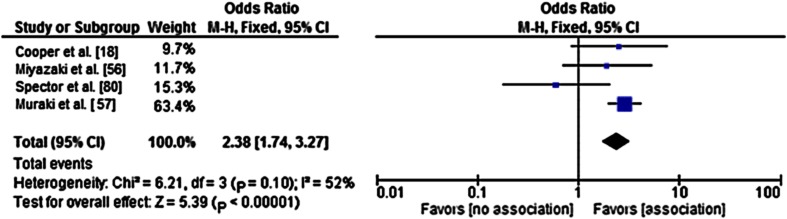
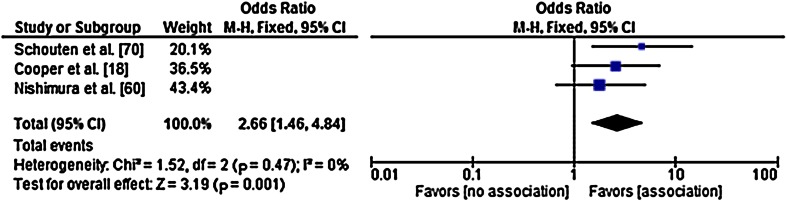
The pooled odds ratio (OR) of two determinants showed associations with knee OA progression: baseline knee pain (OR, 2.38 [95% CI, 1.74-3.27) and Heberden nodes (OR, 2.66 [95% CI, 1.46-8.84]). Our best-evidence synthesis showed strong evidence that varus alignment, serum hyaluronic acid, and tumor necrosis factor-α are associated with knee OA progression. There is strong evidence that sex, former knee injury, quadriceps strength, smoking, running, and regular performance of sports are not associated with knee OA progression. Evidence for the majority of determined associations, however, was limited, conflicting, or inconclusive.
Baseline knee pain, presence of Heberden nodes, varus alignment, and high levels of serum markers hyaluronic acid and tumor necrosis factor-α predict knee OA progression. Sex, knee injury, and quadriceps strength, among others, did not predict knee OA progression. Large variation remains in definitions of knee OA and knee OA progression. Clinical studies should use more consistent definitions of these factors to facilitate data pooling by future meta-analyses.
先前一项关于膝关节骨关节炎(OA)进展预后因素的系统评价显示,全身性OA与透明质酸水平之间存在关联。膝关节疼痛、影像学严重程度、性别、股四头肌力量、膝关节损伤和规律的体育活动并无关联。自该评价的文献检索至今已有十年,此后进行了许多研究来调查膝关节OA影像学进展的预后因素。
问题/目的:本研究的目的是对有关膝关节OA影像学进展预后因素的现有证据进行更新的系统评价。
我们在MEDLINE和EMBASE中检索观察性研究。关键词为:膝关节、骨关节炎(或关节炎、或关节病、或退行性关节病)、进展(或预后、或促成、或预测)以及病例对照(或队列、或纵向、或随访)。根据肌肉骨骼疾病预后因素综述的既定标准,对符合纳入标准的研究进行方法学质量评估。提取数据,若可能则合并结果,或根据最佳证据综合进行总结。共识别出1912篇其他文章;43篇符合我们的纳入标准。先前的综述包含36篇文章,因此总共新增79篇文章。纳入的文章中有72篇质量评分高,其余7篇质量低。
两个决定因素的合并比值比(OR)显示与膝关节OA进展相关:基线膝关节疼痛(OR,2.38 [95% CI,1.74 - 3.27])和赫伯登结节(OR,2.66 [95% CI,1.46 - 8.84])。我们的最佳证据综合显示,有充分证据表明内翻畸形、血清透明质酸和肿瘤坏死因子-α与膝关节OA进展相关。有充分证据表明,性别、既往膝关节损伤、股四头肌力量、吸烟、跑步和规律的体育活动与膝关节OA进展无关。然而,大多数已确定关联的证据有限、相互矛盾或无定论。
基线膝关节疼痛、赫伯登结节的存在、内翻畸形以及血清标志物透明质酸和肿瘤坏死因子-α水平升高可预测膝关节OA进展。性别、膝关节损伤和股四头肌力量等因素不能预测膝关节OA进展。膝关节OA和膝关节OA进展的定义仍存在很大差异。临床研究应使用更一致的这些因素定义,以便未来的荟萃分析能够进行数据合并。