Delaney Rebecca, Strough JoNell, Parker Andrew M, de Bruin Wandi Bruine
West Virginia University, Department of Psychology, 53 Campus Drive, Morgantown, WV 26506.
RAND Corporation, 4570 Fifth Avenue, Suite 600, Pittsburgh, PA 15213.
Pers Individ Dif. 2015 Oct 1;85:19-24. doi: 10.1016/j.paid.2015.04.034.
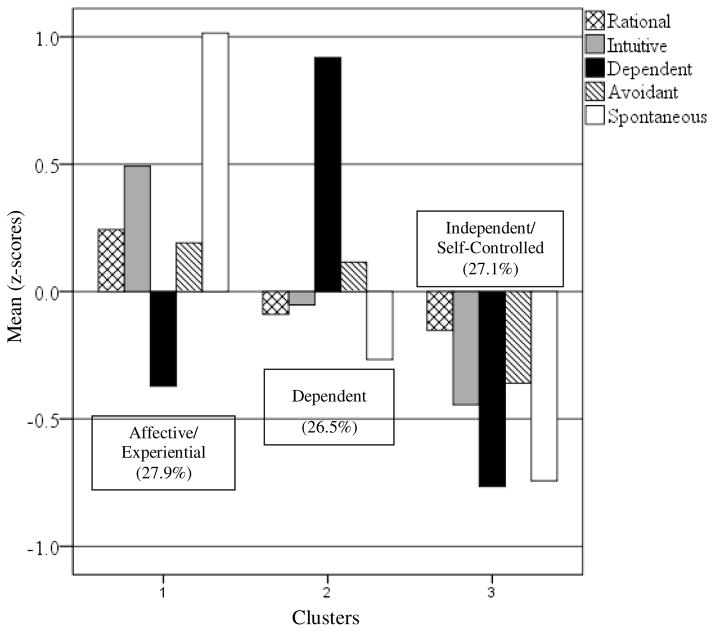
Using cluster-analysis, we investigated whether rational, intuitive, spontaneous, dependent, and avoidant styles of decision making (Scott & Bruce, 1995) combined to form distinct decision-making profiles that differed by age and gender. Self-report survey data were collected from 1,075 members of RAND's American Life Panel (56.2% female, 18-93 years, age = 53.49). Three decision-making profiles were identified: affective/experiential, independent/self-controlled, and an interpersonally-oriented dependent profile. Older people were less likely to be in the affective/experiential profile and more likely to be in the independent/self-controlled profile. Women were less likely to be in the affective/experiential profile and more likely to be in the interpersonally-oriented dependent profile. Interpersonally-oriented profiles are discussed as an overlooked but important dimension of how people make important decisions.
我们运用聚类分析方法,研究了理性、直觉、自发、依赖和回避型决策风格(斯科特和布鲁斯,1995年)是否组合形成了因年龄和性别而异的不同决策模式。我们从兰德美国生活小组的1075名成员中收集了自我报告调查数据(女性占56.2%,年龄在18 - 93岁之间,平均年龄为53.49岁)。识别出了三种决策模式:情感/体验型、独立/自我控制型以及人际导向依赖型。老年人处于情感/体验型模式的可能性较小,而处于独立/自我控制型模式的可能性较大。女性处于情感/体验型模式的可能性较小,而处于人际导向依赖型模式的可能性较大。人际导向型模式被视为人们做出重要决策方式中一个被忽视但重要的维度进行讨论。