Chowdhary Anuradha, Sharma Cheshta, Kathuria Shallu, Hagen Ferry, Meis Jacques F
Department of Medical Mycology, Vallabhbhai Patel Chest Institute, University of Delhi Delhi, India.
Department of Medical Microbiology and Infectious Diseases, Canisius-Wilhelmina Hospital Nijmegen, Netherlands.
Front Microbiol. 2015 May 8;6:428. doi: 10.3389/fmicb.2015.00428. eCollection 2015.
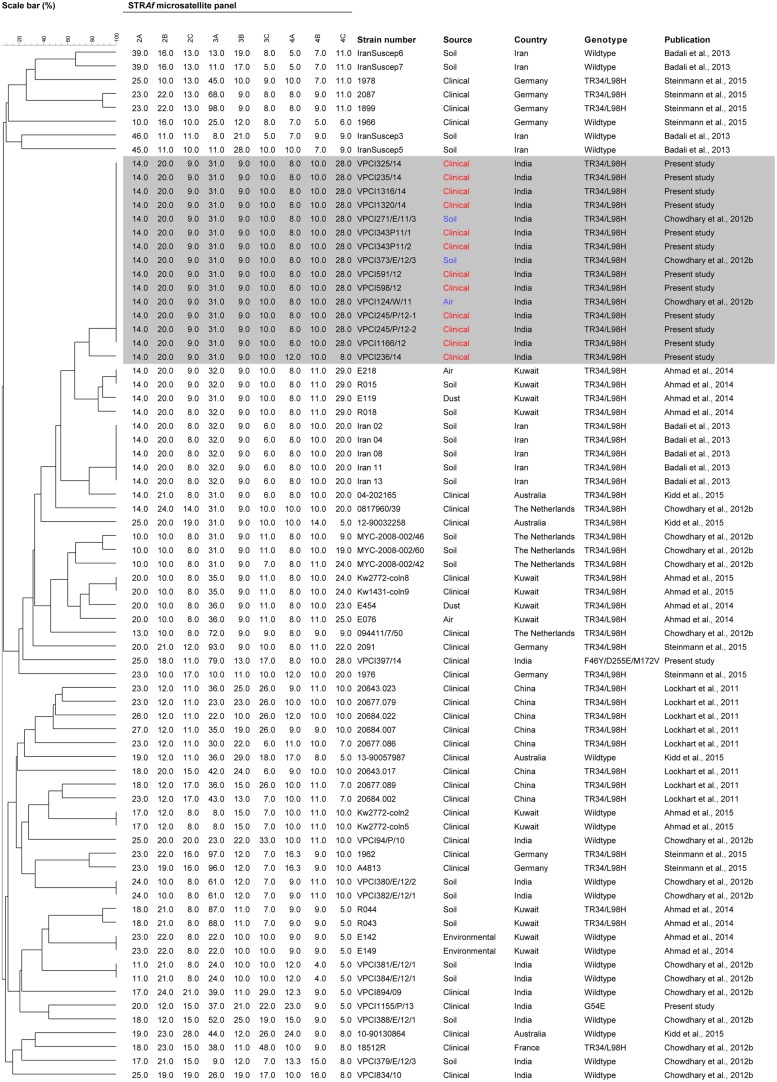
Aspergillus fumigatus causes varied clinical syndromes ranging from colonization to deep infections. The mainstay of therapy of Aspergillus diseases is triazoles but several studies globally highlighted variable prevalence of triazole resistance, which hampers the management of aspergillosis. We studied the prevalence of resistance in clinical A. fumigatus isolates during 4 years in a referral Chest Hospital in Delhi, India and reviewed the scenario in Asia and the Middle East. Aspergillus species (n = 2117) were screened with selective plates for azole resistance. The isolates included 45.4% A. flavus, followed by 32.4% A. fumigatus, 15.6% Aspergillus species and 6.6% A. terreus. Azole resistance was found in only 12 (1.7%) A. fumigatus isolates. These triazole resistant A. fumigatus (TRAF) isolates were subjected to (a) calmodulin and β tubulin gene sequencing (b) in vitro antifungal susceptibility testing against triazoles using CLSI M38-A2 (c) sequencing of cyp51A gene and real-time PCR assay for detection of mutations and (d) microsatellite typing of the resistant isolates. TRAF harbored TR34/L98H mutation in 10 (83.3%) isolates with a pan-azole resistant phenotype. Among the remaining two TRAF isolates, one had G54E and the other had three non-synonymous point mutations. The majority of patients were diagnosed as invasive aspergillosis followed by allergic bronchopulmonary aspergillosis and chronic pulmonary aspergillosis. The Indian TR34/L98H isolates had a unique genotype and were distinct from the Chinese, Middle East, and European TR34/L98H strains. This resistance mechanism has been linked to the use of fungicide azoles in agricultural practices in Europe as it has been mainly reported from azole naïve patients. Reports published from Asia demonstrate the same environmental resistance mechanism in A. fumigatus isolates from two highly populated countries in Asia, i.e., China and India and also from the neighboring Middle East.
烟曲霉可引发从定植到深部感染的多种临床综合征。曲霉病治疗的主要药物是三唑类,但全球多项研究强调了三唑耐药性的不同流行率,这给曲霉病的管理带来了阻碍。我们在印度德里一家转诊胸科医院研究了4年间临床分离的烟曲霉的耐药率,并回顾了亚洲和中东的情况。用选择性平板筛选曲霉属菌种(n = 2117)的唑类耐药性。分离菌株包括45.4%的黄曲霉,其次是32.4%的烟曲霉、15.6%的其他曲霉属菌种和6.6%的土曲霉。仅在12株(1.7%)烟曲霉分离株中发现了唑类耐药性。对这些三唑耐药烟曲霉(TRAF)分离株进行了以下检测:(a)钙调蛋白和β微管蛋白基因测序;(b)使用CLSI M38 - A2对三唑类进行体外抗真菌药敏试验;(c)cyp51A基因测序和用于检测突变的实时PCR分析;(d)耐药分离株的微卫星分型。10株(83.3%)TRAF分离株携带TR34/LXXH突变,具有泛唑耐药表型。在其余两株TRAF分离株中,一株有G54E突变,另一株有三个非同义点突变。大多数患者被诊断为侵袭性曲霉病,其次是变应性支气管肺曲霉病和慢性肺曲霉病。印度的TR34/LXXH分离株具有独特的基因型,与中国、中东和欧洲的TR34/LXXH菌株不同。这种耐药机制与欧洲农业实践中使用杀真菌剂唑类有关,因为主要是在未接触过唑类的患者中报道的。亚洲发表的报告表明,在亚洲两个人口众多的国家即中国和印度以及邻近的中东地区的烟曲霉分离株中存在相同的环境耐药机制。