Chan Raymond C K, Geng Fu-Lei, Lui Simon S Y, Wang Ya, Ho Karen K Y, Hung Karen S Y, Gur Raquel E, Gur Ruben C, Cheung Eric F C
Neuropsychology and Applied Cognitive Neuroscience Laboratory, Key Laboratory of Mental Health, Institute of Psychology, Chinese Academy of Sciences, Beijing, China.
University of Chinese Academy of Sciences, Beijing, China.
Sci Rep. 2015 Jun 8;5:11053. doi: 10.1038/srep11053.
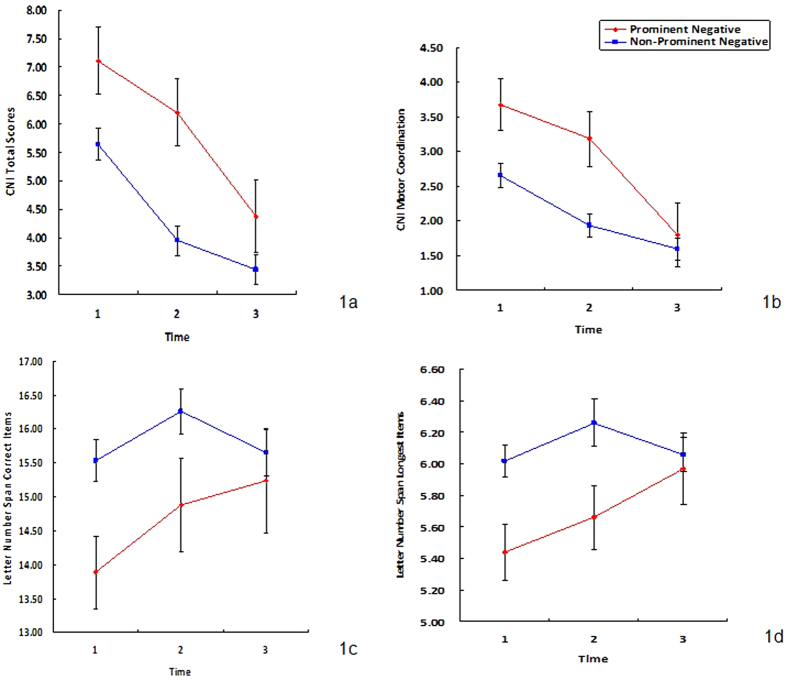
This prospective study examined the course of neurological soft signs (NSS) in patients with first-episode schizophrenia and its relationship with negative symptoms and cognitive functions. One hundred and forty-five patients with first-episode schizophrenia were recruited, 29 were classified as having prominent negative symptoms. NSS and neuropsychological measures were administered to all patients and 62 healthy controls at baseline. Patients were then followed-up prospectively at six-month intervals for up to a year. Patients with prominent negative symptoms exhibited significantly more motor coordination signs and total NSS than patients without prominent negative symptoms. Patients with prominent negative symptoms performed worse than patients without negative symptoms in working memory functions but not other fronto-parietal or fronto-temporal functions. Linear growth model for binary data showed that the prominent negative symptoms were stable over time. Despite general improvement in NSS and neuropsychological functions, the prominent negative symptoms group still exhibited poorer motor coordination and higher levels of NSS, as well as poorer working memory than patients without prominent negative symptoms. Two distinct subtypes of first-episode patients could be distinguished by NSS and prominent negative symptoms.
这项前瞻性研究调查了首发精神分裂症患者神经软体征(NSS)的病程及其与阴性症状和认知功能的关系。招募了145例首发精神分裂症患者,其中29例被归类为具有显著阴性症状。在基线时,对所有患者和62名健康对照者进行了NSS和神经心理学测量。然后对患者进行为期一年的前瞻性随访,每隔六个月进行一次。与无显著阴性症状的患者相比,有显著阴性症状的患者表现出明显更多的运动协调体征和总的NSS。有显著阴性症状的患者在工作记忆功能方面比无阴性症状的患者表现更差,但在其他额顶叶或额颞叶功能方面并非如此。二元数据的线性增长模型表明,显著阴性症状随时间推移保持稳定。尽管NSS和神经心理学功能总体有所改善,但有显著阴性症状的患者组与无显著阴性症状的患者相比,仍表现出较差的运动协调性和更高水平的NSS,以及较差的工作记忆。首发患者可通过NSS和显著阴性症状分为两种不同的亚型。