Ogawa Takahisa, Tamoi Masahiro, Kimura Ayako, Mine Ayaka, Sakuyama Harumi, Yoshida Eriko, Maruta Takanori, Suzuki Kengo, Ishikawa Takahiro, Shigeoka Shigeru
Department of Advanced Bioscience, Faculty of Agriculture, Kinki University, 3327-204 Nakamachi, Nara, 631-8505 Japan ; Core Research for Evolutional Science and Technology (CREST), Japan Science and Technology Agency (JST), Chiyoda-ku, Tokyo, 102-0076 Japan.
Department of Advanced Bioscience, Faculty of Agriculture, Kinki University, 3327-204 Nakamachi, Nara, 631-8505 Japan.
Biotechnol Biofuels. 2015 May 30;8:80. doi: 10.1186/s13068-015-0264-5. eCollection 2015.
Microalgae have recently been attracting attention as a potential platform for the production of biofuels. Euglena gracilis, a unicellular phytoflagellate, has been proposed as an attractive feedstock to produce biodiesel because it can produce large amounts of wax esters, consisting of medium-chain fatty acids and alcohols with 14:0 carbon chains. E. gracilis cells highly accumulate a storage polysaccharide, a β-1,3-glucan known as paramylon, under aerobic conditions. When grown aerobically and then transferred into anaerobic conditions, E. gracilis cells degrade paramylon to actively synthesize and accumulate wax esters. Thus, the enhanced accumulation of paramylon through the genetic engineering of photosynthesis should increase the capacity for wax ester production.
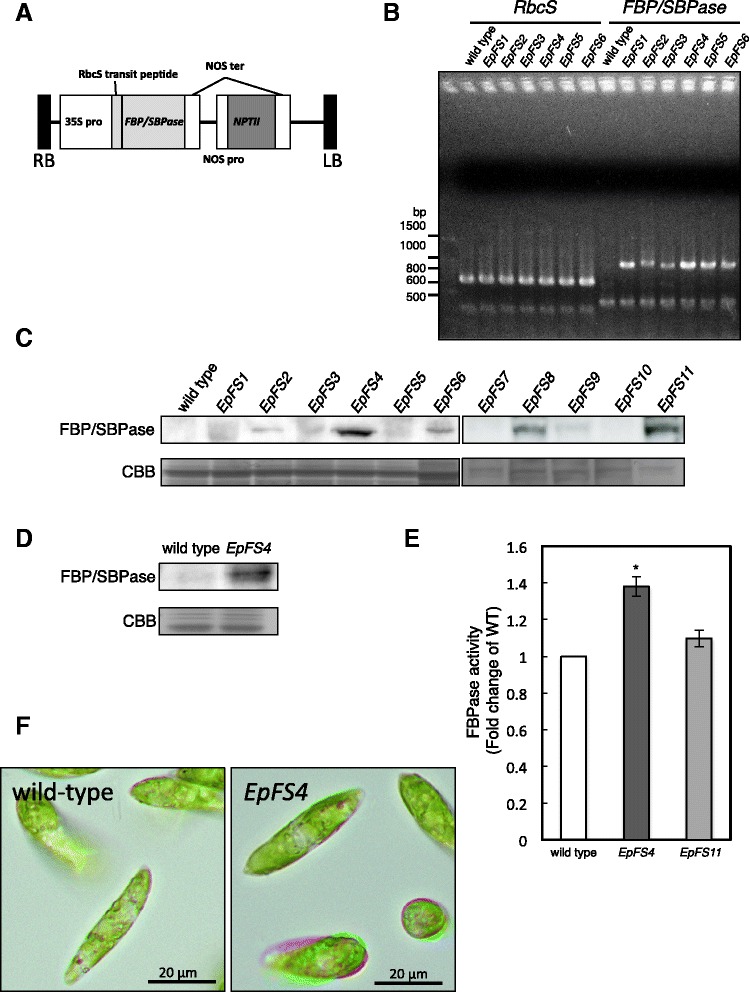
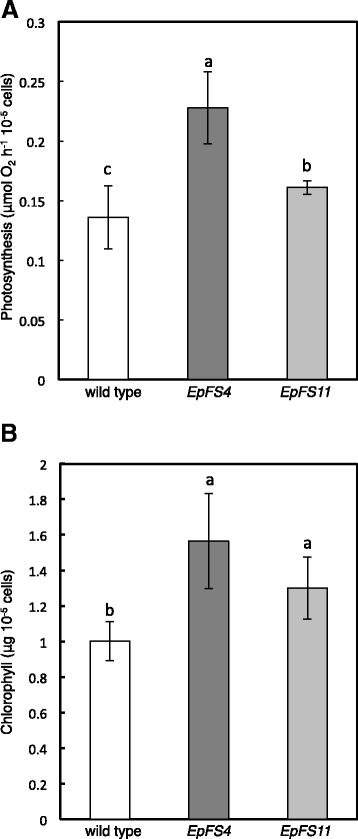
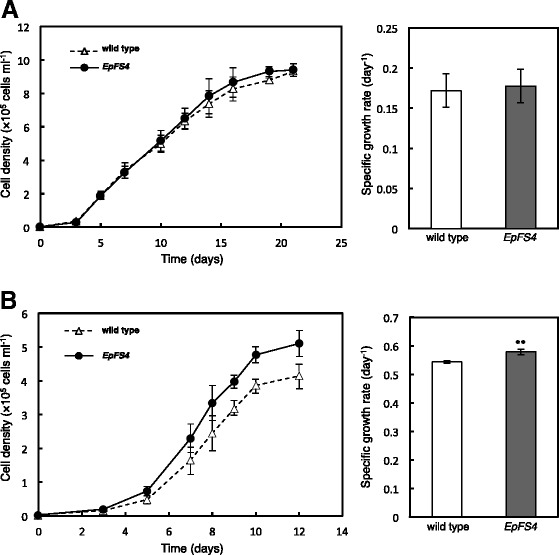
We herein generated transgenic Euglena (EpFS) cells expressing the cyanobacterial fructose-1,6-/sedoheptulose-1,7-bisphosphatase (FBP/SBPase), which is involved in the Calvin cycle, to enhance its photosynthetic activity. FBP/SBPase was successfully expressed within Euglena chloroplasts. The cell volume of the EpFS4 cell line was significantly larger than that of wild-type cells under normal growth conditions. The photosynthetic activity of EpFS4 cells was significantly higher than that of wild type under high light and high CO2, resulting in enhanced biomass production, and the accumulation of paramylon was increased in transgenic cell lines than in wild-type cells. Furthermore, when EpFS cell lines grown under high light and high CO2 were placed on anaerobiosis, the productivity of wax esters was approximately 13- to 100-fold higher in EpFS cell lines than in wild-type cells.
Our results obtained here indicate that the efficiency of biomass production in E. gracilis can be improved by genetically modulating photosynthetic capacity, resulting in the enhanced production of wax esters. This is the first step toward the utilization of E. gracilis as a sustainable source for biofuel production under photoautotrophic cultivation.
微藻作为生物燃料生产的潜在平台,近来备受关注。纤细裸藻是一种单细胞植物鞭毛虫,因其能产生大量由中链脂肪酸和含14:0碳链的醇类组成的蜡酯,被认为是生产生物柴油的理想原料。在有氧条件下,纤细裸藻细胞会大量积累一种储存多糖,即被称为副淀粉的β-1,3-葡聚糖。当在有氧条件下生长然后转入厌氧条件时,纤细裸藻细胞会降解副淀粉以积极合成并积累蜡酯。因此,通过光合作用的基因工程增强副淀粉的积累应能提高蜡酯的生产能力。
我们在此构建了表达参与卡尔文循环的蓝藻果糖-1,6-/景天庚酮糖-1,7-双磷酸酶(FBP/SBPase)的转基因裸藻(EpFS)细胞,以增强其光合活性。FBP/SBPase在裸藻叶绿体中成功表达。在正常生长条件下,EpFS4细胞系的细胞体积显著大于野生型细胞。在高光和高二氧化碳条件下,EpFS4细胞的光合活性显著高于野生型,从而导致生物量产量增加,并且转基因细胞系中副淀粉的积累量高于野生型细胞。此外,当在高光和高二氧化碳条件下生长的EpFS细胞系置于厌氧条件下时,EpFS细胞系中蜡酯的生产率比野生型细胞高约13至100倍。
我们在此获得的结果表明,通过基因调控光合能力可以提高纤细裸藻的生物量生产效率,从而增强蜡酯的产量。这是朝着将纤细裸藻作为光自养培养下生物燃料生产的可持续来源利用迈出的第一步。