Yang Shih-Neng, Li Fang-Jing, Liao Yen-Hsiu, Chen Yueh-Sheng, Shen Wu-Chung, Huang Tzung-Chi
Department of Biomedical Imaging and Radiological Science, China Medical University, Taichung, Taiwan; Department of Radiation Oncology, China Medical University Hospital, Taichung, Taiwan.
Department of Biomedical Imaging and Radiological Science, China Medical University, Taichung, Taiwan.
PLoS One. 2015 Jun 9;10(6):e0128404. doi: 10.1371/journal.pone.0128404. eCollection 2015.
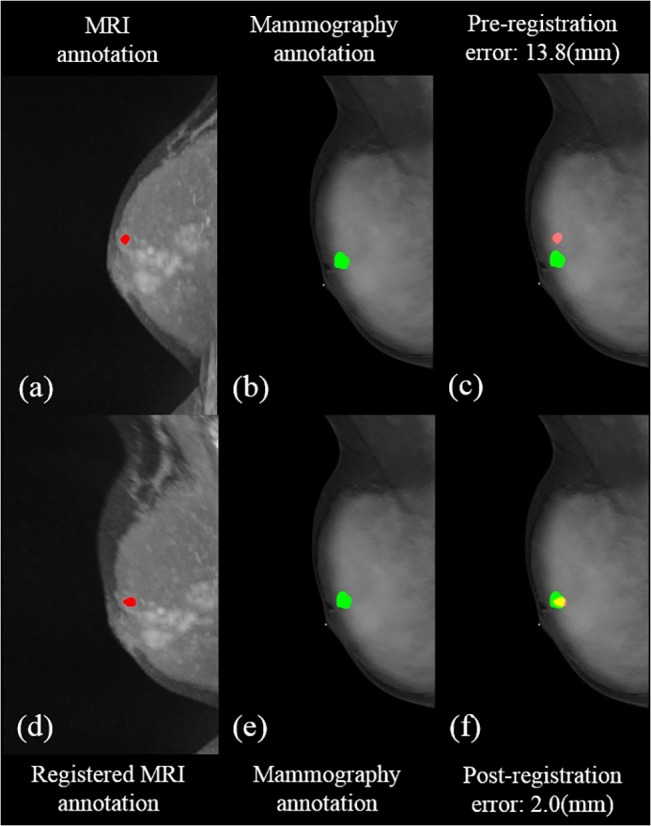
Integration of information from corresponding regions between the breast MRI and an X-ray mammogram could benefit the detection of breast cancer in clinical diagnosis. We aimed to provide a framework of registration from breast MRI to mammography and to evaluate the diagnosis using the combined information.
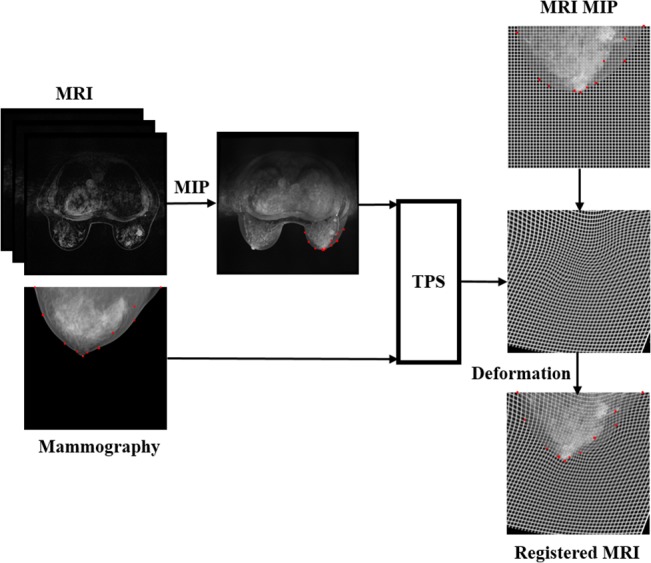
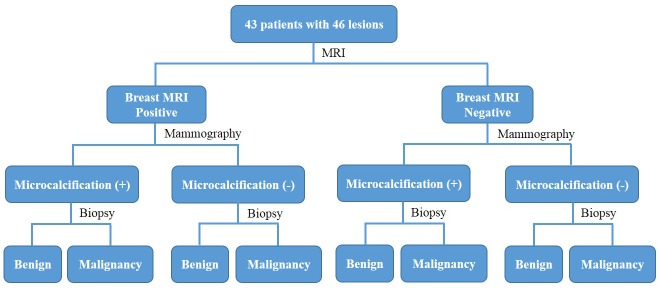
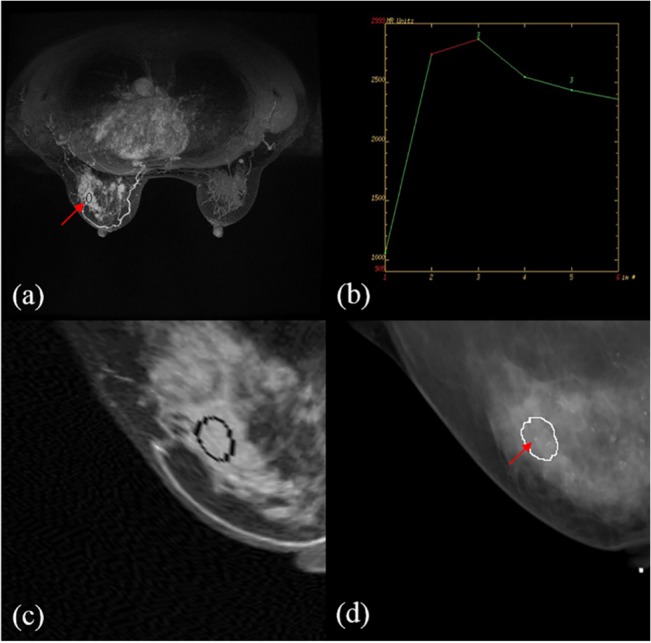
43 patients with 46 lesions underwent both MRI and mammography scans, and the interval between the two examinations was around one month. The distribution of malignant to benign lesions was 31/46 based on histological results. Maximum intensity projection and thin-plate spline methods were applied for image registration for MRI to mammography. The diagnosis using integrated information was evaluated using results of histology as the reference. The assessment of annotations and statistical analysis were performed by the two radiologists.
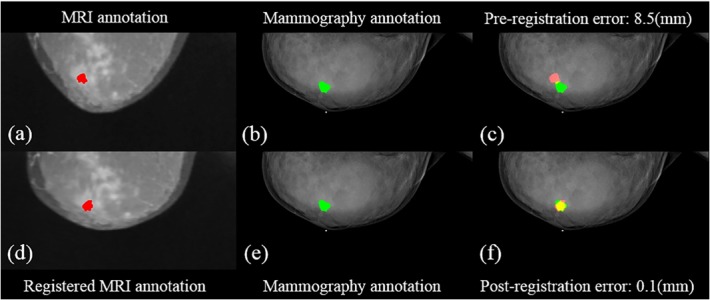
For the cranio-caudal view, the mean post-registration error between MRI and mammography was 2.2±1.9 mm. For the medio-lateral oblique view, the proposed approach performed even better with a mean error of 3.0±2.4 mm. In the diagnosis using MRI assessment with information of mammography, the sensitivity was 91.9±2.3% (29/31, 28/31), specificity 70.0±4.7% (11/15, 10/15), accuracy 84.8±3.1% (40/46, 38/46), positive predictive value 86.4±2.1% (29/33, 28/33) and negative predictive value 80.8±5.4% (11/13, 10/13).
MRI with the aid of mammography shows potential improvements of sensitivity, specificity, accuracy, PPV and NPV in clinical breast cancer diagnosis compared to the use of MRI alone.
整合乳腺磁共振成像(MRI)与乳腺X线摄影相应区域的信息,有助于临床诊断中乳腺癌的检测。我们旨在提供一个从乳腺MRI到乳腺X线摄影的配准框架,并利用整合后的信息评估诊断效果。
43例患者共46个病灶接受了MRI和乳腺X线摄影扫描,两次检查间隔约1个月。根据组织学结果,恶性与良性病灶的分布为31/46。采用最大强度投影和薄板样条法对MRI与乳腺X线摄影进行图像配准。以组织学结果为参考,评估整合信息后的诊断效果。两位放射科医生进行标注评估和统计分析。
在头尾位视图中,MRI与乳腺X线摄影配准后的平均误差为2.2±1.9毫米。在内外斜位视图中,所提出的方法表现更好,平均误差为3.0±2.4毫米。在利用乳腺X线摄影信息进行MRI评估的诊断中,敏感性为91.9±2.3%(29/31,28/31),特异性为70.0±4.7%(11/15,10/15),准确性为84.8±3.1%(40/46,38/46),阳性预测值为86.4±2.1%(29/33,28/33),阴性预测值为80.8±5.4%(11/13,10/13)。
与单独使用MRI相比,借助乳腺X线摄影的MRI在临床乳腺癌诊断中显示出敏感性、特异性、准确性、阳性预测值和阴性预测值的潜在提高。