Wong Adison, Wang Huijuan, Poh Chueh Loo, Kitney Richard I
Division of Bioengineering, School of Chemical and Biomedical Engineering, Nanyang Technological University, Singapore, 637459, Singapore.
Centre for Synthetic Biology and Innovation, and Department of Bioengineering, Imperial College London, London, SW7 2AZ, UK.
BMC Biol. 2015 Jun 16;13:40. doi: 10.1186/s12915-015-0146-0.
Gene regulation in biological systems is impacted by the cellular and genetic context-dependent effects of the biological parts which comprise the circuit. Here, we have sought to elucidate the limitations of engineering biology from an architectural point of view, with the aim of compiling a set of engineering solutions for overcoming failure modes during the development of complex, synthetic genetic circuits.
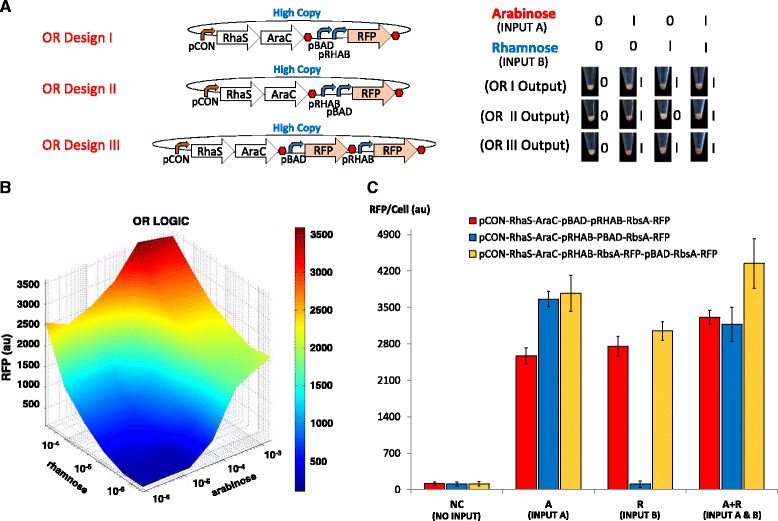
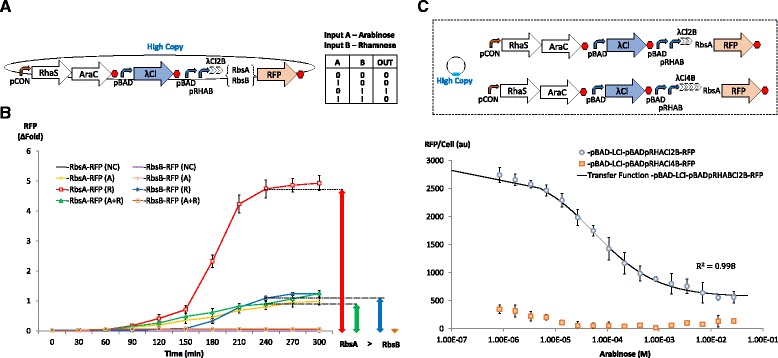
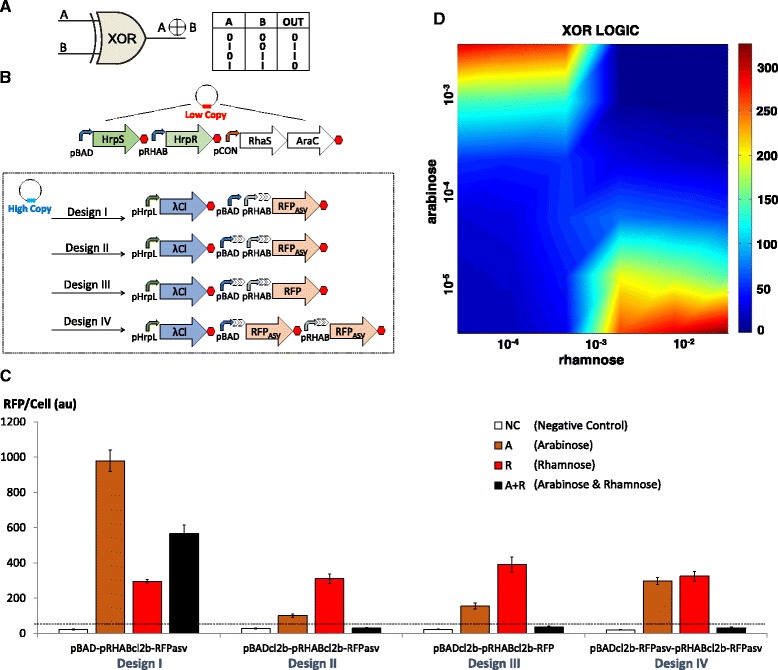
Using a synthetic biology approach that is supported by computational modelling and rigorous characterisation, AND, OR and NOT biological logic gates were layered in both parallel and serial arrangements to generate a repertoire of Boolean operations that include NIMPLY, XOR, half adder and half subtractor logics in a single cell. Subsequent evaluation of these near-digital biological systems revealed critical design pitfalls that triggered genetic context-dependent effects, including 5' UTR interferences and uncontrolled switch-on behaviour of the supercoiled σ54 promoter. In particular, the presence of seven consecutive hairpins immediately downstream of the promoter transcription start site severely impeded gene expression.
As synthetic biology moves forward with greater focus on scaling the complexity of engineered genetic circuits, studies which thoroughly evaluate failure modes and engineering solutions will serve as important references for future design and development of synthetic biological systems. This work describes a representative case study for the debugging of genetic context-dependent effects through principles elucidated herein, thereby providing a rational design framework to integrate multiple genetic circuits in a single prokaryotic cell.
生物系统中的基因调控受到构成回路的生物元件的细胞和基因背景依赖性效应的影响。在此,我们试图从架构角度阐明合成生物学的局限性,目的是汇编一套工程解决方案,以克服复杂合成基因回路开发过程中的故障模式。
采用一种由计算建模和严格表征支持的合成生物学方法,与、或和非生物逻辑门以并行和串行排列方式分层,以在单个细胞中生成一系列布尔运算,包括“与非”、“异或”、半加器和半减器逻辑。随后对这些近数字生物系统的评估揭示了引发基因背景依赖性效应的关键设计缺陷,包括5'非翻译区干扰和超螺旋σ54启动子的失控开启行为。特别是,启动子转录起始位点下游紧邻的七个连续发夹结构的存在严重阻碍了基因表达。
随着合成生物学更加注重扩大工程基因回路的复杂性,全面评估故障模式和工程解决方案的研究将为合成生物系统的未来设计和开发提供重要参考。这项工作通过本文阐明的原理描述了一个调试基因背景依赖性效应的代表性案例研究,从而提供了一个合理的设计框架,以在单个原核细胞中整合多个基因回路。