BenDor Todd, Lester T William, Livengood Avery, Davis Adam, Yonavjak Logan
Department of City and Regional Planning, University of North Carolina, Chapel Hill, NC, United States of America.
Ecosystem Investment Partners, Baltimore, MD, United States of America.
PLoS One. 2015 Jun 17;10(6):e0128339. doi: 10.1371/journal.pone.0128339. eCollection 2015.
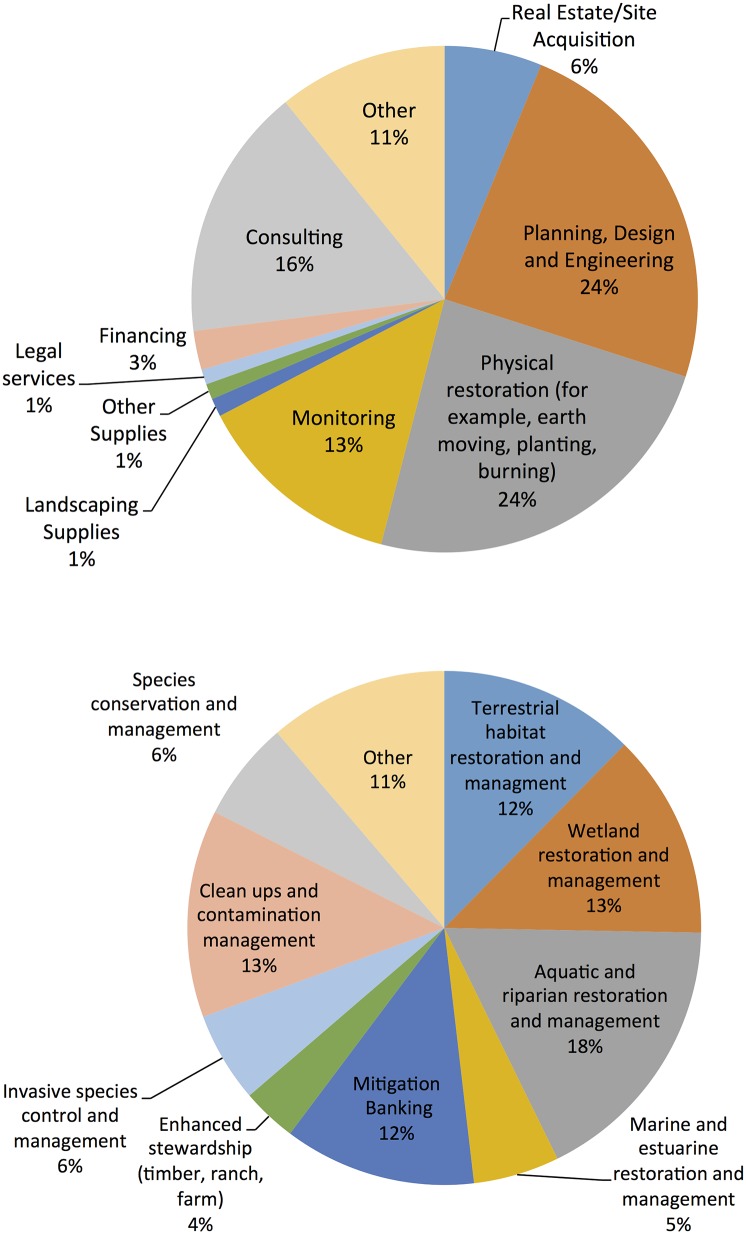
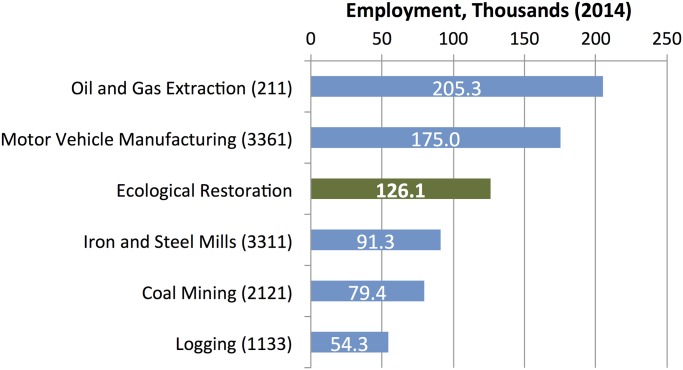
Domestic public debate continues over the economic impacts of environmental regulations that require environmental restoration. This debate has occurred in the absence of broad-scale empirical research on economic output and employment resulting from environmental restoration, restoration-related conservation, and mitigation actions - the activities that are part of what we term the "restoration economy." In this article, we provide a high-level accounting of the size and scope of the restoration economy in terms of employment, value added, and overall economic output on a national scale. We conducted a national survey of businesses that participate in restoration work in order to estimate the total sales and number of jobs directly associated with the restoration economy, and to provide a profile of this nascent sector in terms of type of restoration work, industrial classification, workforce needs, and growth potential. We use survey results as inputs into a national input-output model (IMPLAN 3.1) in order to estimate the indirect and induced economic impacts of restoration activities. Based on this analysis we conclude that the domestic ecological restoration sector directly employs ~ 126,000 workers and generates ~ $9.5 billion in economic output (sales) annually. This activity supports an additional 95,000 jobs and $15 billion in economic output through indirect (business-to-business) linkages and increased household spending.
国内公众对于要求进行环境修复的环境法规所产生的经济影响仍在持续争论。这场争论是在缺乏对环境修复、与修复相关的保护措施以及缓解行动(即我们所称的“修复经济”的组成部分)所带来的经济产出和就业情况进行大规模实证研究的情况下发生的。在本文中,我们从就业、增加值和全国范围内的总体经济产出方面,对修复经济的规模和范围进行了高层次核算。我们对参与修复工作的企业进行了全国性调查,以估算与修复经济直接相关的总销售额和就业岗位数量,并从修复工作类型、产业分类、劳动力需求和增长潜力等方面对这个新兴行业进行描述。我们将调查结果作为输入数据,纳入一个全国投入产出模型(IMPLAN 3.1),以估算修复活动的间接和诱导性经济影响。基于这一分析,我们得出结论,国内生态修复行业直接雇用约12.6万名工人,每年产生约95亿美元的经济产出(销售额)。通过间接(企业对企业)联系以及家庭支出增加,这项活动还支持另外9.5万个就业岗位和150亿美元的经济产出。