Chrencik Jill E, Roth Christopher B, Terakado Masahiko, Kurata Haruto, Omi Rie, Kihara Yasuyuki, Warshaviak Dora, Nakade Shinji, Asmar-Rovira Guillermo, Mileni Mauro, Mizuno Hirotaka, Griffith Mark T, Rodgers Caroline, Han Gye Won, Velasquez Jeffrey, Chun Jerold, Stevens Raymond C, Hanson Michael A
Department of Structural Discovery, Receptos, San Diego, CA 92121, USA.
Medicinal Chemistry Research Laboratories, Ono Pharmaceutical Co., Ltd., Osaka 618-8585, Japan.
Cell. 2015 Jun 18;161(7):1633-43. doi: 10.1016/j.cell.2015.06.002.
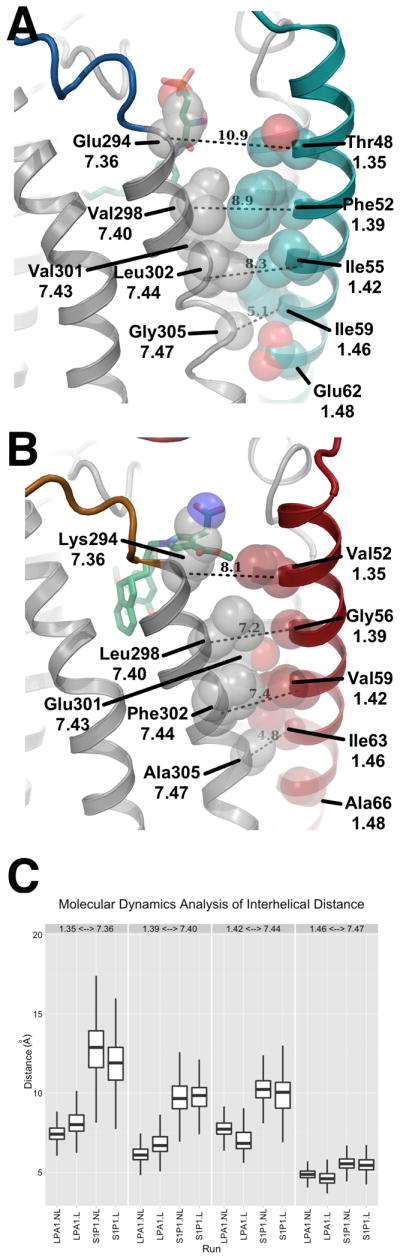
Lipid biology continues to emerge as an area of significant therapeutic interest, particularly as the result of an enhanced understanding of the wealth of signaling molecules with diverse physiological properties. This growth in knowledge is epitomized by lysophosphatidic acid (LPA), which functions through interactions with at least six cognate G protein-coupled receptors. Herein, we present three crystal structures of LPA1 in complex with antagonist tool compounds selected and designed through structural and stability analyses. Structural analysis combined with molecular dynamics identified a basis for ligand access to the LPA1 binding pocket from the extracellular space contrasting with the proposed access for the sphingosine 1-phosphate receptor. Characteristics of the LPA1 binding pocket raise the possibility of promiscuous ligand recognition of phosphorylated endocannabinoids. Cell-based assays confirmed this hypothesis, linking the distinct receptor systems through metabolically related ligands with potential functional and therapeutic implications for treatment of disease.
脂质生物学作为一个具有重大治疗意义的领域正在不断发展,尤其是由于对具有多种生理特性的丰富信号分子有了更深入的了解。溶血磷脂酸(LPA)就是这种知识增长的典型代表,它通过与至少六种同源G蛋白偶联受体相互作用发挥功能。在此,我们展示了LPA1与通过结构和稳定性分析选择和设计的拮抗剂工具化合物形成复合物的三种晶体结构。结构分析与分子动力学相结合,确定了配体从细胞外空间进入LPA1结合口袋的基础,这与鞘氨醇-1-磷酸受体的推测进入方式形成对比。LPA1结合口袋的特征增加了对磷酸化内源性大麻素进行混杂配体识别的可能性。基于细胞的实验证实了这一假设,通过代谢相关配体将不同的受体系统联系起来,对疾病治疗具有潜在的功能和治疗意义。