Eze Ikenna C, Schaffner Emmanuel, Foraster Maria, Imboden Medea, von Eckardstein Arnold, Gerbase Margaret W, Rothe Thomas, Rochat Thierry, Künzli Nino, Schindler Christian, Probst-Hensch Nicole
Swiss Tropical and Public Health Institute, Basel, Switzerland; University of Basel, Basel, Switzerland.
Institute of Clinical Chemistry, University Hospital Zurich, Zurich, Switzerland.
PLoS One. 2015 Jun 23;10(6):e0130337. doi: 10.1371/journal.pone.0130337. eCollection 2015.
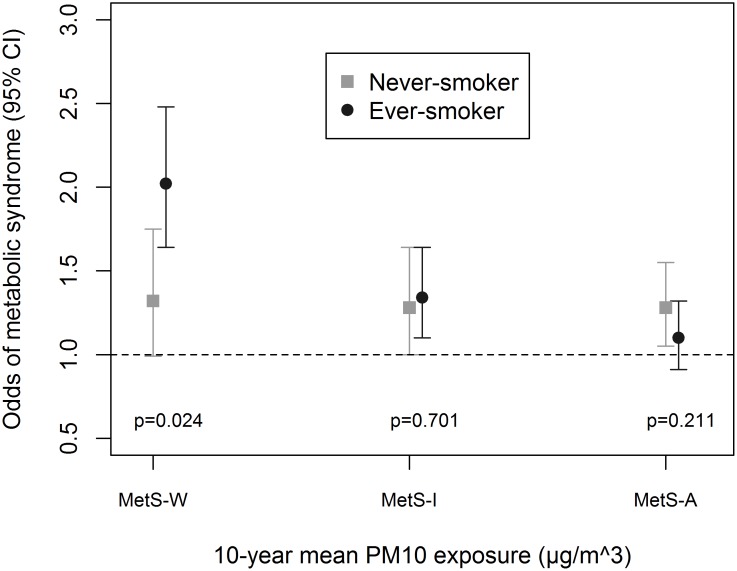
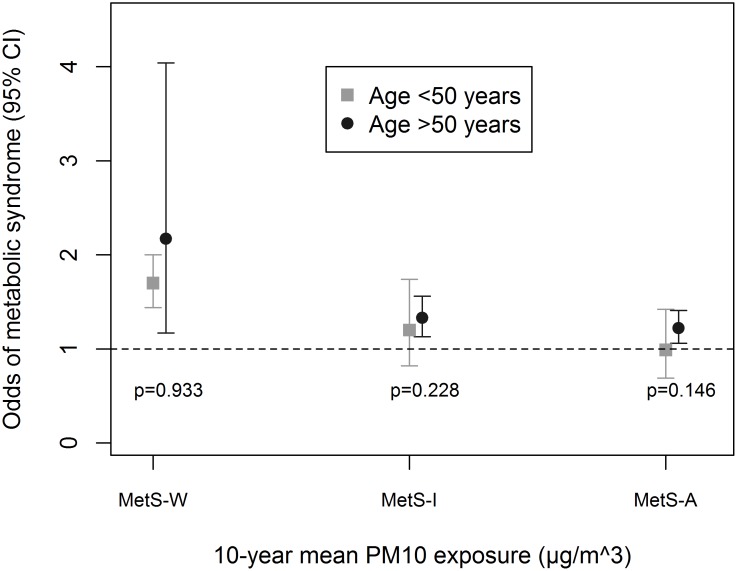
Air pollutants (AP) play a role in subclinical inflammation, and are associated with cardiovascular morbidity and mortality. Metabolic syndrome (MetS) is inflammatory and precedes cardiovascular morbidity and type 2 diabetes. Thus, a positive association between AP and MetS may be hypothesized. We explored this association, (taking into account, pathway-specific MetS definitions), and its potential modifiers in Swiss adults. We studied 3769 participants of the Swiss Cohort Study on Air Pollution and Lung and Heart Diseases in Adults, reporting at least four-hour fasting time before venepuncture. AP exposures were 10-year mean residential PM10 (particulate matter <10μm in diameter) and NO2 (nitrogen dioxide). Outcomes included MetS defined by World Health Organization (MetS-W), International Diabetes Federation (MetS-I) and Adult Treatment Panel-III (MetS-A) using four- and eight-hour fasting time limits. We also explored associations with individual components of MetS. We applied mixed logistic regression models to explore these associations. The prevalence of MetS-W, MetS-I and MetS-A were 10%, 22% and 18% respectively. Odds of MetS-W, MetS-I and MetS-A increased by 72% (51-102%), 31% (11-54%) and 18% (4-34%) per 10μg/m3 increase in 10-year mean PM10. We observed weaker associations with NO2. Associations were stronger among physically-active, ever-smokers and non-diabetic participants especially with PM10 (p<0.05). Associations remained robust across various sensitivity analyses including ten imputations of missing observations and exclusion of diabetes cases. The observed associations between AP exposure and MetS were sensitive to MetS definitions. Regarding the MetS components, we observed strongest associations with impaired fasting glycemia, and positive but weaker associations with hypertension and waist-circumference-based obesity. Cardio-metabolic effects of AP may be majorly driven by impairment of glucose homeostasis, and to a less-strong extent, visceral adiposity. Well-designed prospective studies are needed to confirm these findings.
空气污染物(AP)在亚临床炎症中起作用,并与心血管疾病的发病率和死亡率相关。代谢综合征(MetS)具有炎症性,且先于心血管疾病的发病和2型糖尿病。因此,可以假设AP与MetS之间存在正相关。我们探讨了这种关联(考虑到特定途径的MetS定义)及其在瑞士成年人中的潜在调节因素。我们研究了瑞士成人空气污染与肺和心脏疾病队列研究中的3769名参与者,他们在静脉穿刺前报告至少禁食4小时。AP暴露为10年平均居住PM10(直径<10μm的颗粒物)和NO2(二氧化氮)。结局包括世界卫生组织定义的MetS(MetS-W)、国际糖尿病联盟定义的MetS(MetS-I)和成人治疗小组III定义的MetS(MetS-A),使用4小时和8小时禁食时间限制。我们还探讨了与MetS各个组成部分的关联。我们应用混合逻辑回归模型来探讨这些关联。MetS-W、MetS-I和MetS-A的患病率分别为10%、22%和18%。10年平均PM10每增加10μg/m3,MetS-W、MetS-I和MetS-A的比值分别增加72%(51-102%)、31%(11-54%)和18%(4-34%)。我们观察到与NO2的关联较弱。在身体活跃、曾经吸烟和非糖尿病参与者中,关联更强,尤其是与PM10的关联(p<0.05)。在各种敏感性分析中,包括对缺失观察值的十次插补和排除糖尿病病例,关联仍然稳健。观察到的AP暴露与MetS之间的关联对MetS定义敏感。关于MetS的组成部分(组分),我们观察到与空腹血糖受损的关联最强,与高血压和基于腰围的肥胖的关联为正但较弱。AP的心脏代谢效应可能主要由葡萄糖稳态受损驱动,在较小程度上由内脏肥胖驱动。需要设计良好前瞻性研究来证实这些发现。