Thukral Anu, Lockyer Jocelyn, Bucher Sherri L, Berkelhamer Sara, Bose Carl, Deorari Ashok, Esamai Fabian, Faremo Sonia, Keenan William J, McMillan Douglas, Niermeyer Susan, Singhal Nalini
All India Institute of Medical Sciences, New Delhi, India.
University of Calgary, Calgary, Canada.
BMC Pediatr. 2015 Jun 24;15:71. doi: 10.1186/s12887-015-0382-z.
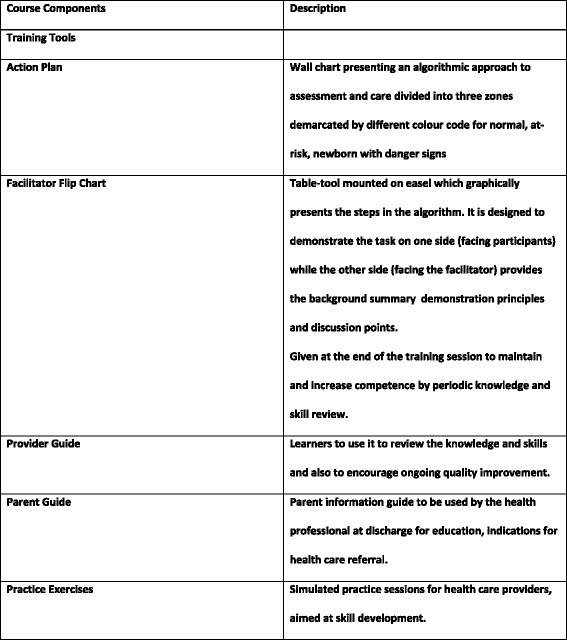
Essential Care for Every Baby (ECEB) is an evidence-based educational program designed to increase cognitive knowledge and develop skills of health care professionals in essential newborn care in low-resource areas. The course focuses on the immediate care of the newborn after birth and during the first day or until discharge from the health facility. This study assessed the overall design of the course; the ability of facilitators to teach the course; and the knowledge and skills acquired by the learners.
Testing occurred at 2 global sites. Data from a facilitator evaluation survey, a learner satisfaction survey, a multiple choice question (MCQ) examination, performance on two objective structured clinical evaluations (OSCE), and pre- and post-course confidence assessments were analyzed using descriptive statistics. Pre-post course differences were examined. Comments on the evaluation form and post-course group discussions were analyzed to identify potential program improvements.
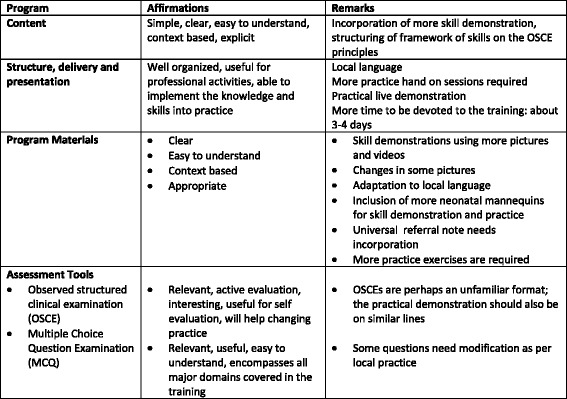
Using ECEB course material, master trainers taught 12 facilitators in India and 11 in Kenya who subsequently taught 62 providers of newborn care in India and 64 in Kenya. Facilitators and learners were satisfied with their ability to teach and learn from the program. Confidence (3.5 to 5) and MCQ scores (India: pre 19.4, post 24.8; Kenya: pre 20.8, post 25.0) improved (p < 0.001). Most participants demonstrated satisfactory skills on the OSCEs. Qualitative data suggested the course was effective, but also identified areas for course improvement. These included additional time for hands-on practice, including practice in a clinical setting, the addition of video learning aids and the adaptation of content to conform to locally recommended practices.
ECEB program was highly acceptable, demonstrated improved confidence, improved knowledge and developed skills. ECEB may improve newborn care in low resource settings if it is part of an overall implementation plan that addresses local needs and serves to further strengthen health systems.
“关爱每一个婴儿基本护理”(ECEB)是一项基于证据的教育项目,旨在提高低资源地区医疗保健专业人员在新生儿基本护理方面的认知知识并培养相关技能。该课程聚焦于新生儿出生后及出生后第一天或直至从医疗机构出院期间的即时护理。本研究评估了该课程的总体设计、培训师授课的能力以及学习者获得的知识和技能。
在2个全球地点进行测试。使用描述性统计分析来自培训师评估调查、学习者满意度调查、多项选择题(MCQ)考试、两项客观结构化临床评估(OSCE)的表现以及课程前后信心评估的数据。检查课程前后的差异。分析评估表上的评论和课程后的小组讨论,以确定潜在的项目改进之处。
使用ECEB课程材料,培训大师在印度培训了12名培训师,在肯尼亚培训了11名培训师,这些培训师随后在印度培训了62名新生儿护理提供者,在肯尼亚培训了64名。培训师和学习者对他们从该项目中教学和学习的能力感到满意。信心(从3.5提升至5)和MCQ分数(印度:课前19.4,课后24.8;肯尼亚:课前20.8,课后25.0)有所提高(p < 0.001)。大多数参与者在OSCE中表现出令人满意的技能。定性数据表明该课程是有效的,但也确定了课程改进的领域。这些包括增加实践操作时间,包括在临床环境中的实践、增加视频学习辅助工具以及使内容适应当地推荐的做法。
ECEB项目非常受欢迎,表现出信心增强、知识提升和技能发展。如果ECEB作为解决当地需求并进一步加强卫生系统的总体实施计划的一部分,它可能会改善低资源环境中的新生儿护理。