Egli Simon, Pfister Mirjam, Ludin Sabina M, Puente de la Vega Katia, Busato André, Fischer Lorenz
Medical Faculty of the University of Bern, Bern, Switzerland.
Department of Neural Therapy, IKOM, University of Bern, Inselspital, PH4, CH-3010, Bern, Switzerland.
BMC Complement Altern Med. 2015 Jun 27;15:200. doi: 10.1186/s12906-015-0735-z.
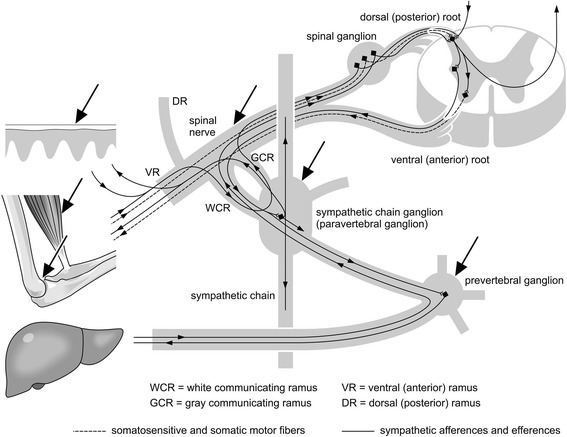
Can the application of local anesthetics (Neural Therapy, NT) alone durably improve pain symptoms in referred patients with chronic and refractory pain? If the application of local anesthetics does lead to an improvement that far exceeds the duration of action of local anesthetics, we will postulate that a vicious circle of pain in the reflex arcs has been disrupted (hypothesis).
Case series design. We exclusively used procaine or lidocaine. The inclusion criteria were severe pain and chronic duration of more than three months, pain unresponsive to conventional medical measures, written referral from physicians or doctors of chiropractic explicitly to NT. Patients with improvement of pain who started on additional therapy during the study period for a reason other than pain were excluded in order to avoid a potential bias. Treatment success was measured after one year follow-up using the outcome measures of pain and analgesics intake.
280 chronic pain patients were included; the most common reason for referral was back pain. The average number of consultations per patient was 9.2 in the first year (median 8.0). After one year, in 60 patients pain was unchanged, 52 patients reported a slight improvement, 126 were considerably better, and 41 pain-free. At the same time, 74.1% of the patients who took analgesics before starting NT needed less or no more analgesics at all. No adverse effects or complications were observed.
The good long-term results of the targeted therapeutic local anesthesia (NT) in the most problematic group of chronic pain patients (unresponsive to all evidence based conventional treatment options) indicate that a vicious circle has been broken. The specific contribution of the intervention to these results cannot be determined. The low costs of local anesthetics, the small number of consultations needed, the reduced intake of analgesics, and the lack of adverse effects also suggest the practicality and cost-effectiveness of this kind of treatment. Controlled trials to evaluate the true effect of NT are needed.
单独应用局部麻醉药(神经疗法,NT)能否持久改善慢性顽固性疼痛转诊患者的疼痛症状?如果局部麻醉药的应用确实能带来远超其作用持续时间的改善,我们将假定反射弧中的疼痛恶性循环已被打破(假设)。
病例系列设计。我们仅使用普鲁卡因或利多卡因。纳入标准为重度疼痛且病程超过三个月、对常规医疗措施无反应、医生或整脊医生明确转诊至NT。为避免潜在偏倚,排除在研究期间因疼痛以外原因开始额外治疗且疼痛有所改善的患者。在一年随访后,使用疼痛和镇痛药摄入量的结果指标来衡量治疗成功与否。
纳入280例慢性疼痛患者;最常见的转诊原因是背痛。第一年每位患者的平均会诊次数为9.2次(中位数8.0次)。一年后,60例患者疼痛无变化,52例患者报告有轻微改善,126例患者有显著改善,41例患者无痛。同时,开始NT治疗前服用镇痛药的患者中有74.1%需要的镇痛药减少或完全不再需要。未观察到不良反应或并发症。
在最棘手的慢性疼痛患者组(对所有基于证据的常规治疗方案均无反应)中,靶向治疗性局部麻醉(NT)取得的良好长期结果表明疼痛恶性循环已被打破。无法确定该干预措施对这些结果的具体贡献。局部麻醉药成本低、所需会诊次数少、镇痛药摄入量减少以及无不良反应,也表明这种治疗方法具有实用性和成本效益。需要进行对照试验以评估NT的真实效果。