Sharman James E, Howes Faline S, Head Geoffrey A, McGrath Barry P, Stowasser Michael, Schlaich Markus, Glasziou Paul, Nelson Mark R
aMenzies Institute for Medical Research, University of Tasmania, Hobart bBaker IDI Heart and Diabetes Institute, Melbourne cMonash University, Clayton, Victoria dEndocrine Hypertension Research Centre, University of Queensland School of Medicine, Greenslopes and Princess Alexandra Hospitals, Brisbane, Queensland eSchool of Medicine and Pharmacology, Royal Perth Hospital Unit, University of Western Australia, Perth fCentre for Research in Evidence Based Practice, Bond University, Queensland, Australia.
J Hypertens. 2015 Sep;33(9):1721-8. doi: 10.1097/HJH.0000000000000673.
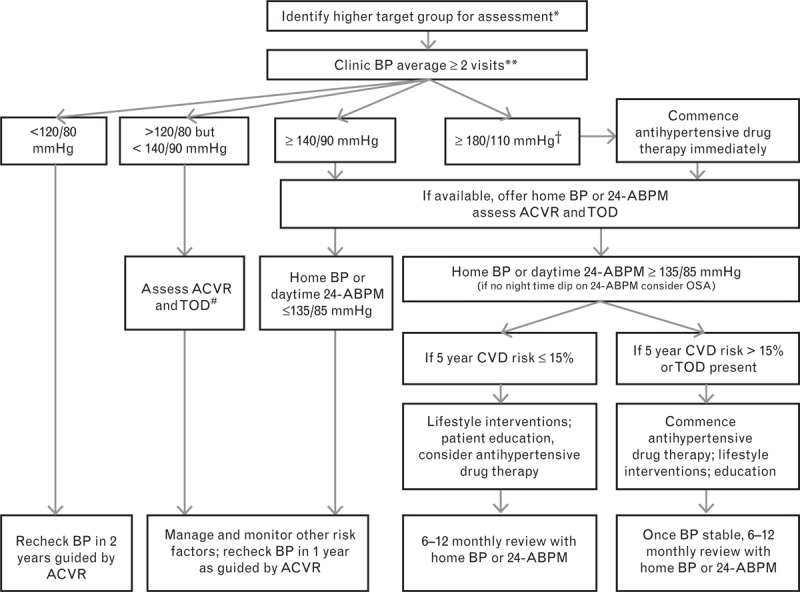
Measurement of blood pressure (BP) by a doctor in the clinic has limitations that may result in an unrepresentative measure of underlying BP which can impact on the appropriate assessment and management of high BP. Home BP monitoring is the self-measurement of BP in the home setting (usually in the morning and evening) over a defined period (e.g. 7 days) under the direction of a healthcare provider. When it may not be feasible to measure 24-h ambulatory BP, home BP may be offered as a method to diagnose and manage patients with high BP. Home BP has good reproducibility, is well tolerated, is relatively inexpensive and is superior to clinic BP for prognosis of cardiovascular morbidity and mortality. Home BP can be used in combination with clinic BP to identify 'white coat' and 'masked' hypertension. An average home BP of at least 135/85 mmHg is an appropriate threshold for the diagnosis of hypertension. Home BP may also offer the advantage of empowering patients with their BP management, with benefits including increased adherence to therapy and lower achieved BP levels. It is recommended that, when feasible, home BP should be considered for routine use in the clinical management of hypertension.
医生在诊所测量血压(BP)存在局限性,这可能导致无法准确反映潜在血压水平,进而影响对高血压的恰当评估和管理。家庭血压监测是指在医疗服务提供者的指导下,在家庭环境中(通常在早晨和晚上)于规定时间段(如7天)内自行测量血压。当进行24小时动态血压监测不可行时,可采用家庭血压监测来诊断和管理高血压患者。家庭血压具有良好的可重复性,耐受性良好,相对便宜,并且在预测心血管疾病发病率和死亡率方面优于诊所血压。家庭血压可与诊所血压结合使用,以识别“白大衣”高血压和“隐匿性”高血压。家庭血压平均至少为135/85 mmHg是诊断高血压的合适阈值。家庭血压监测还可能具有让患者自主管理血压的优势,其益处包括提高治疗依从性和降低血压水平。建议在可行的情况下,应考虑将家庭血压监测常规用于高血压的临床管理。