Teipel Stefan J, Kurth Jens, Krause Bernd, Grothe Michel J
German Center for Neurodegenerative Diseases (DZNE), Rostock, Germany ; Department of Psychosomatic Medicine, University Medicine Rostock, Rostock, Germany.
Department of Nuclear Medicine, University Medicine Rostock, Rostock, Germany.
Neuroimage Clin. 2015 May 21;8:583-93. doi: 10.1016/j.nicl.2015.05.006. eCollection 2015.
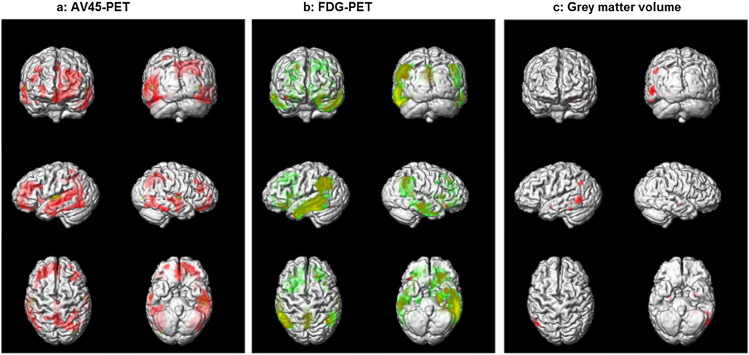
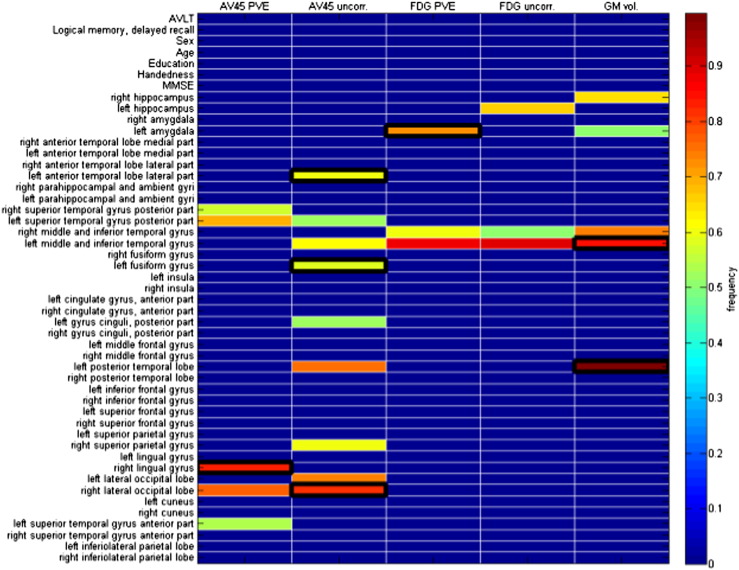
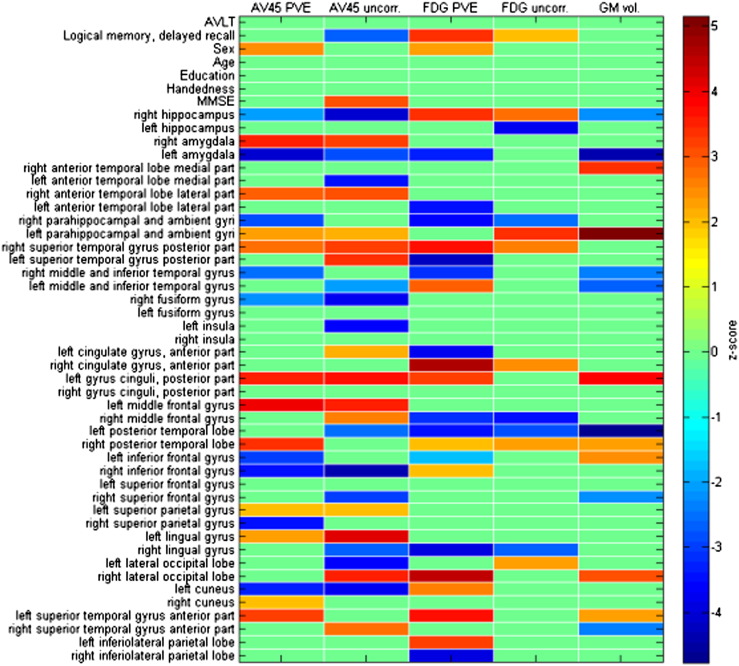
Selecting a set of relevant markers to predict conversion from mild cognitive impairment (MCI) to Alzheimer's disease (AD) has become a challenging task given the wealth of regional pathologic information that can be extracted from multimodal imaging data. Here, we used regularized regression approaches with an elastic net penalty for best subset selection of multiregional information from AV45-PET, FDG-PET and volumetric MRI data to predict conversion from MCI to AD. The study sample consisted of 127 MCI subjects from ADNI-2 who had a clinical follow-up between 6 and 31 months. Additional analyses assessed the effect of partial volume correction on predictive performance of AV45- and FDG-PET data. Predictor variables were highly collinear within and across imaging modalities. Penalized Cox regression yielded more parsimonious prediction models compared to unpenalized Cox regression. Within single modalities, time to conversion was best predicted by increased AV45-PET signal in posterior medial and lateral cortical regions, decreased FDG-PET signal in medial temporal and temporobasal regions, and reduced gray matter volume in medial, basal, and lateral temporal regions. Logistic regression models reached up to 72% cross-validated accuracy for prediction of conversion status, which was comparable to cross-validated accuracy of non-linear support vector machine classification. Regularized regression outperformed unpenalized stepwise regression when number of parameters approached or exceeded the number of training cases. Partial volume correction had a negative effect on the predictive performance of AV45-PET, but slightly improved the predictive value of FDG-PET data. Penalized regression yielded more parsimonious models than unpenalized stepwise regression for the integration of multiregional and multimodal imaging information. The advantage of penalized regression was particularly strong with a high number of collinear predictors.
鉴于可以从多模态成像数据中提取丰富的区域病理信息,选择一组相关标志物来预测从轻度认知障碍(MCI)向阿尔茨海默病(AD)的转化已成为一项具有挑战性的任务。在此,我们使用带有弹性网罚项的正则化回归方法,从AV45正电子发射断层扫描(PET)、氟代脱氧葡萄糖(FDG)-PET和容积磁共振成像(MRI)数据中对多区域信息进行最佳子集选择,以预测从MCI向AD的转化。研究样本包括来自阿尔茨海默病神经影像学计划(ADNI)-2的127名MCI受试者,他们在6至31个月期间接受了临床随访。额外的分析评估了部分容积校正对AV45-和FDG-PET数据预测性能的影响。预测变量在成像模态内和跨成像模态之间具有高度共线性。与未惩罚的Cox回归相比,惩罚Cox回归产生了更简洁的预测模型。在单一模态中,后内侧和外侧皮质区域AV45-PET信号增加、内侧颞叶和颞底区域FDG-PET信号降低以及内侧、基底和外侧颞叶区域灰质体积减少,对转化时间的预测效果最佳。逻辑回归模型对转化状态预测的交叉验证准确率高达72%,这与非线性支持向量机分类的交叉验证准确率相当。当参数数量接近或超过训练病例数量时,正则化回归的表现优于未惩罚的逐步回归。部分容积校正对AV45-PET的预测性能有负面影响,但略微提高了FDG-PET数据的预测价值。对于多区域和多模态成像信息的整合来说,惩罚回归比未惩罚的逐步回归产生了更简洁的模型。在存在大量共线预测变量的情况下,惩罚回归的优势尤为明显。