Elovic Elie Paul, Munin Michael C, Kaňovský Petr, Hanschmann Angelika, Hiersemenzel Reinhard, Marciniak Christina
HealthSouth Rehabilitation Hospital of Utah, 8074 South 1300 East, Sandy, Utah, 84094, USA.
Department of Physical Medicine and Rehabilitation, University of Pittsburgh School of Medicine, Pittsburgh, Pennsylvania, USA.
Muscle Nerve. 2016 Mar;53(3):415-21. doi: 10.1002/mus.24776. Epub 2015 Dec 15.
Efficacy and safety of incobotulinumtoxinA in post-stroke upper-limb spasticity were studied.
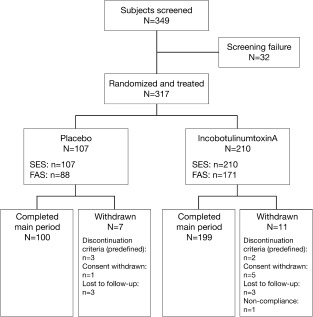
Subjects randomized 2:1 to incobotulinumtoxinA (fixed dose 400 U) or placebo, with fixed doses for the primary target clinical pattern (PTCP; flexed elbow, 200 U; flexed wrist, 150 U; clenched fist, 100 U). Doses for non-primary patterns were flexible within predefined ranges.
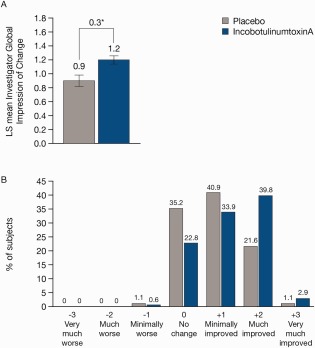
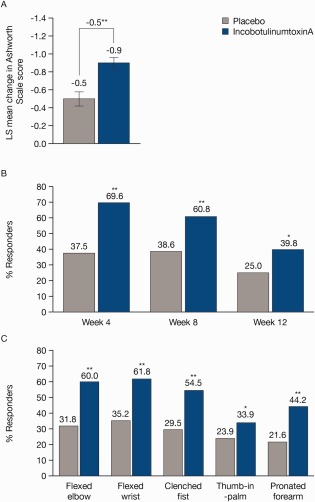
At week 4, incobotulinumtoxinA led to larger improvements in PTCP Ashworth scale (AS) scores than placebo [least-squares mean change ± standard error: -0.9 ± 0.06 (n = 171) vs. -0.5 ± 0.08 (n = 88); P < 0.001], and more subjects were PTCP AS responders (≥1-point improvement) with incobotulinumtoxinA (69.6%) than with placebo (37.5%; P < 0.001). Investigator's Global Impression of Change confirmed superiority of incobotulinumtoxinA vs. placebo (P = 0.003). IncobotulinumtoxinA was associated with functional improvements, as demonstrated in responder rates for Disability Assessment Scale principal target at week 4 (P = 0.007). Adverse events were mainly mild/moderate, and were reported by 22.4% (incobotulinumtoxinA) and 16.8% (placebo) of subjects.
IncobotulinumtoxinA significantly improved upper-limb spasticity and associated disability, and was well-tolerated.
研究了因卡泊肉毒素A治疗中风后上肢痉挛的疗效和安全性。
受试者按2:1随机分为因卡泊肉毒素A组(固定剂量400 U)或安慰剂组,针对主要目标临床模式(PTCP;屈肘,200 U;屈腕,150 U;握拳,100 U)给予固定剂量。非主要模式的剂量在预定义范围内灵活调整。
在第4周时,因卡泊肉毒素A组在PTCP的Ashworth量表(AS)评分上的改善幅度大于安慰剂组[最小二乘均值变化±标准误:-0.9±0.06(n = 171) vs. -0.5±0.08(n = 88);P < 0.001],且因卡泊肉毒素A组中PTCP AS有反应者(改善≥1分)的比例(69.6%)高于安慰剂组(37.5%;P < 0.001)。研究者的整体变化印象证实因卡泊肉毒素A优于安慰剂(P = 0.003)。因卡泊肉毒素A与功能改善相关,这在第4周残疾评估量表主要目标的反应率中得到体现(P = 0.007)。不良事件主要为轻度/中度,因卡泊肉毒素A组和安慰剂组报告不良事件的受试者比例分别为22.4%和16.8%。
因卡泊肉毒素A显著改善了上肢痉挛及相关残疾,且耐受性良好。