Freeman T P, Winstock A R
Clinical Psychopharmacology Unit,University College London,London,UK.
Institute of Psychiatry,King's College London,Camberwell,UK.
Psychol Med. 2015 Nov;45(15):3181-9. doi: 10.1017/S0033291715001178. Epub 2015 Jul 27.
Cannabis use is decreasing in England and Wales, while demand for cannabis treatment in addiction services continues to rise. This could be partly due to an increased availability of high-potency cannabis.
Adults residing in the UK were questioned about their drug use, including three types of cannabis (high potency: skunk; low potency: other grass, resin). Cannabis types were profiled and examined for possible associations between frequency of use and (i) cannabis dependence, (ii) cannabis-related concerns.
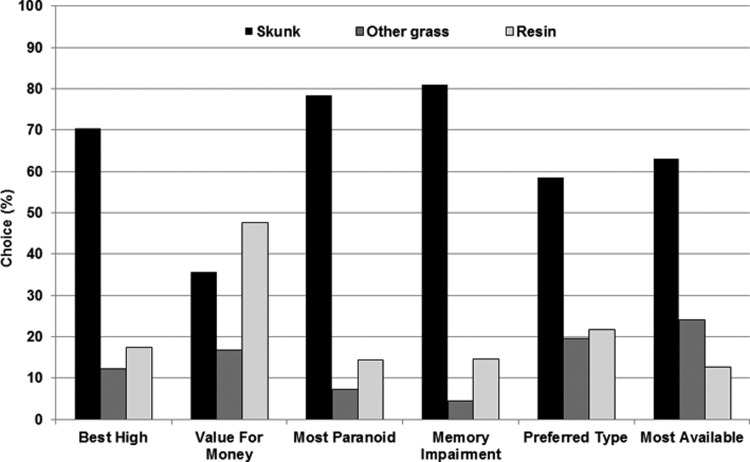
Frequent use of high-potency cannabis predicted a greater severity of dependence [days of skunk use per month: b = 0.254, 95% confidence interval (CI) 0.161-0.357, p < 0.001] and this effect became stronger as age decreased (b = -0.006, 95% CI -0.010 to -0.002, p = 0.004). By contrast, use of low-potency cannabis was not associated with dependence (days of other grass use per month: b = 0.020, 95% CI -0.029 to 0.070, p = 0.436; days of resin use per month: b = 0.025, 95% CI -0.019 to 0.067, p = 0.245). Frequency of cannabis use (all types) did not predict severity of cannabis-related concerns. High-potency cannabis was clearly distinct from low-potency varieties by its marked effects on memory and paranoia. It also produced the best high, was preferred, and most available.
High-potency cannabis use is associated with an increased severity of dependence, especially in young people. Its profile is strongly defined by negative effects (memory, paranoia), but also positive characteristics (best high, preferred type), which may be important when considering clinical or public health interventions focusing on cannabis potency.
在英格兰和威尔士,大麻的使用量正在下降,而成瘾服务中对大麻治疗的需求却持续上升。这可能部分归因于高效能大麻的可获得性增加。
对居住在英国的成年人进行了关于其药物使用情况的询问,包括三种类型的大麻(高效能:臭鼬大麻;低效能:其他草类大麻、大麻脂)。对大麻类型进行了剖析,并研究了使用频率与(i)大麻依赖、(ii)与大麻相关的担忧之间可能存在的关联。
频繁使用高效能大麻预示着更高的依赖严重程度[每月使用臭鼬大麻的天数:b = 0.254,95%置信区间(CI)0.161 - 0.357,p < 0.001],并且随着年龄的降低这种影响变得更强(b = -0.006,95% CI -0.010至 -0.002,p = 0.004)。相比之下,使用低效能大麻与依赖无关(每月使用其他草类大麻的天数:b = 0.020,95% CI -0.029至0.070,p = 0.436;每月使用大麻脂的天数:b = 0.025,95% CI -0.019至0.067,p = 0.245)。大麻使用频率(所有类型)并不能预测与大麻相关担忧的严重程度。高效能大麻在对记忆和偏执的显著影响方面明显有别于低效能品种。它还能产生最佳的快感,更受青睐,且最容易获得。
使用高效能大麻与依赖严重程度增加有关,尤其是在年轻人中。其特征由负面影响(记忆、偏执)以及正面特征(最佳快感、首选类型)强烈界定,这在考虑针对大麻效能的临床或公共卫生干预措施时可能很重要。