Francou Aurée, Hebel Pascale, Braesco Véronique, Drewnowski Adam
CREDOC, Centre de Recherche pour l'EtuDe et l'Observation des Conditions de vie, 142 rue du Chevaleret, Paris 75013, France.
VAB-nutrition, 1 rue Claude Danziger, Clermont-Ferrand 63100, France.
Nutrients. 2015 Jul 23;7(8):6073-87. doi: 10.3390/nu7085268.
Fruit and vegetable consumption is a marker of higher-quality diets; less is known about the contribution of 100% fruit and vegetable juices (FVJ) to diet quality.
To explore FVJ consumption patterns in relation to dietary nutrient density among French children (aged 3-14 years old) and adults (≥21 years old).
Analyses were based on the nationally representative 2013 CCAF (Comportements et Consommations Alimentaires en France) survey of 1930 respondents, stratified by age group, FVJ consumption, and socioeconomic status (SES). Dietary nutrient density was based on the Nutrient Rich Food (NRF9.3) index, adjusted for gender and age.
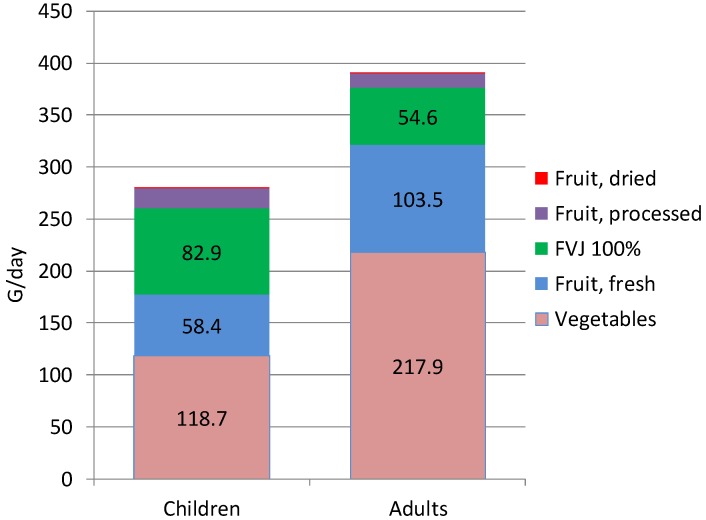
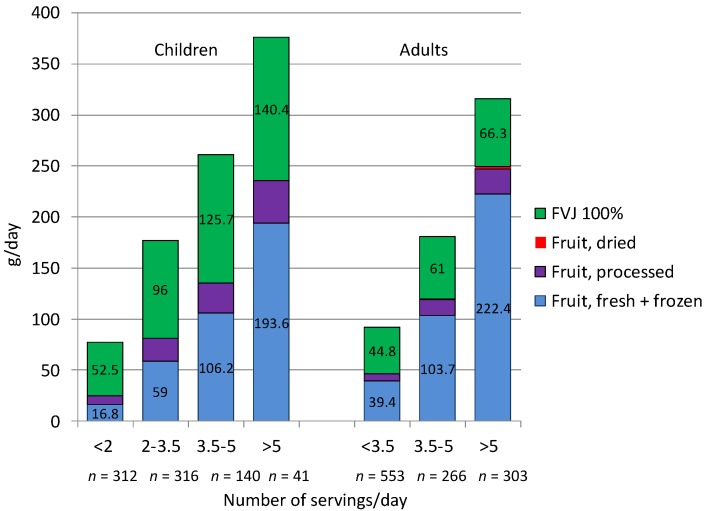
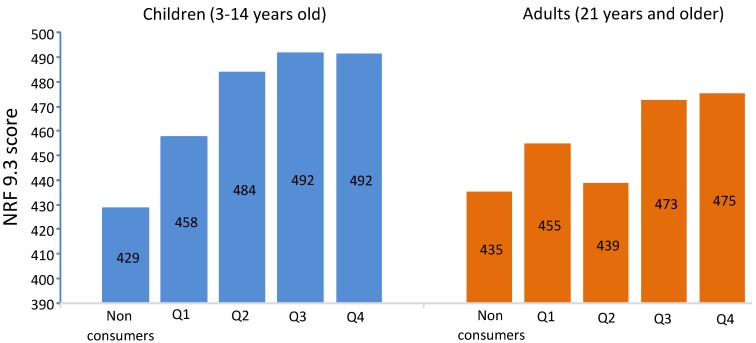
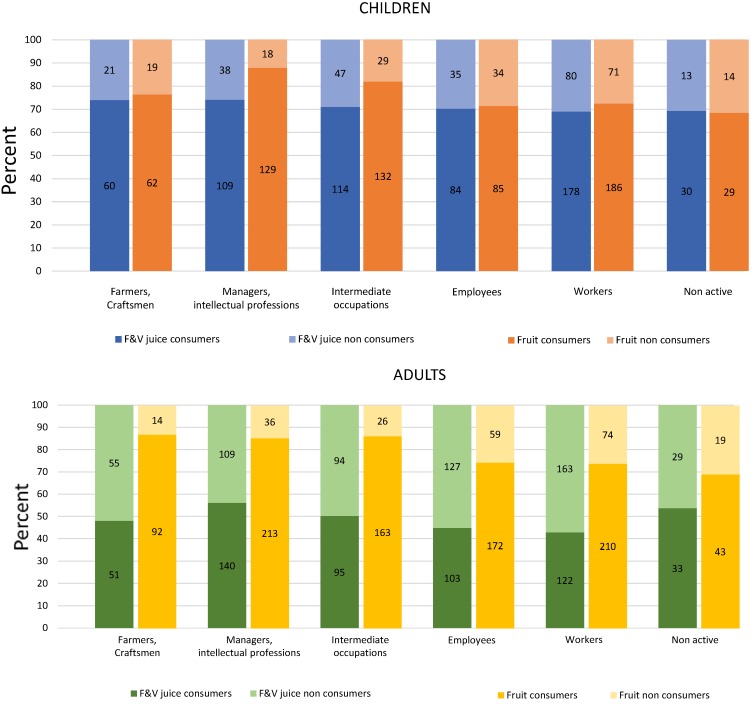
Mean total consumption of fruits and vegetables was 2.6 servings/day for children and 3.8 servings/day for adults. Mean population consumption of FVJ was 83 mL/day for children and 54.6 mL/day for adults, equivalent to 0.4 servings/day and 0.3 servings/day respectively. FVJ consumers had higher quality diets than did non-consumers, after adjusting for covariates. The respective NRF9.3 values were 486.4 ± 4.3 vs. 428.7 ± 7.5 for children and 460.7 ± 4.4 vs. 435.4 ± 4.4 for adults. FVJ consumers had similar or higher intakes of fruits and vegetables than did non-consumers. The socioeconomic gradient for FVJ consumption was much weaker (p < 0.046) than for whole fruit (p < 0.01).
In a nationally representative sample of French children and adults, fruit and vegetable consumption fell short of recommended values. Higher FVJ consumption was associated with higher-quality diets and better compliance with the French National Plan for Nutrition and Health (PNNS).
水果和蔬菜的摄入量是更高质量饮食的一个标志;关于100%水果和蔬菜汁(FVJ)对饮食质量的贡献,人们了解较少。
探讨法国儿童(3至14岁)和成年人(≥21岁)中与饮食营养密度相关的FVJ消费模式。
分析基于2013年具有全国代表性的CCAF(法国饮食行为与消费)调查,该调查有1930名受访者,按年龄组、FVJ消费量和社会经济地位(SES)分层。饮食营养密度基于营养丰富食物(NRF9.3)指数,并根据性别和年龄进行了调整。
儿童水果和蔬菜的平均总摄入量为每天2.6份,成人为每天3.8份。FVJ的平均人群摄入量儿童为每天83毫升,成人为每天54.6毫升,分别相当于每天0.4份和0.3份。在调整协变量后,FVJ消费者的饮食质量高于非消费者。儿童的NRF9.3值分别为486.4±4.3和428.7±7.5,成人分别为460.7±4.4和435.4±4.4。FVJ消费者的水果和蔬菜摄入量与非消费者相似或更高。FVJ消费的社会经济梯度比全果消费的梯度弱得多(p<0.046)(p<0.01)。
在法国儿童和成年人的全国代表性样本中,水果和蔬菜的摄入量未达到推荐值。较高的FVJ消费量与更高质量的饮食以及更好地遵守法国国家营养与健康计划(PNNS)相关。