Moraes Lucélia Campelo Albuquerque, França Eduardo Luzía, Pessoa Rafael Souza, Fagundes Danny Laura Gomes, Hernandes Mara Gil, Ribeiro Victor Pena, Gomes Maria Aparecida, Honorio-França Adenilda Cristina
Department of Parasitology, Institute of Biological Sciences, Federal University of Minas Gerais, Belo Horizonte, Minas Gerais, Brazil.
Institute of Biological and Health Science, Federal University of Mato Grosso, Rodovia BR070, Km 5 s/no, Barra do Garças, MT, Brazil.
Parasit Vectors. 2015 Aug 8;8:413. doi: 10.1186/s13071-015-1028-6.
Entamoeba histolytica (E. histolytica) causes amoebiasis, which is a disease with significant morbidity and mortality. Phagocytic cells and cytokines appear to be important in amoebiasis, but very little is known about the influence of these cells and cytokines in protozoan infections. The aim of this study was to analyse the supernatant of cultures of mononuclear (MN) cells with E. histolytica to determine: 1) the levels of the cytokines IFN-γ and TGF-β, and 2) the amoebicidal activity of MN cells after incubation with cytokines.
Blood samples were collected from 30 volunteer donors. The cytokine concentrations in MN cells culture supernatants, superoxide release, leukophagocytosis, amoebicide activity, intracellular calcium release and apoptosis were analysed.
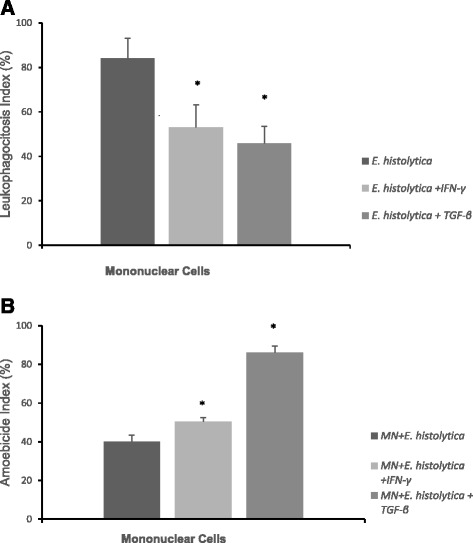
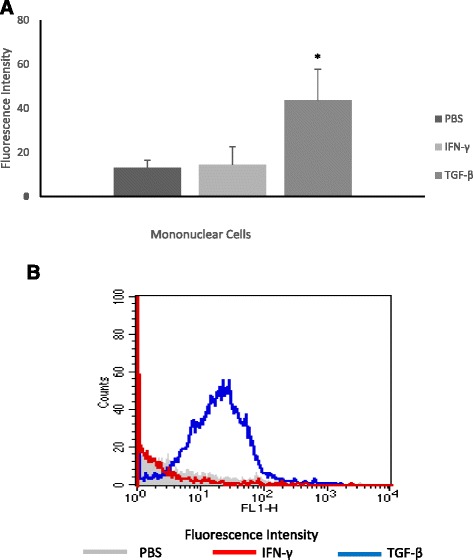
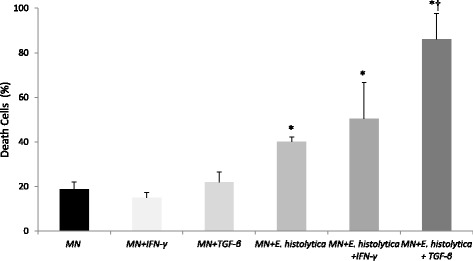
The IFN-γ concentrations were 6.22 ± 0.36 and TGF-β concentrations were 17.01 ± 2.21 in cells-trophozoite culture supernatants. MN cells, independently of cytokines, in the presence of amoeba increase the superoxide release. In the absence of cytokines, the ingestion of MN cells by amoebae was higher. In the presence of IFN- γ or TGF- β, a lower ingestion of MN cells was observed by amoebae. MN cells treated with cytokines exhibited higher amoebicide and apoptosis indexes. The incubation of cytokines increased the intracellular calcium release by MN cells.
These results suggest that cytokines play a beneficial role for the host by activating MN cells against E. histolytica. The increased death of amoebae during the leukophagocytosis suggests that both cytokines (IFN-γ and TGF-β) can modulate the functional activity of MN cells and that these cytokines probably are important in the control of amoebic infections.
溶组织内阿米巴(E. histolytica)可引发阿米巴病,这是一种具有较高发病率和死亡率的疾病。吞噬细胞和细胞因子在阿米巴病中似乎起着重要作用,但对于这些细胞和细胞因子在原生动物感染中的影响却知之甚少。本研究的目的是分析单核(MN)细胞与溶组织内阿米巴共培养的上清液,以确定:1)细胞因子IFN-γ和TGF-β的水平,以及2)细胞因子孵育后MN细胞的杀阿米巴活性。
从30名志愿者捐赠者采集血样。分析MN细胞培养上清液中的细胞因子浓度、超氧化物释放、白细胞吞噬作用、杀阿米巴活性、细胞内钙释放和细胞凋亡。
在细胞-滋养体培养上清液中,IFN-γ浓度为6.22±0.36,TGF-β浓度为17.01±2.21。在有阿米巴存在的情况下,MN细胞无论是否有细胞因子,都会增加超氧化物释放。在没有细胞因子的情况下,阿米巴对MN细胞的摄取更高。在有IFN-γ或TGF-β存在时,观察到阿米巴对MN细胞的摄取较低。用细胞因子处理的MN细胞表现出更高的杀阿米巴和凋亡指数。细胞因子孵育增加了MN细胞的细胞内钙释放。
这些结果表明,细胞因子通过激活MN细胞对抗溶组织内阿米巴,对宿主发挥有益作用。白细胞吞噬过程中阿米巴死亡增加表明,两种细胞因子(IFN-γ和TGF-β)均可调节MN细胞的功能活性,且这些细胞因子可能在控制阿米巴感染中起重要作用。