Gemayel Rita, Chavali Sreenivas, Pougach Ksenia, Legendre Matthieu, Zhu Bo, Boeynaems Steven, van der Zande Elisa, Gevaert Kris, Rousseau Frederic, Schymkowitz Joost, Babu M Madan, Verstrepen Kevin J
Laboratory of Systems Biology, VIB, Gaston Geenslaan 1, 3001 Heverlee, Belgium; Laboratory of Genetics and Genomics, Centre of Microbial and Plant Genetics (CMPG), Department M2S, KU Leuven, Gaston Geenslaan 1, 3001 Heverlee, Belgium.
MRC Laboratory of Molecular Biology, Francis Crick Avenue, Cambridge CB2 0QH, UK.
Mol Cell. 2015 Aug 20;59(4):615-27. doi: 10.1016/j.molcel.2015.07.003. Epub 2015 Aug 6.
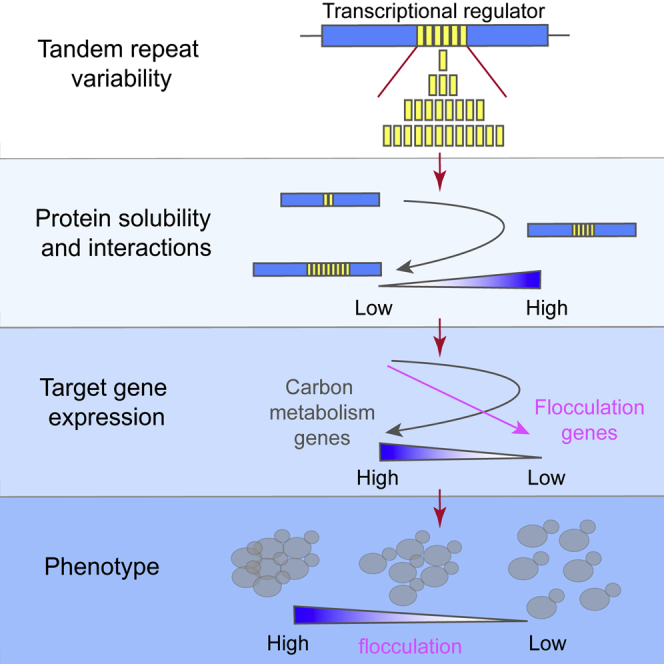
Excessive expansions of glutamine (Q)-rich repeats in various human proteins are known to result in severe neurodegenerative disorders such as Huntington's disease and several ataxias. However, the physiological role of these repeats and the consequences of more moderate repeat variation remain unknown. Here, we demonstrate that Q-rich domains are highly enriched in eukaryotic transcription factors where they act as functional modulators. Incremental changes in the number of repeats in the yeast transcriptional regulator Ssn6 (Cyc8) result in systematic, repeat-length-dependent variation in expression of target genes that result in direct phenotypic changes. The function of Ssn6 increases with its repeat number until a certain threshold where further expansion leads to aggregation. Quantitative proteomic analysis reveals that the Ssn6 repeats affect its solubility and interactions with Tup1 and other regulators. Thus, Q-rich repeats are dynamic functional domains that modulate a regulator's innate function, with the inherent risk of pathogenic repeat expansions.
已知各种人类蛋白质中富含谷氨酰胺(Q)的重复序列过度扩增会导致严重的神经退行性疾病,如亨廷顿舞蹈症和多种共济失调症。然而,这些重复序列的生理作用以及更适度的重复序列变异的后果仍不清楚。在此,我们证明富含Q的结构域在真核转录因子中高度富集,在其中它们作为功能调节剂发挥作用。酵母转录调节因子Ssn6(Cyc8)中重复序列数量的增量变化会导致靶基因表达出现系统性的、依赖重复序列长度的变异,进而导致直接的表型变化。Ssn6的功能随着其重复序列数量的增加而增强,直至达到某个阈值,超过该阈值进一步扩增会导致聚集。定量蛋白质组学分析表明,Ssn6的重复序列会影响其溶解性以及与Tup1和其他调节因子的相互作用。因此,富含Q的重复序列是动态的功能结构域,可调节调节因子的固有功能,但存在致病性重复序列扩增的内在风险。