
实时功能磁共振成像对强迫症患者前脑岛的自我调节及其行为效应:一项可行性研究
Self-Regulation of Anterior Insula with Real-Time fMRI and Its Behavioral Effects in Obsessive-Compulsive Disorder: A Feasibility Study.
作者信息
Buyukturkoglu Korhan, Roettgers Hans, Sommer Jens, Rana Mohit, Dietzsch Leonie, Arikan Ezgi Belkis, Veit Ralf, Malekshahi Rahim, Kircher Tilo, Birbaumer Niels, Sitaram Ranganatha, Ruiz Sergio
机构信息
Graduate School of Neural & Behavioural Sciences, International Max Planck Research School, University of Tübingen, Tuebingen, Germany; Institute for Medical Psychology and Behavioural Neurobiology, University of Tuebingen, Tuebingen, Germany.
Department of Psychiatry and Psychotherapy, Philipps-University Marburg, Marburg, Germany.
出版信息
PLoS One. 2015 Aug 24;10(8):e0135872. doi: 10.1371/journal.pone.0135872. eCollection 2015.
INTRODUCTION
Obsessive-compulsive disorder (OCD) is a common and chronic condition that can have disabling effects throughout the patient's lifespan. Frequent symptoms among OCD patients include fear of contamination and washing compulsions. Several studies have shown a link between contamination fears, disgust over-reactivity, and insula activation in OCD. In concordance with the role of insula in disgust processing, new neural models based on neuroimaging studies suggest that abnormally high activations of insula could be implicated in OCD psychopathology, at least in the subgroup of patients with contamination fears and washing compulsions.
METHODS
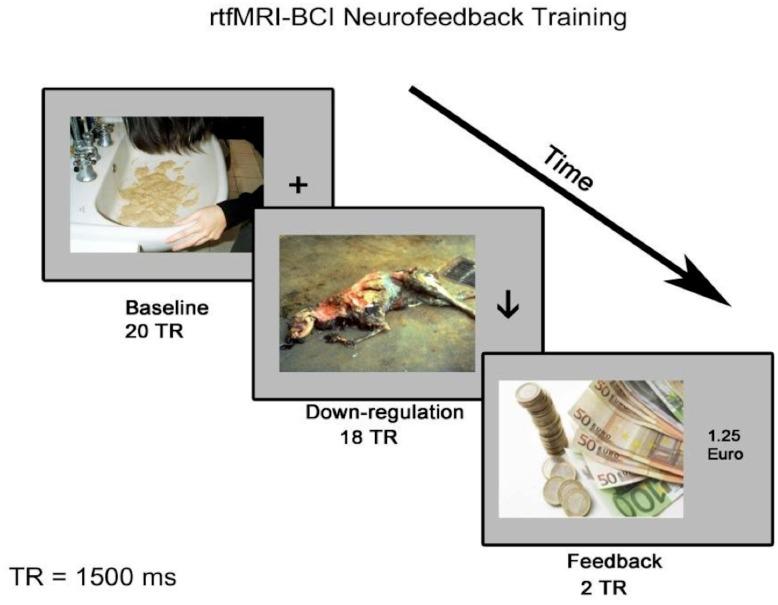
In the current study, we used a Brain Computer Interface (BCI) based on real-time functional magnetic resonance imaging (rtfMRI) to aid OCD patients to achieve down-regulation of the Blood Oxygenation Level Dependent (BOLD) signal in anterior insula. Our first aim was to investigate whether patients with contamination obsessions and washing compulsions can learn to volitionally decrease (down-regulate) activity in the insula in the presence of disgust/anxiety provoking stimuli. Our second aim was to evaluate the effect of down-regulation on clinical, behavioural and physiological changes pertaining to OCD symptoms. Hence, several pre- and post-training measures were performed, i.e., confronting the patient with a disgust/anxiety inducing real-world object (Ecological Disgust Test), and subjective rating and physiological responses (heart rate, skin conductance level) of disgust towards provoking pictures.
RESULTS
Results of this pilot study, performed in 3 patients (2 females), show that OCD patients can gain self-control of the BOLD activity of insula, albeit to different degrees. In two patients positive changes in behaviour in the EDT were observed following the rtfMRI trainings. Behavioural changes were also confirmed by reductions in the negative valence and in the subjective perception of disgust towards symptom provoking images.
CONCLUSION
Although preliminary, results of this study confirmed that insula down-regulation is possible in patients suffering from OCD, and that volitional decreases of insula activation could be used for symptom alleviation in this disorder.
引言
强迫症(OCD)是一种常见的慢性疾病,在患者的整个生命周期中都可能产生致残影响。强迫症患者的常见症状包括对污染的恐惧和强迫性洗涤。多项研究表明,在强迫症中,对污染的恐惧、厌恶过度反应与脑岛激活之间存在联系。与脑岛在厌恶处理中的作用一致,基于神经影像学研究的新神经模型表明,脑岛异常高激活可能与强迫症的精神病理学有关,至少在有污染恐惧和强迫性洗涤的患者亚组中如此。
方法
在本研究中,我们使用了一种基于实时功能磁共振成像(rtfMRI)的脑机接口(BCI),以帮助强迫症患者实现前脑岛血氧水平依赖(BOLD)信号的下调。我们的首要目标是研究有污染强迫观念和强迫性洗涤的患者在面对引发厌恶/焦虑的刺激时,是否能够学会自主降低(下调)脑岛的活动。我们的第二个目标是评估下调对与强迫症症状相关的临床、行为和生理变化的影响。因此,我们进行了多项训练前和训练后的测量,即让患者面对一个引发厌恶/焦虑的现实世界物体(生态厌恶测试),以及对引发厌恶的图片的主观评分和生理反应(心率、皮肤电导率水平)。
结果
这项对3名患者(2名女性)进行的初步研究结果表明,强迫症患者能够对脑岛的BOLD活动获得自我控制,尽管程度不同。在两名患者中,rtfMRI训练后观察到生态厌恶测试中的行为有积极变化。对引发症状的图像的负性效价和厌恶主观感知的降低也证实了行为变化。
结论
尽管本研究结果初步,但证实了强迫症患者可以实现脑岛下调,并且脑岛激活的自主降低可用于缓解该疾病的症状。



 Zotero 插件