Brown Joseph E, Partlow Benjamin P, Berman Alison M, House Michael D, Kaplan David L
Department of Biomedical Engineering, Tufts University, Medford, MA.
Department of Obstetrics and Gynecology, Division of Maternal Fetal Medicine, Tufts Medical Center, Boston, MA.
Am J Obstet Gynecol. 2016 Jan;214(1):118.e1-9. doi: 10.1016/j.ajog.2015.08.046. Epub 2015 Aug 24.
Cerclage therapy is an important treatment option for preterm birth prevention. Several patient populations benefit from cerclage therapy including patients with a classic history of cervical insufficiency; patients who present with advanced cervical dilation prior to viability; and patients with a history of preterm birth and cervical shortening. Although cerclage is an effective treatment option in some patients, it can be associated with limited efficacy and procedure complications. Development of an alternative to cerclage therapy would be an important clinical development. Here we report on an injectable, silk protein-based biomaterial for cervical tissue augmentation. The rationale for the development of an injectable biomaterial is to restore the native properties of cervical tissue. While cerclage provides support to the tissue, it does not address excessive tissue softening, which is a central feature of the pathogenesis of cervical insufficiency. Silk protein-based hydrogels, which are biocompatible and naturally degrade in vivo, are suggested as a platform for restoring the native properties of cervical tissue and improving cervical function.
We sought to study the properties of an injectable, silk-based biomaterial for potential use as an alternative treatment for cervical insufficiency. These biomaterials were evaluated for mechanical tunability, biocompatibility, facile injection, and in vitro degradation.
Silk protein solutions were cross-linked by an enzyme catalyzed reaction to form elastic biomaterials. Biomaterials were formulated to match the native physical properties of cervical tissue during pregnancy. The cell compatibility of the materials was assessed in vitro using cervical fibroblasts, and biodegradation was evaluated using concentrated protease solution. Tissue augmentation or bulking was demonstrated using human cervical tissue from nonpregnant hysterectomy specimens. Mechanical compression tests measured the tissue stiffness as a function of the volume of injected biomaterial.
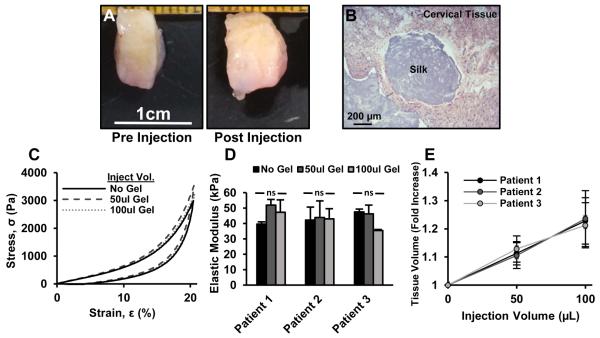
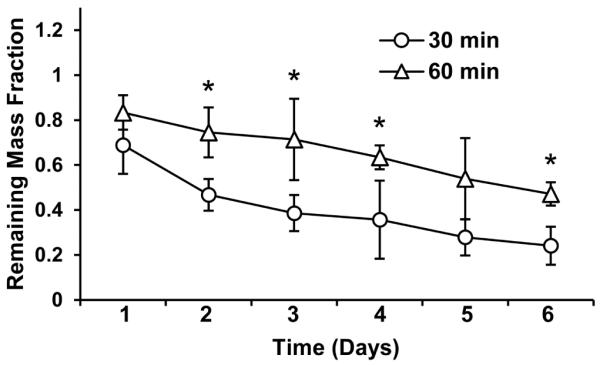
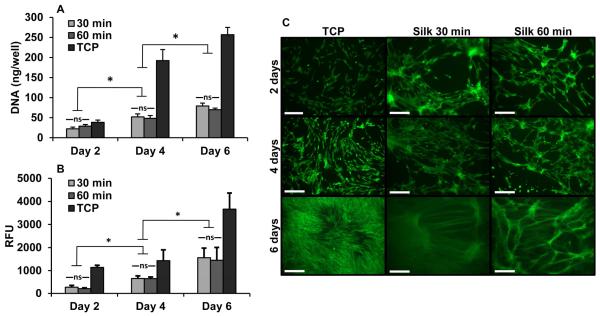
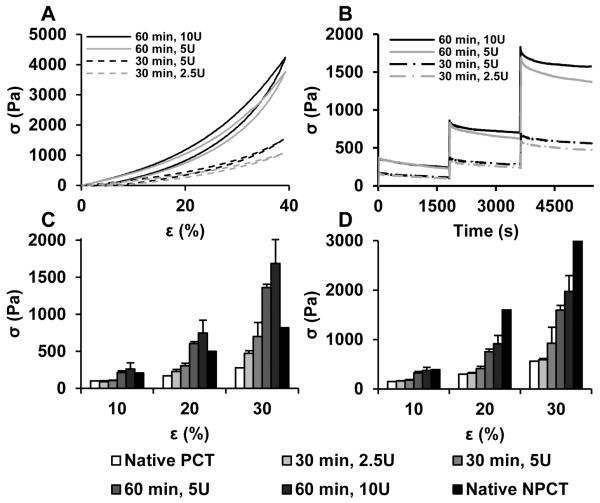
Silk protein concentration, molecular weight, and concentration of cross-linking agent were varied to generate biomaterials that functioned from hard gels to viscous fluids. Biomaterials that matched the mechanical features of cervical tissues were chosen for further study. Cervical fibroblasts cultured on these biomaterials were proliferative and metabolically active over 6 days. Biomaterials were degraded in protease solution, with rate of mass loss dependent on silk protein molecular weight. Injection of cervical tissue samples with 100 μL of the biomaterial resulted in a significant volume increase (22.6% ± 8.8%, P < .001) with no significant change in tissue stiffness.
Cytocompatible, enzyme cross-linked silk protein biomaterials show promise as a tissue bulking agent. The biomaterials were formulated to match the native mechanical properties of human cervical tissue. These biomaterials should be explored further as a possible alternative to cerclage for providing support to the cervix during pregnancy.
宫颈环扎术是预防早产的重要治疗选择。包括有经典宫颈机能不全病史的患者、在胎儿存活之前出现宫颈进行性扩张的患者以及有早产和宫颈缩短病史的患者在内的几类患者群体可从宫颈环扎术中获益。尽管宫颈环扎术对某些患者是一种有效的治疗选择,但它可能疗效有限且存在手术并发症。开发一种宫颈环扎术的替代方法将是一项重要的临床进展。在此,我们报告一种用于增强宫颈组织的可注射丝蛋白基生物材料。开发可注射生物材料的基本原理是恢复宫颈组织的天然特性。虽然宫颈环扎术为组织提供支撑,但它并未解决组织过度软化的问题,而组织过度软化是宫颈机能不全发病机制的核心特征。具有生物相容性且在体内可自然降解的丝蛋白基水凝胶被认为是恢复宫颈组织天然特性并改善宫颈功能的一个平台。
我们试图研究一种可注射的丝基生物材料的特性,以作为宫颈机能不全的潜在替代治疗方法。对这些生物材料的机械可调性、生物相容性、易于注射性和体外降解性进行了评估。
通过酶催化反应使丝蛋白溶液交联以形成弹性生物材料。将生物材料配制成与孕期宫颈组织的天然物理特性相匹配。使用宫颈成纤维细胞在体外评估材料的细胞相容性,并使用浓缩蛋白酶溶液评估生物降解性。使用来自非孕子宫切除标本的人宫颈组织证明了组织增强或填充效果。机械压缩试验测量了作为注射生物材料体积函数的组织硬度。
改变丝蛋白浓度、分子量和交联剂浓度以生成从硬凝胶到粘性流体的生物材料。选择与宫颈组织机械特性相匹配的生物材料进行进一步研究。在这些生物材料上培养的宫颈成纤维细胞在6天内增殖且代谢活跃。生物材料在蛋白酶溶液中降解,质量损失率取决于丝蛋白分子量。向宫颈组织样本注射100 μL生物材料导致体积显著增加(22.6%±8.8%,P<.001),而组织硬度无显著变化。
具有细胞相容性的、酶交联的丝蛋白生物材料有望作为一种组织填充剂。这些生物材料被配制成与人类宫颈组织的天然机械特性相匹配。应进一步探索这些生物材料作为宫颈环扎术的一种可能替代方法,以便在孕期为宫颈提供支撑。