Louis Elan D, Rohl Brittany, Rice Catherine
Department of Neurology, Yale School of Medicine, Yale University, New Haven, CT, USA ; Department of Chronic Disease Epidemiology, Yale School of Public Health, Yale University, New Haven, CT, USA ; Center for Neuroepidemiology and Clinical Neurological Research, Yale School of Medicine, Yale University, New Haven, CT, USA.
Department of Neurology, Yale School of Medicine, Yale University, New Haven, CT, USA.
Tremor Other Hyperkinet Mov (N Y). 2015 Aug 14;5:331. doi: 10.7916/D87080M9. eCollection 2015.
Patient-centeredness (i.e., providing care that is responsive to individual patient preferences) is increasingly recognized as a crucial element of quality of care.
A six-item patient-centeredness questionnaire was devised to assess the self-perceived needs of essential tremor (ET) patients. A link to the questionnaire was included in the monthly e-newsletter of the International Essential Tremor Foundation. The questionnaires were completed online and data were available in electronic format.
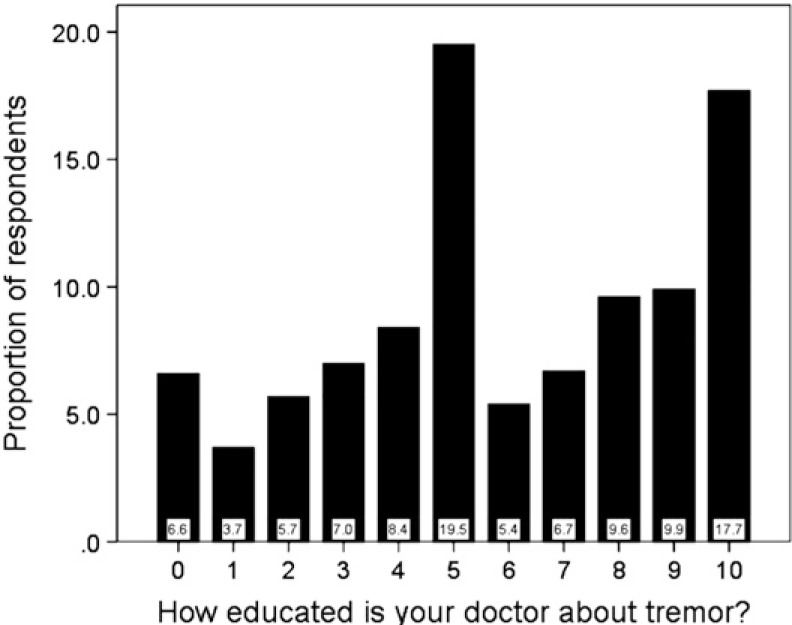
There were 1,418 respondents. One in three respondents (i.e., 31.4%) indicated that the doctor was not even "moderately well-educated" about ET. Only 11.8% of respondents were satisfied with their care. Respondents raised a multiplicity of issues that were not being addressed in their current care. The top items were psychological services and support (33.9%), physical or occupational therapy (28.6%), handling embarrassment and social effects of tremor (15.8%), feelings of not being in control (13.7%), a detailed report and a more quantitative way of assessing tremor and tracking progression (12.7%), better counseling about current treatment and medications (11.9%), empathy, compassion and a feeling of being heard (11.6%), a treatment approach other than just medications and surgery (11.2%), and a discussion of all symptoms aside from tremor (e.g., cognition, balance).
Patients with ET identified a broad range of issues that they felt were not addressed in their treatment; indeed, only one in 10 patients reported that they were satisfied with their care. It is hoped that patient-centered approaches such as this will lead to improved models for the care of patients with this common chronic disease.
以患者为中心(即提供符合个体患者偏好的护理)日益被视为护理质量的关键要素。
设计了一份包含六个条目的以患者为中心的问卷,以评估特发性震颤(ET)患者的自我感知需求。该问卷的链接包含在国际特发性震颤基金会的月度电子通讯中。问卷通过在线方式完成,数据以电子格式提供。
有1418名受访者。三分之一的受访者(即31.4%)表示医生对ET甚至没有“受过适度良好的教育”。只有11.8%的受访者对他们接受的护理感到满意。受访者提出了当前护理中未得到解决的众多问题。首要问题是心理服务与支持(33.9%)、物理或职业治疗(28.6%)、应对震颤的尴尬和社会影响(15.8%)、失控感(13.7%)、一份详细报告以及评估震颤和跟踪进展的更量化方法(12.7%)、关于当前治疗和药物的更好咨询(11.9%)、同理心、同情心和被倾听的感觉(11.6%)、除药物和手术之外的治疗方法(11.2%),以及除震颤之外对所有症状(如认知、平衡)的讨论。
ET患者指出了他们认为在治疗中未得到解决的广泛问题;实际上,只有十分之一的患者报告对他们接受的护理感到满意。希望这样的以患者为中心的方法将带来针对这种常见慢性病患者护理的改进模式。