Briley Daniel A, Harden K Paige, Bates Timothy C, Tucker-Drob Elliot M
Department of Psychology and Population Research Center, University of Texas at Austin, 108 E. Dean Keeton Stop A8000, Austin, TX, 78712-1043, USA,
Behav Genet. 2015 Sep;45(5):581-96. doi: 10.1007/s10519-015-9732-8. Epub 2015 Aug 29.
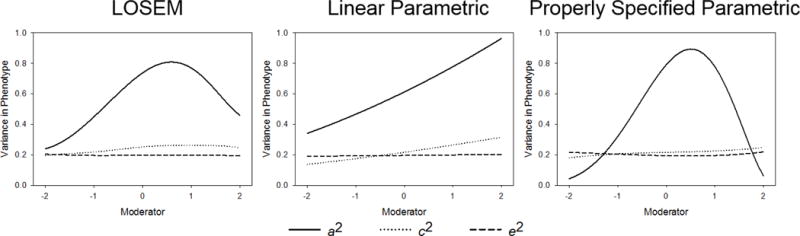
Gene × environment (G × E) interaction studies test the hypothesis that the strength of genetic influence varies across environmental contexts. Existing latent variable methods for estimating G × E interactions in twin and family data specify parametric (typically linear) functions for the interaction effect. An improper functional form may obscure the underlying shape of the interaction effect and may lead to failures to detect a significant interaction. In this article, we introduce a novel approach to the behavior genetic toolkit, local structural equation modeling (LOSEM). LOSEM is a highly flexible nonparametric approach for estimating latent interaction effects across the range of a measured moderator. This approach opens up the ability to detect and visualize new forms of G × E interaction. We illustrate the approach by using LOSEM to estimate gene × socioeconomic status interactions for six cognitive phenotypes. Rather than continuously and monotonically varying effects as has been assumed in conventional parametric approaches, LOSEM indicated substantial nonlinear shifts in genetic variance for several phenotypes. The operating characteristics of LOSEM were interrogated through simulation studies where the functional form of the interaction effect was known. LOSEM provides a conservative estimate of G × E interaction with sufficient power to detect statistically significant G × E signal with moderate sample size. We offer recommendations for the application of LOSEM and provide scripts for implementing these biometric models in Mplus and in OpenMx under R.
基因×环境(G×E)相互作用研究检验了这样一种假设,即遗传影响的强度在不同环境背景下会有所不同。现有的用于估计双胞胎和家庭数据中G×E相互作用的潜在变量方法为相互作用效应指定了参数化(通常是线性)函数。不恰当的函数形式可能会掩盖相互作用效应的潜在形状,并可能导致无法检测到显著的相互作用。在本文中,我们介绍了行为遗传学工具包中的一种新方法,即局部结构方程建模(LOSEM)。LOSEM是一种高度灵活的非参数方法,用于估计在测量的调节变量范围内的潜在相互作用效应。这种方法开启了检测和可视化新形式的G×E相互作用的能力。我们通过使用LOSEM估计六种认知表型的基因×社会经济地位相互作用来说明该方法。与传统参数方法中假设的连续且单调变化的效应不同,LOSEM表明几种表型的遗传方差存在显著的非线性变化。通过模拟研究来探究LOSEM的操作特性,在模拟研究中相互作用效应的函数形式是已知的。LOSEM提供了对G×E相互作用的保守估计,具有足够的能力在中等样本量下检测到具有统计学意义的G×E信号。我们为LOSEM的应用提供了建议,并提供了在Mplus和R语言下的OpenMx中实现这些生物统计学模型的脚本。