Petrillo Marco, Zannoni Gian Franco, Martinelli Enrica, Pedone Anchora Luigi, Ferrandina Gabriella, Tropeano Giovanna, Fagotti Anna, Scambia Giovanni
Department of Obstetrics and Gynecology, Gynecologic Oncology Unit, Catholic University of the Sacred Heart, Rome, Italy; Department of Oncology, Gynecologic Oncology Unit, Foundation "John Paul II" Catholic University of the Sacred Heart, Campobasso, Italy.
Department of Human Pathology, Division of Gynecologic Pathology, Catholic University of the Sacred Heart, Rome, Italy.
PLoS One. 2015 Sep 3;10(9):e0136654. doi: 10.1371/journal.pone.0136654. eCollection 2015.
We investigate the prognostic role of pre-treatment ratio between Type 1 (M1) and Type 2 (M2) tumor-associated macrophages (TAMs) in locally advanced cervical cancer (LACC) patients treated with chemoradiation (CT/RT).
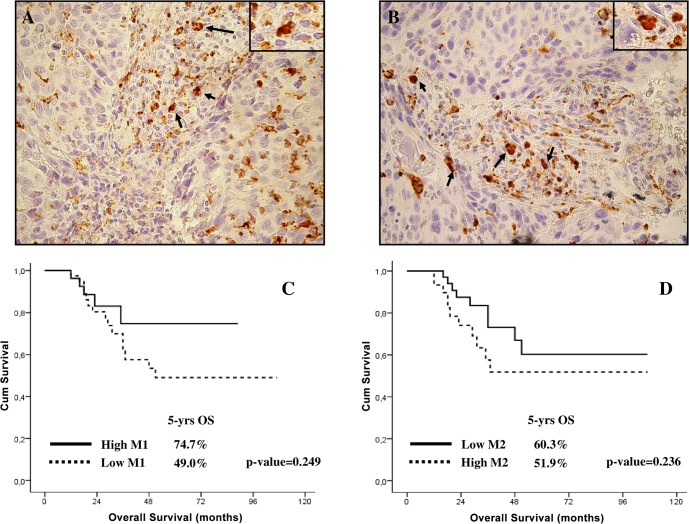
84 consecutive LACC patients treated with cisplatin-based CT/RT for a total dose of 50.0 Gy, followed by radical surgery were analysed. Double-staining immunohistochemistry of CD163/p-STAT, CD68/pSTAT1, CD163/c-MAF, and CD68/c-MAF was performed on tumor samples taken at the time of diagnosis. TAMs with CD163+pSTAT1+, or CD68+pSTAT1+ were defined M1; CD163+c-MAF+ or CD68+c-MAF+ defined the M2 phenotype. The number of M1 and M2 cells was counted at low magnification by evaluating for each case the same tumour area. The ratio between M1 and M2 (M1/M2) was finally calculated.
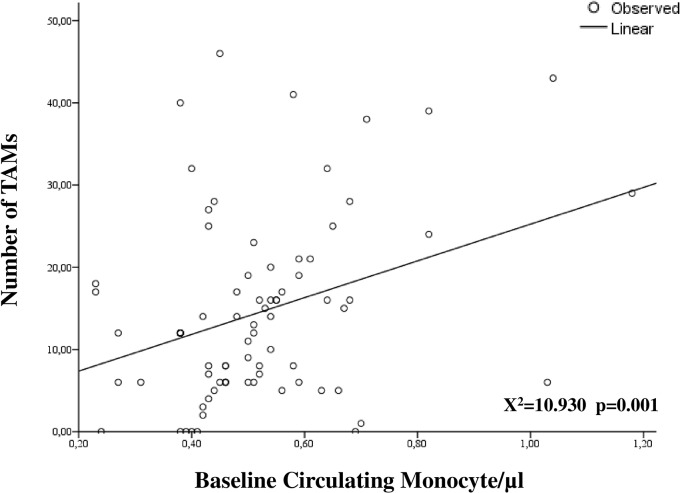
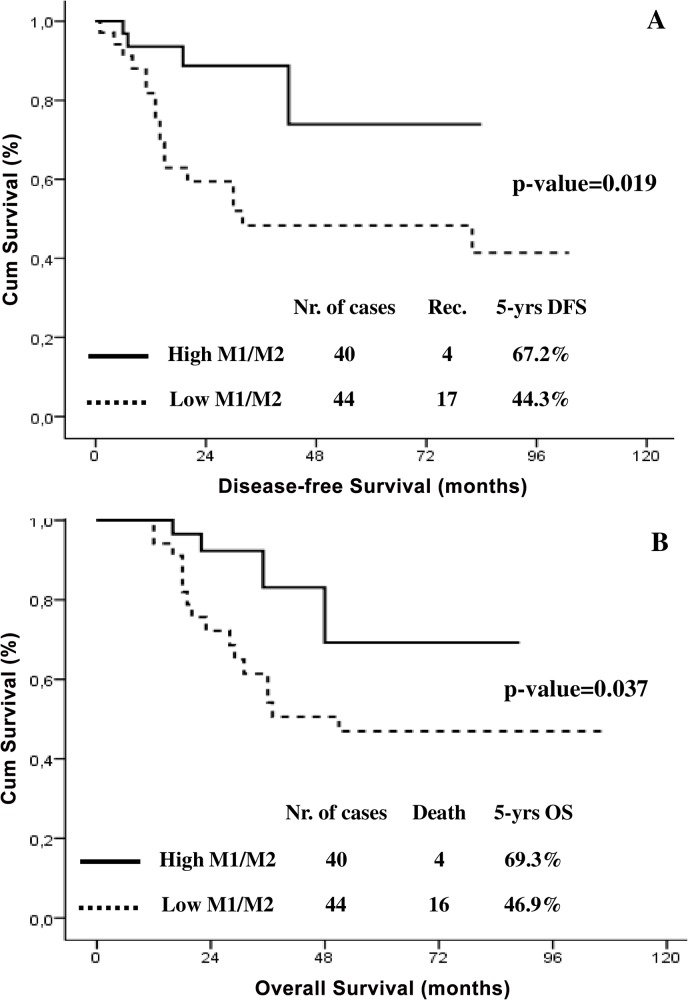
At diagnosis, we observed a direct correlation between the number of circulating monocytes and of TAMs (p-value = 0.001). Patients with high M1/M2 experienced more frequently complete pathologic response (no residual tumor) to CT/RT, compared to cases with low M1/M2 (55.0% Vs 29.5%; p-value = 0.029). At multivariate analysis M1/M2 (OR = 2.067; p-value = 0.037) emerged as independent predictor of pathologic response to CT/RT. Women with high M1/M2 showed a longer 5-yrs Disease-free (67.2% Vs. 44.3%; p-value = 0.019), and 5-yrs Overall (69.3% Vs. 46.9%; p-value = 0.037) survival, compared to cases with low M1/M2. The presence of a high M1/M2 ratio was independently associated with an unfavourable survival outcome in multivariate analysis.
Polarisation of TAMs toward a M2 phenotype, as reflected by a lower M1/M2 ratio, is an independent predictor of poor response to CT/RT, and shorter survival in LACC.
我们研究了在接受放化疗(CT/RT)的局部晚期宫颈癌(LACC)患者中,1型(M1)和2型(M2)肿瘤相关巨噬细胞(TAM)的预处理比例的预后作用。
分析了84例连续接受基于顺铂的CT/RT治疗、总剂量为50.0 Gy、随后进行根治性手术的LACC患者。在诊断时采集的肿瘤样本上进行CD163/p-STAT、CD68/pSTAT1、CD163/c-MAF和CD68/c-MAF的双重免疫组化染色。CD163+pSTAT1+或CD68+pSTAT1+的TAM被定义为M1;CD163+c-MAF+或CD68+c-MAF+定义为M2表型。通过评估每个病例相同的肿瘤区域,在低倍镜下计数M1和M2细胞的数量。最终计算M1与M2的比例(M1/M2)。
在诊断时,我们观察到循环单核细胞数量与TAM数量之间存在直接相关性(p值 = 0.001)。与M1/M2低的病例相比,M1/M2高的患者对CT/RT更频繁地出现完全病理缓解(无残留肿瘤)(55.0%对29.5%;p值 = 0.029)。在多变量分析中,M1/M2(比值比 = 2.067;p值 = 0.037)成为对CT/RT病理反应的独立预测因子。与M1/M2低的病例相比,M1/M2高的女性显示出更长的5年无病生存期(67.2%对44.3%;p值 = 0.019)和5年总生存期(69.3 %对46.9%;p值 = 0.037)。在多变量分析中,高M1/M2比例的存在与不良生存结果独立相关。
如较低的M1/M2比例所反映的,TAM向M2表型的极化是LACC中对CT/RT反应不佳和生存期较短的独立预测因子。