Roman S, Keefer L, Imam H, Korrapati P, Mogni B, Eident K, Friesen L, Kahrilas P J, Martinovich Z, Pandolfino J E
Division of Gastroenterology and Hepatology, Department of Medicine, Feinberg School of Medicine, Northwestern University, Chicago, IL, USA.
Digestive Physiology, Hospices Civils de Lyon, Lyon I university and LabTAU Inserm 1032, Lyon, France.
Neurogastroenterol Motil. 2015 Nov;27(11):1667-74. doi: 10.1111/nmo.12666. Epub 2015 Sep 4.
Genesis of persistent gastro-esophageal reflux symptoms despite proton pump inhibitor (PPI) therapy is not fully understood. We aimed at determining reflux patterns on 24-h pH-impedance monitoring performed on PPI and correlating impedance patterns and symptom occurrence in PPI non-responders.
Seventy-eight PPI non-responder patients underwent 24-h pH-impedance monitoring on PPI. Reflux impedance characterization included gastric and supragastric belches and proximal extent of reflux. Symptoms were considered associated with reflux if occurring within 5 min after a reflux event. Patients were classified into three groups: persistent acid reflux (acid esophageal exposure [AET] >5% of time), reflux sensitivity (AET <5%, symptom index [SI] ≥50%), and functional symptoms (AET <5%, SI <50%). Dominant impedance pattern was determined for each patient.
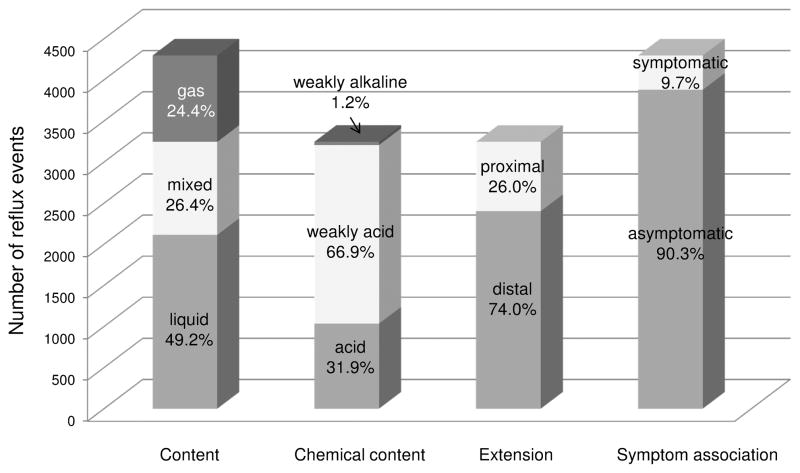
Seven patients (9%) had persistent acid reflux, 28 (36%) reflux sensitivity, and 43 (55%) functional symptoms. A total of 4296 reflux events were identified (median per patient 45 [range 4-221]). Although liquid reflux was the most common pattern in all groups, patients with reflux sensitivity and functional symptoms had much more variability in their pattern profile with a large proportion being associated with gastric and supragastric belching. Only 417 reflux events (9.7%) were associated with symptoms. Reflux with a supragastric component and proximal extent were more likely to be associated with symptoms.
CONCLUSIONS & INFERENCES: The impedance reflux profile in PPI non-responders was heterogeneous and the majority of reflux events were not associated with symptoms. Thus, the treatment of PPI non-responders should focus on mechanisms beyond reflux, such as visceral hypersensitivity and hypervigilance.
尽管使用质子泵抑制剂(PPI)治疗,持续性胃食管反流症状的成因仍未完全明确。我们旨在通过对使用PPI的患者进行24小时pH阻抗监测来确定反流模式,并将阻抗模式与PPI无反应者的症状发生情况相关联。
78例PPI无反应患者在使用PPI的情况下接受了24小时pH阻抗监测。反流阻抗特征包括胃内和胃上嗳气以及反流的近端范围。如果症状在反流事件发生后5分钟内出现,则认为与反流相关。患者分为三组:持续性酸反流(酸食管暴露时间[AET]>5%)、反流敏感性(AET<5%,症状指数[SI]≥50%)和功能性症状(AET<5%,SI<50%)。确定每位患者的主要阻抗模式。
7例患者(9%)有持续性酸反流,28例(36%)有反流敏感性,43例(55%)有功能性症状。共识别出4296次反流事件(每位患者中位数为45次[范围4 - 221次])。尽管液体反流在所有组中都是最常见的模式,但有反流敏感性和功能性症状的患者其模式特征的变异性更大,其中很大一部分与胃内和胃上嗳气有关。只有417次反流事件(9.7%)与症状相关。伴有胃上成分和近端范围的反流更有可能与症状相关。
PPI无反应者的阻抗反流特征是异质性的,且大多数反流事件与症状无关。因此,对PPI无反应者的治疗应关注反流以外的机制,如内脏高敏感性和过度警觉。