Ratamess Nicholas A, Bush Jill A, Kang Jie, Kraemer William J, Stohs Sidney J, Nocera Vincenzo G, Leise Megan D, Diamond Keith B, Faigenbaum Avery D
Department of Health and Exercise Science, The College of New Jersey, Ewing, NJ 08628 USA.
Department of Human Sciences, The Ohio State University, Columbus, OH 43210 USA.
J Int Soc Sports Nutr. 2015 Sep 17;12:35. doi: 10.1186/s12970-015-0096-5. eCollection 2015.
Little is known concerning the potential ergogenic effects of p-synephrine supplementation. Therefore, the purpose of the present study was to examine the effects of supplementation with p-synephrine alone and in combination with caffeine on free-weight resistance exercise performance.
Twelve healthy, college-aged men performed a control (CT) resistance exercise protocol consisting of 6 sets of squats for up to 10 repetitions per set using 80% of their one repetition-maximum (1RM) with 2 min of rest in between sets. Each subject was randomly assigned (in double-blind, balanced manner) to a treatment sequence consisting of use of 3 supplements: p-synephrine (S; 100 mg), p-synephrine + caffeine (SCF; 100 mg of p-synephrine plus 100 mg of caffeine), or a placebo (P). For each supplement treatment (separated by 1 week), subjects consumed the supplement for 3 days prior to each protocol and the morning of each protocol, and subsequently did not consume any supplements for 3 days following (i.e. wash-out period). On each protocol day, subjects reported to the lab at a standard time, consumed a supplement, sat quietly for 45 min, performed the resistance exercise protocol, and sat quietly for 30 min post exercise. Performance (repetition number, force, velocity and power), blood lactate, and ratings of perceived exertion (RPE) data were collected during each protocol.
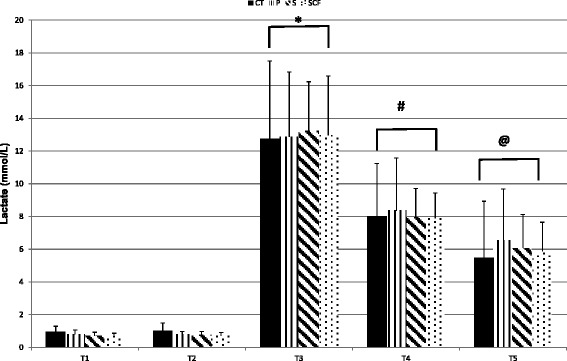
Supplements SCF and S produced a significantly (P < 0.05) greater number of repetitions performed than CT (by 11.0 ± 8.0%) and P (by 6.0 ± 7.0%) and a 10.6 ± 12.0% greater increase in volume load per protocol than CT and P. Most of the differences were seen during the last 3 sets. Mean power and velocity for all 6 sets were significantly higher in SCF compared to CT and P by ~6.2 ± 8.0%. No supplement effects were observed in RPE or blood lactate, and no adverse side effects were observed or reported.
S and SCF augmented resistance exercise performance (total repetitions, volume load) without increasing blood lactate or RPE. The addition of caffeine in SCF increased mean power and velocity of squat performance. These results indicate supplementation with S and SCF can enhance local muscle endurance during resistance exercise.
关于补充对羟基苯乙胺的潜在促力作用知之甚少。因此,本研究的目的是研究单独补充对羟基苯乙胺以及与咖啡因联合补充对自由重量抗阻运动表现的影响。
12名健康的大学生男性进行了一项对照(CT)抗阻运动方案,包括6组深蹲,每组最多进行10次重复,使用其一次重复最大值(1RM)的80%,组间休息2分钟。每个受试者被随机分配(以双盲、平衡的方式)到一个治疗序列,包括使用3种补充剂:对羟基苯乙胺(S;100毫克)、对羟基苯乙胺+咖啡因(SCF;100毫克对羟基苯乙胺加100毫克咖啡因)或安慰剂(P)。对于每种补充剂治疗(间隔1周),受试者在每个方案前3天和每个方案当天早上服用补充剂,随后在接下来的3天不服用任何补充剂(即洗脱期)。在每个方案日,受试者在标准时间到实验室,服用一种补充剂,安静地坐45分钟,进行抗阻运动方案,运动后安静地坐30分钟。在每个方案期间收集运动表现(重复次数、力量、速度和功率)、血乳酸和主观用力程度(RPE)数据。
补充剂SCF和S的重复次数显著多于CT(P<0.05)(多11.0±8.0%)和P(多6.0±7.0%),且每个方案的体积负荷增加量比CT和P高10.6±12.0%。大多数差异出现在最后3组。与CT和P相比,SCF组所有6组的平均功率和速度显著提高约6.2±8.0%。在RPE或血乳酸方面未观察到补充剂的影响,也未观察到或报告有不良副作用。
S和SCF可增强抗阻运动表现(总重复次数、体积负荷),而不增加血乳酸或RPE。SCF中添加咖啡因可提高深蹲表现的平均功率和速度。这些结果表明,补充S和SCF可增强抗阻运动期间的局部肌肉耐力。