Exercise & Sport Nutrition Lab, Department of Health & Kinesiology, Texas A&M University, College Station, TX 77843-4243 USA.
Exercise & Sport Nutrition Lab, Department of Health & Kinesiology, Texas A&M University, College Station, TX 77843-4243 USA ; Nutrabolt, Bryan, TX 77807 USA.
J Int Soc Sports Nutr. 2017 Jan 3;14:1. doi: 10.1186/s12970-016-0158-3. eCollection 2017.
The purpose of this study was to examine whether ingesting a pre-workout dietary supplement (PWS) with and without synephrine (S) during training affects training responses in resistance-trained males.
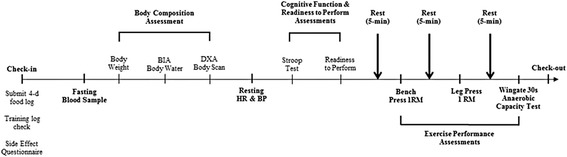
Resistance-trained males ( = 80) were randomly assigned to supplement their diet in a double-blind manner with either a flavored placebo (PLA); a PWS containing beta-alanine (3 g), creatine nitrate as a salt (2 g), arginine alpha-ketoglutarate (2 g), N-Acetyl-L-Tyrosine (300 mg), caffeine (284 mg), extract standardized for 15% L-Dopa (15 mg), Vitamin C as Ascorbic Acid (500 mg), niacin (60 mg), folate as folic acid (50 mg), and Vitamin B12 as Methylcobalamin (70 mg); or, the PWS supplement with extract containing 20 mg of synephrine (PWS + S) once per day for 8-weeks during training. Participants donated a fasting blood sample and had body composition (DXA), resting heart rate and blood pressure, cognitive function (Stroop Test), readiness to perform, bench and leg press 1 RM, and Wingate anaerobic capacity assessments determined a 0, 4, and 8-weeks of standardized training. Data were analyzed by MANOVA with repeated measures. Performance and cognitive function data were analyzed using baseline values as covariates as well as mean changes from baseline with 95% confidence intervals (CI). Blood chemistry data were also analyzed using Chi-square analysis.
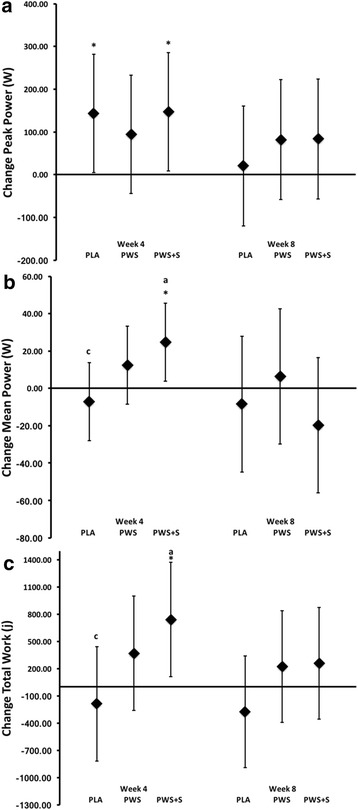
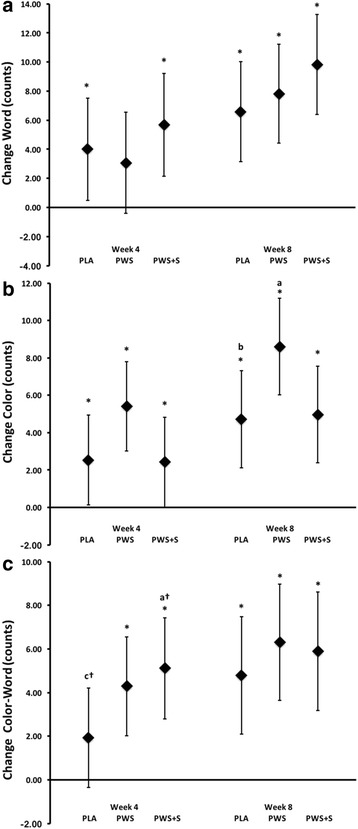
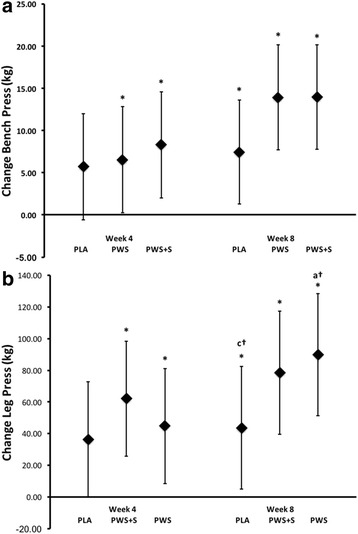
Although significant time effects were seen, no statistically significant overall MANOVA Wilks' Lambda interactions were observed among groups for body composition, resting heart and blood pressure, readiness to perform questions, 1RM strength, anaerobic sprint capacity, or blood chemistry panels. MANOVA univariate analysis and analysis of changes from baseline with 95% CI revealed some evidence that cognitive function and 1RM strength were increased to a greater degree in the PWS and/or PWS + S groups after 4- and/or 8-weeks compared to PLA responses. However, there was no evidence that PWS + S promoted greater overall training adaptations compared to the PWS group. Dietary supplementation of PWS and PWS + S did not increase the incidence of reported side effects or significantly affect the number of blood values above clinical norms compared to PLA.
Results provide some evidence that 4-weeks of PWS and/or PWS + S supplementation can improve some indices of cognitive function and exercise performance during resistance-training without significant side effects in apparently health males. However, these effects were similar to PLA responses after 8-weeks of supplementation and inclusion of synephrine did not promote additive benefits.
This trial (NCT02999581) was retrospectively registered on December 16th 2016.
本研究旨在探讨在训练过程中摄入含有和不含有辛弗林的运动前补剂(PWS)是否会影响经过力量训练的男性的训练反应。
将 80 名经过力量训练的男性随机分配,以双盲的方式在饮食中补充调味安慰剂(PLA);一种含有β-丙氨酸(3g)、硝酸肌盐作为盐(2g)、精氨酸α-酮戊二酸(2g)、N-乙酰-L-酪氨酸(300mg)、咖啡因(284mg)、标准化提取物为 15%左旋多巴(15mg)、维生素 C 作为抗坏血酸(500mg)、烟酰胺(60mg)、叶酸作为叶酸(50mg)和维生素 B12 作为甲钴铵(70mg)的 PWS;或 PWS 补充剂含有 20mg 辛弗林的提取物(PWS+S),每天一次,持续 8 周。参与者在训练前 0、4 和 8 周分别捐献了一份空腹血样,并进行了身体成分(DXA)、静息心率和血压、认知功能(斯特鲁普测试)、准备进行、卧推和腿举 1RM 以及瓦格纳无氧能力评估。数据通过重复测量的 MANOVA 进行分析。使用基线值作为协变量以及使用 95%置信区间(CI)进行的从基线的平均变化分析了性能和认知功能数据。还使用卡方分析对血液化学数据进行了分析。
尽管观察到了显著的时间效应,但在身体成分、静息心率和血压、准备进行问题、1RM 强度、无氧冲刺能力或血液化学面板方面,组间没有观察到总体 MANOVA Wilks' Lambda 交互的统计学意义。MANOVA 单变量分析和使用 95%CI 进行的从基线的变化分析表明,与 PLA 反应相比,PWS 和/或 PWS+S 组在 4 周和/或 8 周后,认知功能和 1RM 强度的增加程度更大。然而,没有证据表明 PWS+S 比 PWS 组更能促进整体训练适应性。与 PLA 相比,补充 PWS 和 PWS+S 不会增加报告的副作用发生率,也不会显著影响血液值超过临床正常值的数量。
结果提供了一些证据,表明在 4 周的 PWS 和/或 PWS+S 补充剂可以改善力量训练过程中的一些认知功能和运动表现指标,而在健康男性中没有明显的副作用。然而,这些效果与 PLA 反应在 8 周的补充后相似,并且包含辛弗林并没有促进额外的益处。
本试验(NCT02999581)于 2016 年 12 月 16 日进行了回顾性注册。