Ramar Kannan, Hale Curt W, Dankbar Eugene C
Division of Pulmonary and Critical Care, Mayo Clinic, Rochester, MN, USA;
Quality Improvement Advisor, Quality Academy, Mayo Clinic, Rochester, MN, USA.
Med Educ Online. 2015 Sep 22;20:28764. doi: 10.3402/meo.v20.28764. eCollection 2015.
After incorporating quality improvement (QI) education as a required curriculum for our trainees in 2010, a need arose to readdress our didactic sessions as they were too long, difficult to schedule, and resulting in a drop in attendance. A 'flipped classroom' (FC) model to deliver QI education was touted to be an effective delivery method as it allows the trainees to view didactic materials on videos, on their own time, and uses the classroom to clarify concepts and employ learned tools on case-based scenarios including workshops.
The Mayo Quality Academy prepared 29 videos that incorporated the previously delivered 17 weekly didactic sessions, for a total duration of 135 min. The half-day session clarified questions related to the videos, followed by case examples and a hands-on workshop on how to perform and utilize a few commonly used QI tools and methods.
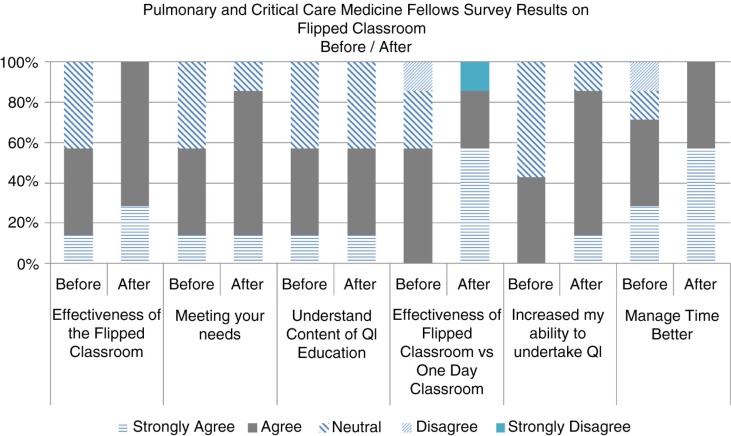
Seven trainees participated. There was a significant improvement in knowledge as measured by pre- and post-FC model test results [improvement by 40.34% (SD 16.34), p<0.001]. The survey results were overall positive about the FC model with all trainees strongly agreeing that we should continue with this model to deliver QI education.
The pilot project of using the FC model to deliver QI education was successful in a small sample of trainees.
2010年将质量改进(QI)教育纳入我们学员的必修课程后,由于教学课程过长、难以安排且导致出勤率下降,因此需要重新调整教学课程。一种用于提供QI教育的“翻转课堂”(FC)模式被认为是一种有效的教学方法,因为它允许学员在自己的时间观看教学视频,并利用课堂来澄清概念,并在包括研讨会在内的基于案例的场景中应用所学工具。
梅奥质量学院制作了29个视频,涵盖了之前每周17次的教学课程,总时长为135分钟。半天的课程澄清了与视频相关的问题,随后是案例示例以及关于如何执行和使用一些常用QI工具和方法的实践工作坊。
七名学员参加了此次课程。通过FC模式前后测试结果衡量,学员的知识水平有显著提高[提高了40.34%(标准差16.34),p<0.001]。调查结果总体上对FC模式持积极态度,所有学员都强烈同意我们应该继续采用这种模式来提供QI教育。
使用FC模式提供QI教育的试点项目在一小部分学员中取得了成功。