Kang Min Ho, Pengkit Anchalee, Choi Kihong, Jeon Seong Sil, Choi Hyo Won, Shin Dong Bum, Choi Eun Ha, Uhm Han Sup, Park Gyungsoon
Plasma Bioscience Research Center, Kwangwoon University, Seoul, 139-701, Republic of Korea.
Department of Crop Life Safety, National Academy of Agricultural Science, Suwon, 441-707, Republic of Korea.
PLoS One. 2015 Sep 25;10(9):e0139263. doi: 10.1371/journal.pone.0139263. eCollection 2015.
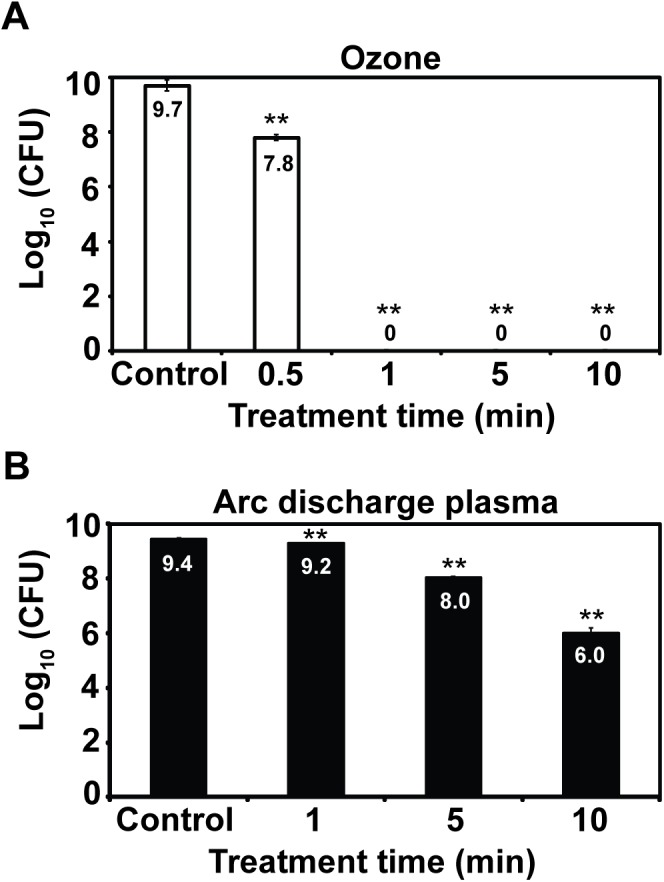
Seed sterilization is essential for preventing seed borne fungal diseases. Sterilization tools based on physical technologies have recently received much attention. However, available information is very limited in terms of efficiency, safety, and mode of action. In this study, we have examined antifungal activity of ozone and arc discharge plasma, potential tools for seed sterilization. In our results, ozone and arc discharge plasma have shown differential antifungal effects, depending on the environment associated with fungal spores (freely submerged in water or infected seeds). Ozone inactivates Fusarium fujikuroi (fungus causing rice bakanae disease) spores submerged in water more efficiently than arc discharge plasma. However, fungal spores associated with or infecting rice seeds are more effectively deactivated by arc discharge plasma. ROS generated in water by ozone may function as a powerful fungicidal factor. On the other hand, shockwave generated from arc discharge plasma may have greatly contributed to antifungal effects on fungus associated with rice seeds. In support of this notion, addition of ultrasonic wave in ozone generating water has greatly increased the efficiency of seed disinfection.
种子灭菌对于预防种传真菌病害至关重要。基于物理技术的灭菌工具近来备受关注。然而,在效率、安全性和作用方式方面,现有信息非常有限。在本研究中,我们检测了臭氧和电弧放电等离子体作为种子灭菌潜在工具的抗真菌活性。在我们的结果中,臭氧和电弧放电等离子体表现出不同的抗真菌效果,这取决于与真菌孢子相关的环境(自由浸没在水中或感染种子)。臭氧比电弧放电等离子体更有效地灭活浸没在水中的藤仓镰孢菌(引起水稻恶苗病的真菌)孢子。然而,与水稻种子相关或感染水稻种子的真菌孢子被电弧放电等离子体更有效地灭活。臭氧在水中产生的活性氧可能作为一种强大的杀菌因子发挥作用。另一方面,电弧放电等离子体产生的冲击波可能对与水稻种子相关的真菌的抗真菌效果有很大贡献。支持这一观点的是,在产生臭氧的水中添加超声波大大提高了种子消毒的效率。