Ley Benedikt, Luter Nick, Espino Fe Esperanza, Devine Angela, Kalnoky Michael, Lubell Yoel, Thriemer Kamala, Baird J Kevin, Poirot Eugenie, Conan Nolwenn, Kheong Chong Chee, Dysoley Lek, Khan Wasif Ali, Dion-Berboso April G, Bancone Germana, Hwang Jimee, Kumar Ritu, Price Ric N, von Seidlein Lorenz, Domingo Gonzalo J
Global and Tropical Health Division, Menzies School of Health Research, Charles Darwin University, PO Box 41096, Casuarina, Darwin, NT, 0811, Australia.
PATH, Diagnostics Program, Seattle, WA, USA.
Malar J. 2015 Sep 29;14:377. doi: 10.1186/s12936-015-0896-8.
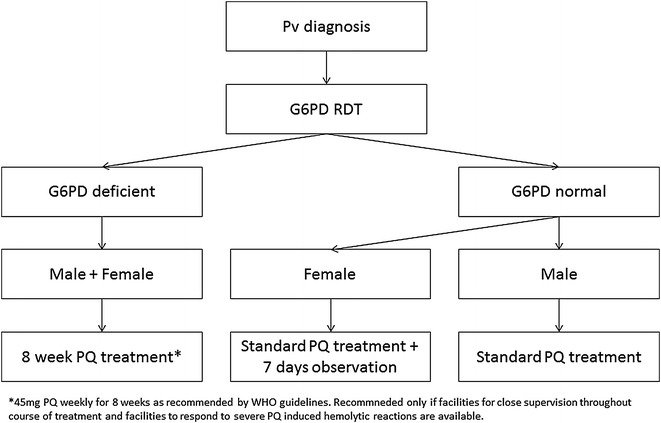
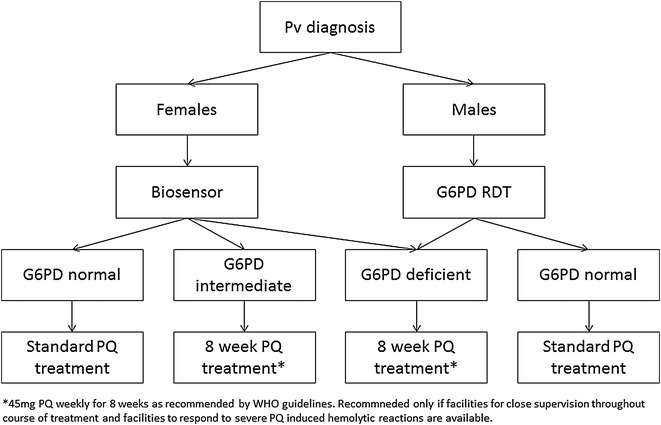
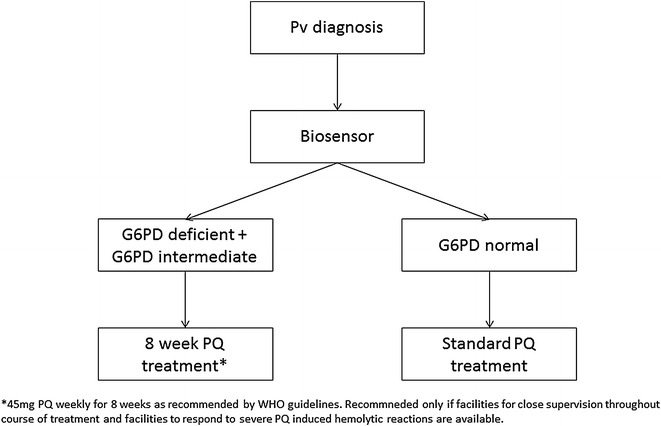
The only currently available drug that effectively removes malaria hypnozoites from the human host is primaquine. The use of 8-aminoquinolines is hampered by haemolytic side effects in glucose-6-phosphate dehydrogenase (G6PD) deficient individuals. Recently a number of qualitative and a quantitative rapid diagnostic test (RDT) format have been developed that provide an alternative to the current standard G6PD activity assays. The WHO has recently recommended routine testing of G6PD status prior to primaquine radical cure whenever possible. A workshop was held in the Philippines in early 2015 to discuss key challenges and knowledge gaps that hinder the introduction of routine G6PD testing. Two point-of-care (PoC) test formats for the measurement of G6PD activity are currently available: qualitative tests comparable to malaria RDT as well as biosensors that provide a quantitative reading. Qualitative G6PD PoC tests provide a binomial test result, are easy to use and some products are comparable in price to the widely used fluorescent spot test. Qualitative test results can accurately classify hemizygous males, heterozygous females, but may misclassify females with intermediate G6PD activity. Biosensors provide a more complex quantitative readout and are better suited to identify heterozygous females. While associated with higher costs per sample tested biosensors have the potential for broader use in other scenarios where knowledge of G6PD activity is relevant as well. The introduction of routine G6PD testing is associated with additional costs on top of routine treatment that will vary by setting and will need to be assessed prior to test introduction. Reliable G6PD PoC tests have the potential to play an essential role in future malaria elimination programmes, however require an improved understanding on how to best integrate routine G6PD testing into different health settings.
目前唯一能有效清除人体宿主体内疟原虫休眠子的药物是伯氨喹。葡萄糖-6-磷酸脱氢酶(G6PD)缺乏个体使用8-氨基喹啉会受到溶血副作用的阻碍。最近已开发出一些定性和定量的快速诊断检测(RDT)形式,为当前标准的G6PD活性检测提供了替代方法。世界卫生组织最近建议,只要有可能,在使用伯氨喹进行根治性治疗之前,应对G6PD状态进行常规检测。2015年初在菲律宾举办了一次研讨会,讨论阻碍引入常规G6PD检测的关键挑战和知识空白。目前有两种用于测量G6PD活性的即时检测(PoC)形式:与疟疾RDT类似的定性检测以及提供定量读数的生物传感器。定性G6PD PoC检测提供二项式检测结果,易于使用,一些产品价格与广泛使用的荧光斑点试验相当。定性检测结果可以准确地对半合子男性、杂合子女性进行分类,但可能会将具有中等G6PD活性的女性误分类。生物传感器提供更复杂的定量读数,更适合识别杂合子女性。虽然每个检测样本的成本较高,但生物传感器在其他与G6PD活性相关的场景中也有更广泛的应用潜力。引入常规G6PD检测除了常规治疗费用外还会产生额外费用,这将因环境而异,在引入检测之前需要进行评估。可靠的G6PD PoC检测有可能在未来的疟疾消除计划中发挥重要作用,然而需要更好地了解如何将常规G6PD检测最佳地整合到不同的卫生环境中。