Tipyasang Rungpiyada, Kunwittaya Sarun, Mukda Sujira, Kotchabhakdi Nittaya J, Kotchabhakdi Naiphinich
Research Center for Neuroscience, Institute of Molecular Biosciences, Mahidol University, Nakornpathom, Thailand.
National Institute for Child and Family Development, Mahidol University, Nakornpathom, Thailand.
EXCLI J. 2014 May 15;13:536-47. eCollection 2014.
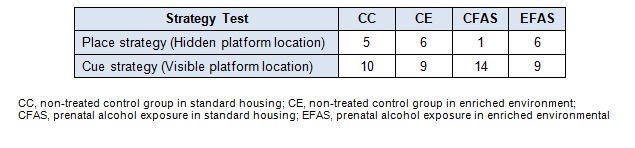
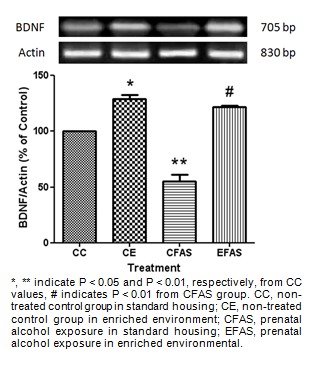
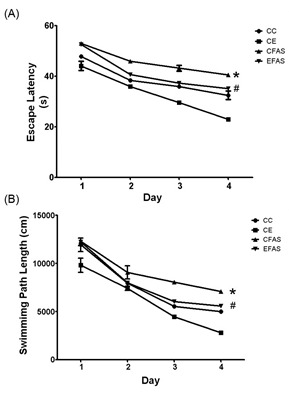
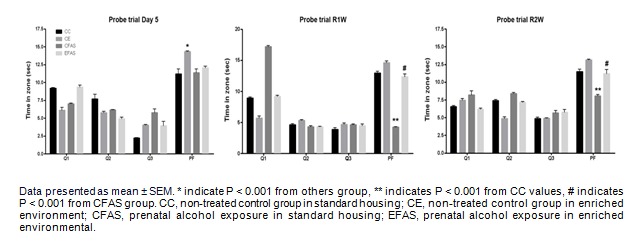
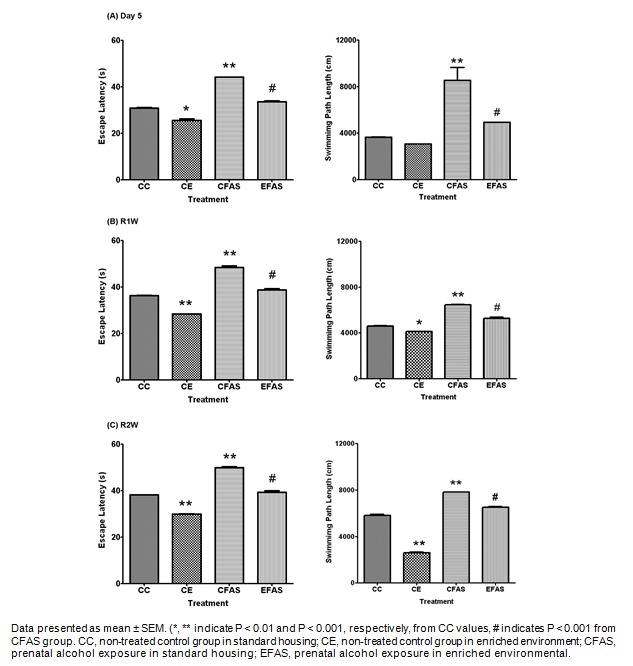
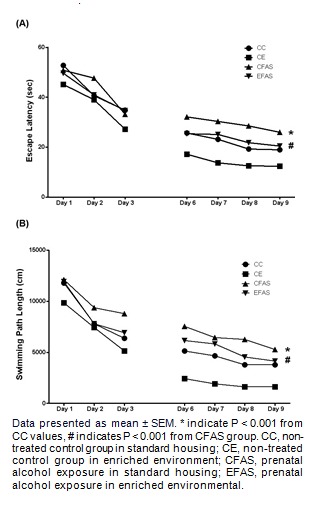
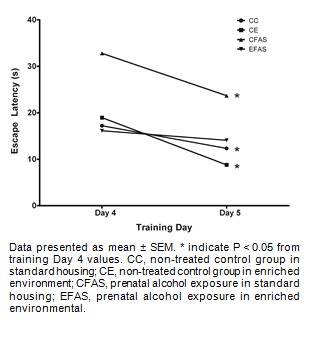
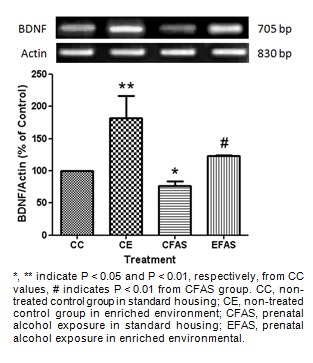
Prenatal exposure to alcohol can result in fetal alcohol syndrome (FAS), characterized by significant changes in the physiology, structural plasticity of hippocampal function, including long-term deficits in learning and memory. Environmental enrichment has long been known to improve motor and cognitive function levels, causes several neurochemical and morphological alterations in the brain. Therefore, the effects of environmental enrichment on the neurobehavioral and neurotrophic changes in mice exposed prenatally to alcohol were investigated in this study. The pregnant dams were given 25 % ethanol (w/v) or isocaloric sucrose by liquid diet from gestation day 7 to 20. After weaning on postnatal day 28, offspring were exposed to standard cage (CC, CFAS) or enriched living conditions (CE, EFAS) for 8 weeks. Neurobehavioral studies both on hippocampus-dependent spatial learning and place and cue learning strategy, a striatum-dependent test, were measured by the Morris water maze task. Moreover, the reverse-transcriptase polymerase chain reaction (RT-PCR) technique was also used in order to study the expression of brain-derived neurotrophic factor (BDNF) level in both the hippocampus and striatum of mice. Neurobehavioral studies show that animals exposed prenatally to alcohol were impaired as shown in both hippocampal-dependent spatial/place and striatal-dependent response/cue learning tests. Moreover, the levels of BDNF expression both in the hippocampus and striatum of mice were also decreased. Interestingly, environmental enrichment can ameliorate the effects of prenatal alcohol exposure both on the neurobehavioral and neurotrophic levels. These observations indicated that enriched environment attenuated memory impairment of prenatal alcohol exposure both in hippocampal and striatal circuitry.
产前暴露于酒精可导致胎儿酒精综合征(FAS),其特征为生理功能发生显著变化,海马体功能的结构可塑性也出现改变,包括学习和记忆方面的长期缺陷。长期以来,人们已知环境丰富化可改善运动和认知功能水平,并引起大脑中的多种神经化学和形态学改变。因此,本研究调查了环境丰富化对产前暴露于酒精的小鼠神经行为和神经营养变化的影响。从妊娠第7天至第20天,给怀孕的母鼠通过液体饮食给予25%乙醇(重量/体积)或等热量蔗糖。产后第28天断奶后,将后代置于标准笼(CC,CFAS)或丰富生活条件(CE,EFAS)下饲养8周。通过莫里斯水迷宫任务测量了对海马体依赖性空间学习以及地点和线索学习策略(一种纹状体依赖性测试)的神经行为研究。此外,还使用逆转录聚合酶链反应(RT-PCR)技术来研究小鼠海马体和纹状体中脑源性神经营养因子(BDNF)水平的表达。神经行为研究表明,产前暴露于酒精的动物在海马体依赖性空间/地点和纹状体依赖性反应/线索学习测试中均表现受损。此外,小鼠海马体和纹状体中的BDNF表达水平也降低。有趣的是,环境丰富化可在神经行为和神经营养水平上改善产前酒精暴露的影响。这些观察结果表明,丰富的环境减轻了产前酒精暴露对海马体和纹状体回路记忆的损害。