Sun Jianhua, Wu Xiaoliang, Meng Yunfang, Cheng Jie, Ning Houxu, Peng Yongjun, Pei Lixia, Zhang Wei
Department of Acupuncture and Rehabilitation, Affiliated Hospital of Nanjing University of Chinese Medicine, Nanjing, 210029, Jiangsu Province, China.
Chinese Medicine Hospital of Jiangsu Province, 155 Hanzhong Road, Nanjing, 210029, Jiangsu Province, China.
BMC Complement Altern Med. 2015 Sep 29;15:340. doi: 10.1186/s12906-015-0863-5.
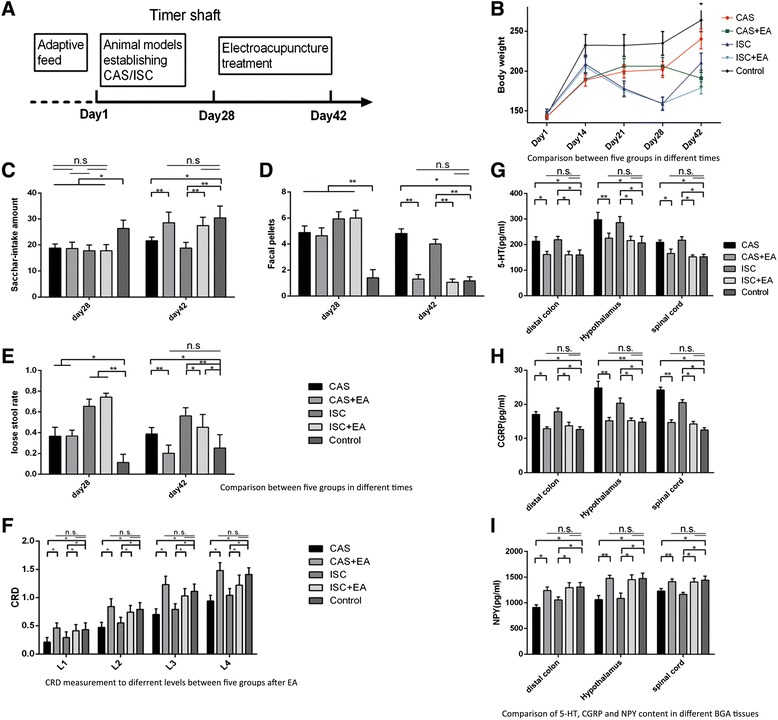
To examine whether electro-acupuncture (EA) could decrease 5-hydroxytryptamine (5-HT) and calcitonin gene-related peptide (CGRP), and increase neuro-peptide Y (NPY) in the brain-gut axis (BGA) in D-IBS using rat models.
Rats were randomly exposed to unpredictable chronic stress for 3 weeks followed by 1-hour acute restraint stress (CAS) after 7 days of rest, or daily gavage of Senna decoction (6 g/kg) plus chronic restraint stress (for a duration of 2 h, starting from 1 h prior to the gavage) for 2 weeks (ISC). The content of 5-HT, CGRP and NPY in the distal colon, spinal cord, hypothalamus was examined at the end of the treatment.
使用大鼠模型研究电针(EA)是否能降低腹泻型肠易激综合征(D-IBS)大鼠脑-肠轴(BGA)中5-羟色胺(5-HT)和降钙素基因相关肽(CGRP)的水平,并增加神经肽Y(NPY)的水平。
大鼠随机接受不可预测的慢性应激3周,休息7天后再接受1小时急性束缚应激(CAS),或每日灌胃番泻叶汤(6 g/kg)加慢性束缚应激(持续2小时,从灌胃前1小时开始)2周(ISC)。治疗结束时检测远端结肠、脊髓、下丘脑组织中5-HT、CGRP和NPY的含量。