Kennedy Jonathan, McKee Martin, King Lawrence
Department of Political Science, School of Public Policy, University College London, 29-31 Tavistock Square, London, WC1H 9QU, UK.
London School of Hygiene and Tropical Medicine, European Centre on Health of Societies in Transition, 15-17 Tavistock Place, London, WC1H 9SH, UK.
Global Health. 2015 Sep 30;11:40. doi: 10.1186/s12992-015-0123-y.
There is widespread agreement that civil war obstructs efforts to eradicate polio. It is suggested that Islamist insurgents have a particularly negative effect on vaccination programmes, but this claim is controversial.
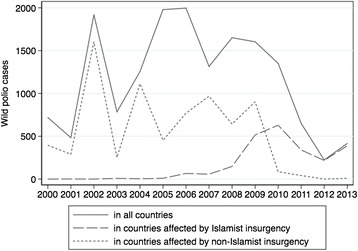
We analyse cross-national data for the period 2003-14 using negative binomial regressions to investigate the relationship between Islamist and non-Islamist insurgency and the global distribution of polio. The dependent variable is the annual number of polio cases in a country according to the WHO. Insurgency is operationalized as armed conflict between the state and an insurgent organization resulting in ≥25 battle deaths per year according to the Uppsala Conflict Data Programme. Insurgencies are divided into Islamist and non-Islamist insurgencies. We control for other possible explanatory variables.
Islamist insurgency did not have a significant positive relationship with polio throughout the whole period. But in the past few years - since the assassination of Osama bin Laden in 2011- Islamist insurgency has had a strong effect on where polio cases occur. The evidence for a relationship between non-Islamist insurgency and polio is less compelling and where there is a relationship it is either spurious or driven by ecological fallacy.
Only particular forms of internal armed conflict - those prosecuted by Islamist insurgents - explain the current global distribution of polio. The variation over time in the relationship between Islamist insurgency and polio suggests that Islamist insurgent's hostility to polio vaccinations programmes is not the result of their theology, as the core tenets of Islam have not changed over the period of the study. Rather, our analysis indicates that it is a plausibly a reaction to the counterinsurgency strategies used against Islamist insurgents. The assassination of Osama bin Laden and the use of drone strikes seemingly vindicated Islamist insurgents' suspicions that immunization drives are a cover for espionage activities.
人们普遍认为内战阻碍了根除脊髓灰质炎的努力。有人认为,伊斯兰叛乱分子对疫苗接种计划有特别负面的影响,但这一说法存在争议。
我们使用负二项回归分析2003年至2014年期间的跨国数据,以研究伊斯兰和非伊斯兰叛乱与脊髓灰质炎全球分布之间的关系。因变量是根据世界卫生组织统计的一个国家每年的脊髓灰质炎病例数。叛乱被定义为根据乌普萨拉冲突数据计划,国家与叛乱组织之间的武装冲突,每年导致至少25人死亡。叛乱分为伊斯兰叛乱和非伊斯兰叛乱。我们控制了其他可能的解释变量。
在整个时期,伊斯兰叛乱与脊髓灰质炎之间没有显著的正相关关系。但在过去几年里——自2011年奥萨马·本·拉丹被暗杀以来——伊斯兰叛乱对脊髓灰质炎病例的发生地点产生了强烈影响。非伊斯兰叛乱与脊髓灰质炎之间关系的证据不那么有说服力,而且即使有关系,要么是虚假的,要么是由生态谬误导致的。
只有特定形式的内部武装冲突——即由伊斯兰叛乱分子发动的冲突——才能解释目前脊髓灰质炎的全球分布情况。伊斯兰叛乱与脊髓灰质炎之间关系随时间的变化表明,伊斯兰叛乱分子对脊髓灰质炎疫苗接种计划的敌意并非源于他们的神学,因为在研究期间伊斯兰教的核心教义并未改变。相反,我们的分析表明,这可能是对针对伊斯兰叛乱分子的反叛乱策略的一种反应。奥萨马·本·拉丹的被暗杀和无人机袭击的使用似乎证实了伊斯兰叛乱分子的怀疑,即免疫行动是间谍活动的掩护。