Shi Jiang, Ma ChengYing, Qi DanDan, Lv HaiPeng, Yang Ting, Peng QunHua, Chen ZongMao, Lin Zhi
Key Laboratory of Tea Biology and Resource Utilization of Ministry of Agriculture, Tea Research Institute, Chinese Academy of Agricultural Sciences, 9th South Meiling Road, Hangzhou, Zhejiang, 310008, PR China.
Graduate School of Chinese Academy of Agricultural Sciences, 12 South Street of Zhongguancun, Beijing, 100081, PR China.
BMC Plant Biol. 2015 Sep 30;15:233. doi: 10.1186/s12870-015-0609-z.
Tea (Camellia sinensis) has long been consumed worldwide for its amazing flavor and aroma. Methyl jasmonate (MeJA), which acts as an effective elicitor among the plant kingdom, could mostly improve the quality of tea aroma by promoting flavor volatiles in tea leaves. Although a variety of volatile secondary metabolites that contribute to aroma quality have been identified, our understanding of the biosynthetic pathways of these compounds has remained largely incomplete. Therefore, information aboaut the transcriptome of tea leaves and, specifically, details of any changes in gene expression in response to MeJA, is required for a better understanding of the biological mechanisms of MeJA-mediated volatiles biosynthesis. Moreover, MeJA treatment could exaggerate the responses of secondary metabolites and some gene expression which offer a better chance to figure out the mechanism.
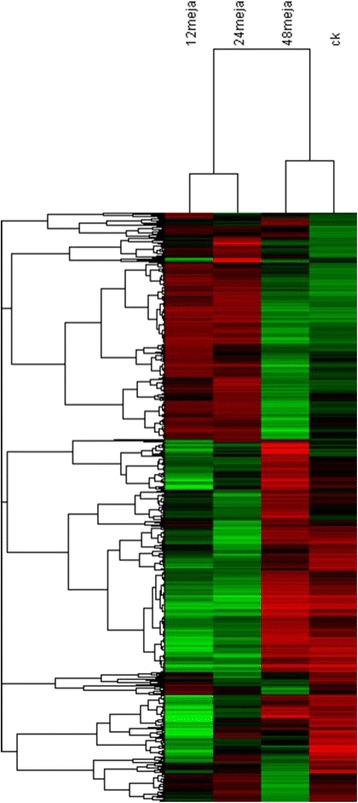
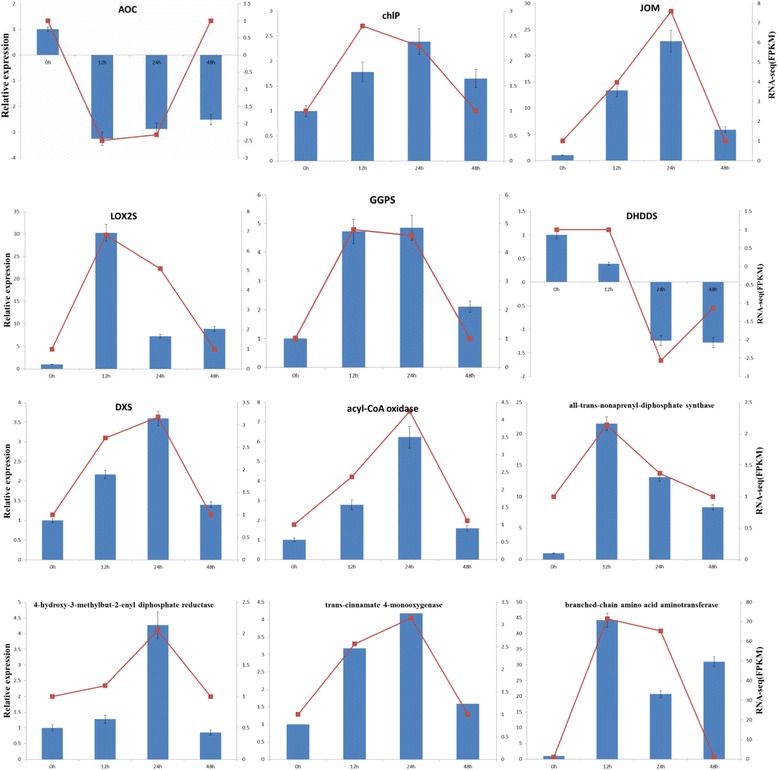
The results of two-dimensional gas-chromatograph mass-spectrometry showed that the terpenoids content in MeJA-treated tea leaves increased, especially linalool, geraniol, and phenylethyl alcohol. More importantly, we carried out RNA-seq to identify the differentially expressed genes (DEGs) related to volatiles biosynthesis pathways induced by MeJA treatment (0 h, 12 h, 24 h and 48 h) in tea leaves. We identified 19245, 18614, 11890 DEGs respectively in the MeJA_12h, MeJA_24 h and MeJA_48 h samples. The α-Lenolenic acid degradation pathway was firstly responded resulting in activating the JA-pathway inner tea leaves, and the MEP/DOXP pathway significantly exaggerated. Notably, the expression level of jasmonate O-methyltransferase, which is associated with the central JA biosynthesis pathway, was increased by 7.52-fold in MeJA_24 h tea leaves. Moreover, the genes related to the terpenoid backbone biosynthesis pathway showed different expression patterns compared with the untreated leaves. The expression levels of 1-deoxy-D-xylulose-phosphate synthase (DXS), all-trans-nonaprenyl-diphosphate synthase, geranylgeranyl reductase, geranylgeranyl diphosphate synthase (type II), hydroxymethylglutaryl-CoA reductase and 4-hydroxy-3-methylbut-2-enyl diphosphate reductase increased by approximately 2-4-fold.
The results of two-dimension gas-chromatography mass-spectrometry analysis suggested that exogenous application of MeJA could induce the levels of volatile components in tea leaves, especially the geraniol, linalool and its oxides. Moreover, the transcriptome analysis showed increased expression of genes in α-Lenolenic acid degradation pathway which produced massive jasmonic acid and quickly activated holistic JA-pathway inner tea leaves, also the terpenoid backbones biosynthesis pathway was significantly affected after MeJA treatment. In general, MeJA could greatly activate secondary metabolism pathways, especially volatiles. The results will deeply increase our understanding of the volatile metabolites biosynthesis pathways of tea leaves in response to MeJA.
长期以来,茶(茶树)因其独特的风味和香气而在全球范围内广受欢迎。茉莉酸甲酯(MeJA)作为植物界一种有效的诱导剂,能够通过促进茶叶中风味挥发物的产生来显著提升茶叶香气品质。尽管已经鉴定出多种有助于香气品质的挥发性次生代谢物,但我们对这些化合物生物合成途径的了解仍不完整。因此,为了更好地理解MeJA介导的挥发物生物合成的生物学机制,需要了解茶叶转录组信息,特别是响应MeJA时基因表达变化的细节。此外,MeJA处理可以增强次生代谢物和一些基因表达的响应,这为阐明其机制提供了更好的机会。
二维气相色谱 - 质谱分析结果表明,经MeJA处理的茶叶中萜类化合物含量增加,尤其是芳樟醇、香叶醇和苯乙醇。更重要的是,我们进行了RNA测序,以鉴定茶叶中由MeJA处理(0小时、12小时、24小时和48小时)诱导的与挥发物生物合成途径相关的差异表达基因(DEG)。我们在MeJA_12h、MeJA_24h和MeJA_48h样本中分别鉴定出19245个、18614个和11890个DEG。α-亚麻酸降解途径首先做出响应,导致茶叶内部的茉莉酸途径被激活,且MEP/DOXP途径显著增强。值得注意的是,与茉莉酸核心生物合成途径相关的茉莉酸O-甲基转移酶在MeJA_24h茶叶中的表达水平提高了7.52倍。此外,与萜类骨架生物合成途径相关的基因与未处理的叶片相比表现出不同的表达模式。1-脱氧-D-木酮糖-5-磷酸合酶(DXS)、全反式壬二烯基二磷酸合酶、香叶基香叶基还原酶、香叶基香叶基二磷酸合酶(II型)、3-羟基-3-甲基戊二酰辅酶A还原酶和4-羟基-3-甲基-2-丁烯基二磷酸还原酶的表达水平提高了约2 - 4倍。
二维气相色谱 - 质谱分析结果表明,外源施用MeJA可诱导茶叶中挥发性成分的含量增加。特别是香叶醇、芳樟醇及其氧化物。此外,转录组分析表明,α-亚麻酸降解途径中基因表达增加,该途径产生大量茉莉酸并迅速激活茶叶内部的整体茉莉酸途径,MeJA处理后萜类骨架生物合成途径也受到显著影响。总体而言,MeJA可极大地激活次生代谢途径,尤其是挥发物途径。这些结果将加深我们对茶叶响应MeJA的挥发性代谢物生物合成途径的理解。