Zaytsev Anatoly V, Grishchuk Ekaterina L
Department of Physiology, Perelman School of Medicine, University of Pennsylvania, Philadelphia, PA 19104.
Department of Physiology, Perelman School of Medicine, University of Pennsylvania, Philadelphia, PA 19104
Mol Biol Cell. 2015 Nov 5;26(22):3985-98. doi: 10.1091/mbc.E15-06-0384. Epub 2015 Sep 30.
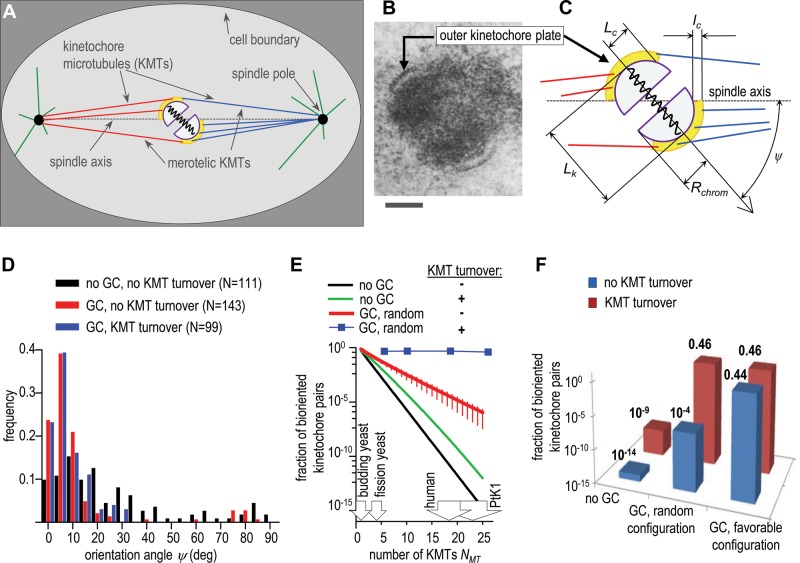
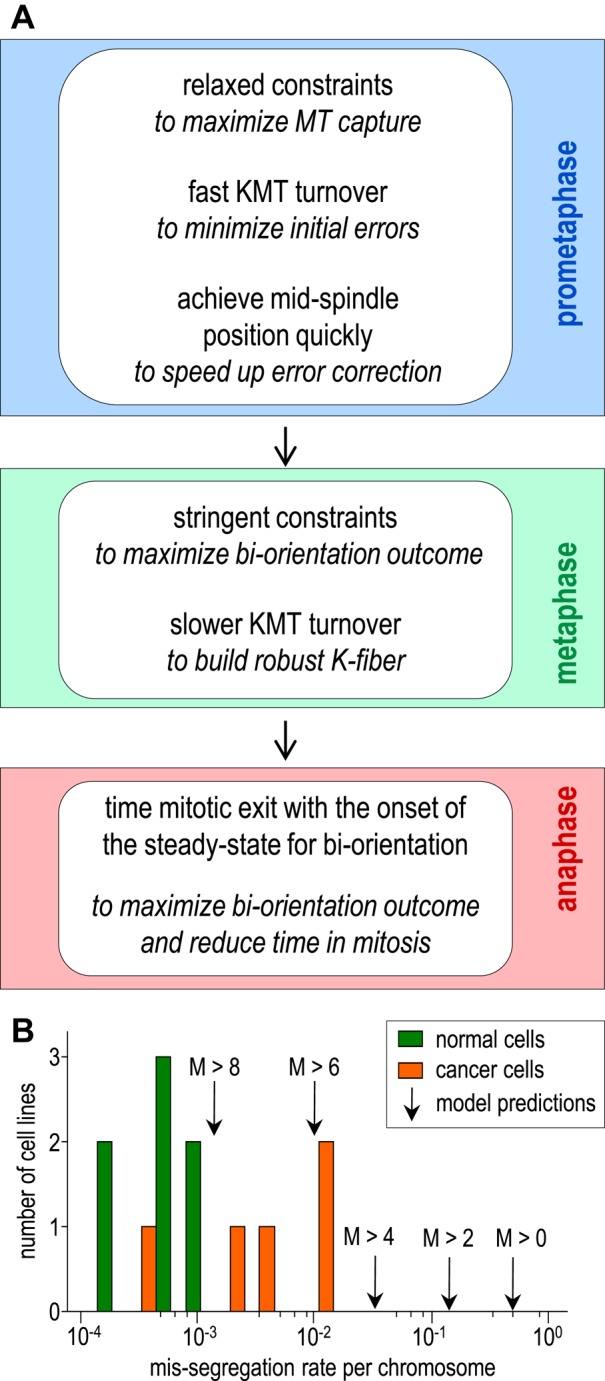
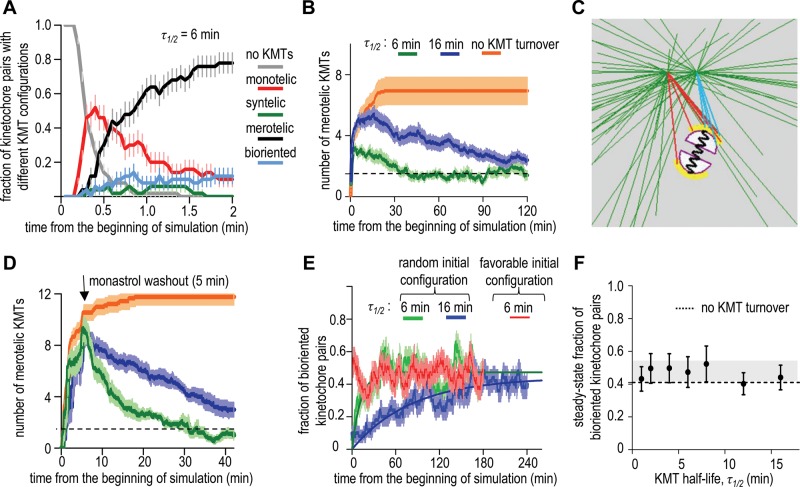
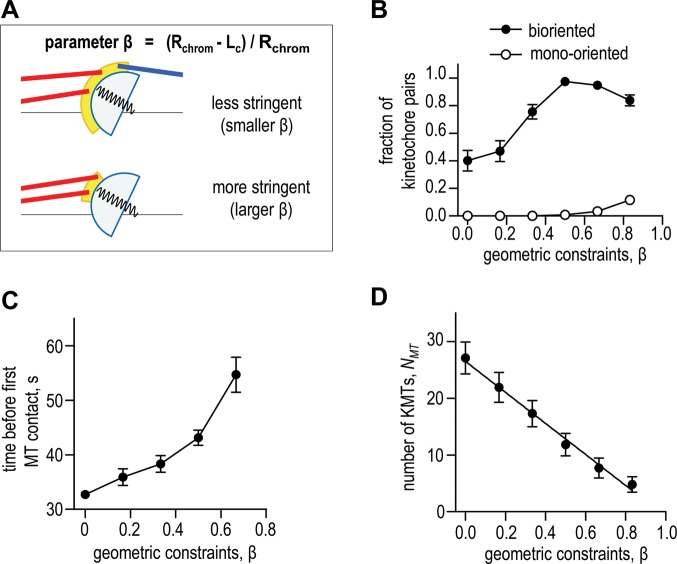
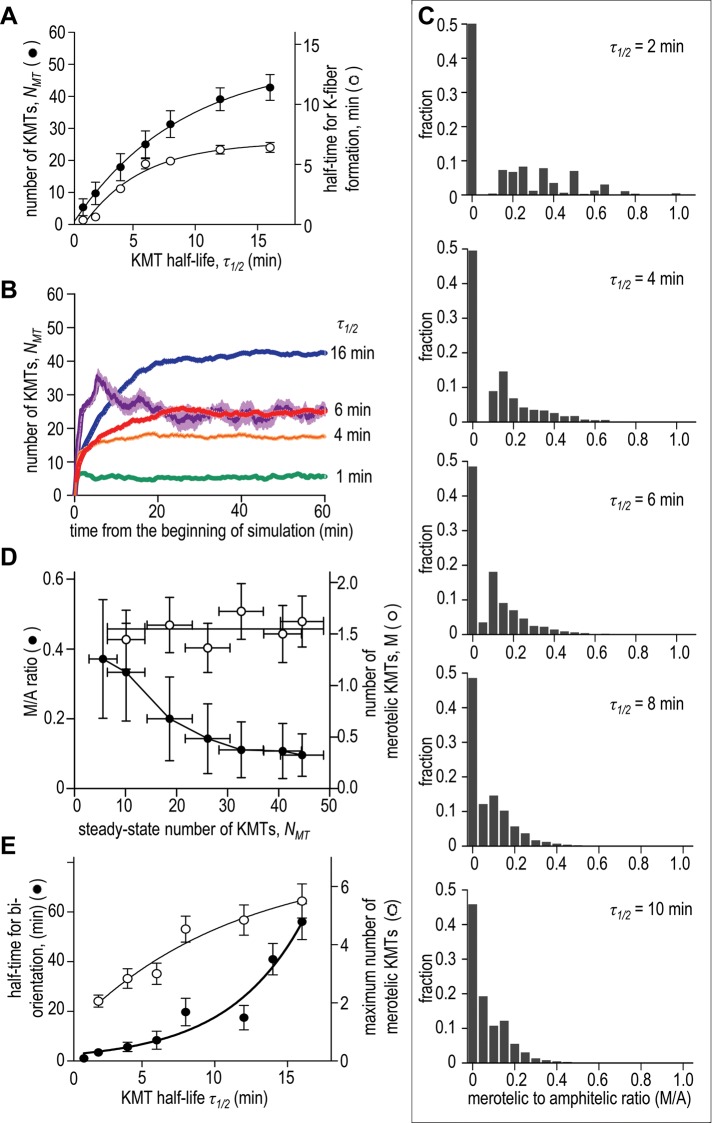
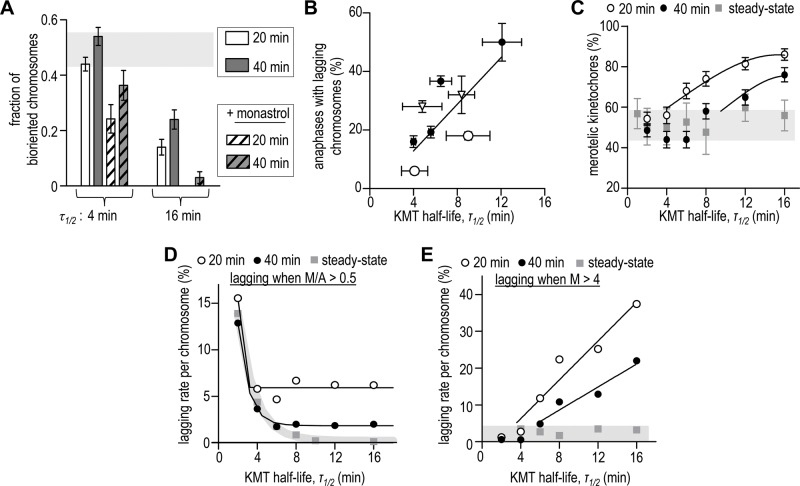
Accuracy of chromosome segregation relies on the ill-understood ability of mitotic kinetochores to biorient, whereupon each sister kinetochore forms microtubule (MT) attachments to only one spindle pole. Because initial MT attachments result from chance encounters with the kinetochores, biorientation must rely on specific mechanisms to avoid and resolve improper attachments. Here we use mathematical modeling to critically analyze the error-correction potential of a simplified biorientation mechanism, which involves the back-to-back arrangement of sister kinetochores and the marked instability of kinetochore-MT attachments. We show that a typical mammalian kinetochore operates in a near-optimal regime, in which the back-to-back kinetochore geometry and the indiscriminate kinetochore-MT turnover provide strong error-correction activity. In human cells, this mechanism alone can potentially enable normal segregation of 45 out of 46 chromosomes during one mitotic division, corresponding to a mis-segregation rate in the range of 10(-1)-10(-2) per chromosome. This theoretical upper limit for chromosome segregation accuracy predicted with the basic mechanism is close to the mis-segregation rate in some cancer cells; however, it cannot explain the relatively low chromosome loss in diploid human cells, consistent with their reliance on additional mechanisms.
染色体分离的准确性依赖于有丝分裂动粒双定向的能力,而这种能力目前还了解甚少。在此过程中,每个姐妹动粒仅与一个纺锤极形成微管(MT)附着。由于最初的MT附着是与动粒偶然相遇的结果,双定向必须依赖特定机制来避免和解决不适当的附着。在这里,我们使用数学建模来严格分析一种简化的双定向机制的纠错潜力,该机制涉及姐妹动粒的背对背排列以及动粒-MT附着的显著不稳定性。我们表明,典型的哺乳动物动粒在接近最优的状态下运作,其中背对背的动粒几何结构和不加区分的动粒-MT周转提供了强大的纠错活性。在人类细胞中,仅这一机制就有可能使46条染色体中的45条在一次有丝分裂过程中正常分离,对应于每条染色体10(-1)-10(-2)范围内的错误分离率。用基本机制预测的染色体分离准确性的这一理论上限接近某些癌细胞中的错误分离率;然而,它无法解释二倍体人类细胞中相对较低的染色体丢失率,这与它们对其他机制的依赖是一致的。