• 文献检索
  • 文档翻译
  • 深度研究
  • 学术资讯
  • Suppr Zotero 插件Zotero 插件
  • 邀请有礼
  • 套餐&价格
  • 历史记录
应用&插件
Suppr Zotero 插件Zotero 插件浏览器插件Mac 客户端Windows 客户端微信小程序
定价
高级版会员购买积分包购买API积分包
服务
文献检索文档翻译深度研究API 文档MCP 服务
关于我们
关于 Suppr公司介绍联系我们用户协议隐私条款
关注我们

Suppr 超能文献

核心技术专利:CN118964589B侵权必究
粤ICP备2023148730 号-1Suppr @ 2026

文献检索

告别复杂PubMed语法,用中文像聊天一样搜索,搜遍4000万医学文献。AI智能推荐,让科研检索更轻松。

立即免费搜索

文件翻译

保留排版,准确专业,支持PDF/Word/PPT等文件格式,支持 12+语言互译。

免费翻译文档

深度研究

AI帮你快速写综述,25分钟生成高质量综述,智能提取关键信息,辅助科研写作。

立即免费体验

计算机办公人员手臂、颈部和肩部不适的患病率及危险因素问卷的心理测量评估

Prevalence of complaints of arm, neck and shoulder among computer office workers and psychometric evaluation of a risk factor questionnaire.

作者信息

Eltayeb Shahla, Staal J Bart, Kennes Janneke, Lamberts Petra H G, de Bie Rob A

机构信息

Maastricht University, Department of Epidemiology and Caphri Research Institute, Maastricht, The Netherlands.

出版信息

BMC Musculoskelet Disord. 2007 Jul 14;8:68. doi: 10.1186/1471-2474-8-68.

DOI:10.1186/1471-2474-8-68
PMID:17629925
原文链接:https://pmc.ncbi.nlm.nih.gov/articles/PMC1952062/
Abstract

BACKGROUND

Complaints of Arm Neck and Shoulder (CANS) represent a wide range of complaints, which can differ in severity from mild, periodic symptoms to severe, chronic and debilitating conditions. They are thought to be associated with both physical and psychosocial risk factors. The measurement and identification of the various risk factors for these complaints is an important step towards recognizing (a) high risk subgroups that are relevant in profiling CANS; and (b) also for developing targeted and effective intervention plans for treatment. The purpose of the present study was to investigate the prevalence of CANS in a Dutch population of computer workers and to develop a questionnaire aimed at measuring workplace physical and psychosocial risk factors for the presence of these complaints.

METHODS

To examine potential workplace risk factors for the presence of CANS, the Maastricht Upper Extremity Questionnaire (MUEQ), a structured questionnaire, was developed and tested among 264 computer office workers of a branch office of the national social security institution in the Netherlands. The MUEQ holds 95 items covering demographic characteristics, in addition to seven main domains assessing potential risk factors with regard to (1) work station, (2) posture during work, (3) quality of break time, (4) job demands, (5) job control, and (6) social support. The MUEQ further contained some additional questions about the quality of the work environment and the presence of complaints in the neck, shoulder, upper and lower arm, elbow, hand and wrist. The prevalence rates of CANS in the past year were computed. Further, we investigated the psychometric properties of the MUEQ (i.e. factor structure and reliability).

RESULTS

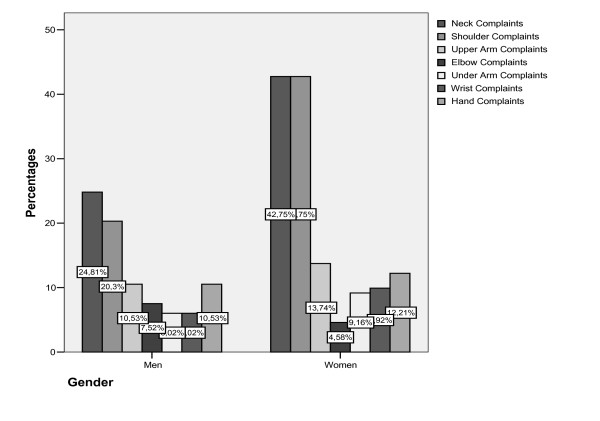
The one-year prevalence rate of CANS indicated that 54% of the respondents reported at least one complaint in the arm, neck and/or shoulder. The highest prevalence rates were found for neck and shoulder symptoms (33% and 31% respectively), followed by hand and upper arm complaints (11% to 12%) and elbow, lower arm and wrist complaints (6% to 7%). The psychometric properties of the MUEQ were assessed using exploratory factor analysis which resulted in the identification of 12 factors. The calculation of internal consistency and cross validation provided evidence of reliability and lack of redundancy of items.

CONCLUSION

Neck and shoulder complaints are more frequently reported among Dutch computer workers than arm, elbow and hand complaints. The results further indicate that the MUEQ has satisfactory reliability and internal consistency when used to document CANS among computer workers in the Netherlands.

摘要

背景

手臂、颈部和肩部不适(CANS)涵盖了广泛的不适症状,其严重程度差异很大,从轻微的周期性症状到严重的慢性致残状况不等。人们认为这些不适与身体和心理社会风险因素都有关。对这些不适的各种风险因素进行测量和识别,是识别(a)在CANS特征分析中相关的高风险亚组的重要一步;也是制定有针对性的有效治疗干预计划的重要一步。本研究的目的是调查荷兰计算机工作人群中CANS的患病率,并开发一份问卷,旨在测量这些不适存在时的工作场所身体和心理社会风险因素。

方法

为了检查CANS存在的潜在工作场所风险因素,开发了马斯特里赫特上肢问卷(MUEQ),这是一份结构化问卷,并在荷兰国家社会保障机构一个分支机构的264名计算机办公室工作人员中进行了测试。MUEQ包含95个项目,涵盖人口统计学特征,此外还有七个主要领域,评估关于(1)工作站、(2)工作时的姿势、(3)休息时间质量、(4)工作要求、(5)工作控制和(6)社会支持的潜在风险因素。MUEQ还包含一些关于工作环境质量以及颈部、肩部、上臂、下臂、肘部、手部和腕部不适情况的附加问题。计算了过去一年中CANS的患病率。此外,我们调查了MUEQ的心理测量特性(即因子结构和信度)。

结果

CANS的一年患病率表明,54%的受访者报告在手臂、颈部和/或肩部至少有一处不适。颈部和肩部症状的患病率最高(分别为33%和31%),其次是手部和上臂不适(11%至12%)以及肘部、下臂和腕部不适(6%至7%)。使用探索性因子分析评估了MUEQ的心理测量特性,结果识别出12个因子。内部一致性计算和交叉验证提供了信度证据以及项目无冗余的证据。

结论

在荷兰计算机工作人群中,颈部和肩部不适的报告频率高于手臂、肘部和手部不适。结果还表明,当用于记录荷兰计算机工作人群中的CANS时,MUEQ具有令人满意的信度和内部一致性。
https://cdn.ncbi.nlm.nih.gov/pmc/blobs/5084/1952062/8f419388bb90/1471-2474-8-68-1.jpg

相似文献

1
Prevalence of complaints of arm, neck and shoulder among computer office workers and psychometric evaluation of a risk factor questionnaire.计算机办公人员手臂、颈部和肩部不适的患病率及危险因素问卷的心理测量评估
BMC Musculoskelet Disord. 2007 Jul 14;8:68. doi: 10.1186/1471-2474-8-68.
2
Complaints of the arm, neck and shoulder among computer office workers in Sudan: a prevalence study with validation of an Arabic risk factors questionnaire.苏丹计算机办公人员的手臂、颈部和肩部不适:一项阿拉伯语风险因素问卷验证的患病率研究。
Environ Health. 2008 Jun 27;7:33. doi: 10.1186/1476-069X-7-33.
3
Work related complaints of neck, shoulder and arm among computer office workers: a cross-sectional evaluation of prevalence and risk factors in a developing country.工作相关的颈、肩和手臂抱怨在电脑办公人员中:一个发展中国家的患病率和风险因素的横断面评估。
Environ Health. 2011 Aug 4;10:70. doi: 10.1186/1476-069X-10-70.
4
Prevalence and characteristics of complaints of the arm, neck, and/or shoulder (CANS) in the open population.普通人群中手臂、颈部和/或肩部不适(CANS)的患病率及特征
Clin J Pain. 2008 Mar-Apr;24(3):253-9. doi: 10.1097/AJP.0b013e318160a8b4.
5
A validation study and psychometrical evaluation of the Maastricht Upper Extremity Questionnaire (MUEQ) for the Greek-speaking population.针对希腊语人群的马斯特里赫特上肢问卷(MUEQ)的验证研究及心理测量评估。
J Musculoskelet Neuronal Interact. 2011 Mar;11(1):52-76.
6
Work-related complaints of arm, neck and shoulder among computer office workers in an Asian country: prevalence and validation of a risk-factor questionnaire.在一个亚洲国家,电脑办公人员手臂、颈部和肩部与工作相关的抱怨:危险因素调查问卷的流行率和有效性。
BMC Musculoskelet Disord. 2011 Apr 4;12:68. doi: 10.1186/1471-2474-12-68.
7
Ergonomic risk factors among computer office workers for complaints of arm, neck and shoulder and workstation evaluation.电脑办公人员的手臂、颈部和肩部投诉的人机工程学风险因素以及工作站评估。
Work. 2022;73(1):321-326. doi: 10.3233/WOR-211029.
8
Occupational neck and shoulder pain among automobile manufacturing workers in Iran.伊朗汽车制造工人的职业性颈肩痛
Am J Ind Med. 2008 May;51(5):372-9. doi: 10.1002/ajim.20562.
9
Study on musculoskeletal complaints involving the back, neck and upper limbs.涉及背部、颈部和上肢的肌肉骨骼疾病研究。
Singapore Med J. 1998 Aug;39(8):363-7.
10
Prevalence and impact of musculoskeletal disorders in New Zealand nurses, postal workers and office workers.新西兰护士、邮政工作人员和办公室工作人员的肌肉骨骼疾病的流行率和影响。
Aust N Z J Public Health. 2009 Oct;33(5):437-41. doi: 10.1111/j.1753-6405.2009.00425.x.

引用本文的文献

1
Comparison of Cervical Spine Kinematics and Clinical Neck Symptoms Between Mobile Device and Desktop Computer Use.移动设备与台式计算机使用过程中颈椎运动学与颈部临床症状的比较
Sensors (Basel). 2025 Feb 26;25(5):1438. doi: 10.3390/s25051438.
2
Epidemiology of Chronic Shoulder Pain Among Adult Patients in a Tertiary Care Hospital in South India.印度南部一家三级护理医院成年患者慢性肩痛的流行病学
Cureus. 2024 Aug 27;16(8):e67982. doi: 10.7759/cureus.67982. eCollection 2024 Aug.
3
Psychosocial Factors and Musculoskeletal Symptoms in Office Workers: Validating the Maastricht Upper Extremity Questionnaire.

本文引用的文献

1
Should office workers spend fewer hours at their computer? A systematic review of the literature.上班族应该减少在电脑前的工作时间吗?文献的系统综述。
Occup Environ Med. 2007 Apr;64(4):211-22. doi: 10.1136/oem.2006.026468. Epub 2006 Nov 9.
2
Multidisciplinary consensus on the terminology and classification of complaints of the arm, neck and/or shoulder.关于手臂、颈部和/或肩部不适的术语和分类的多学科共识。
Occup Environ Med. 2007 May;64(5):313-9. doi: 10.1136/oem.2005.023861. Epub 2006 Oct 16.
3
Epidemiology of work related neck and upper limb problems: psychosocial and personal risk factors (part I) and effective interventions from a bio behavioural perspective (part II).
办公室职员的心理社会因素与肌肉骨骼症状:验证马斯特里赫特上肢问卷
Med J Islam Repub Iran. 2024 Mar 18;38:29. doi: 10.47176/mjiri.38.29. eCollection 2024.
4
Neck and Shoulder Pain with Scapular Dyskinesis in Computer Office Workers.电脑办公人员的颈肩部疼痛伴肩胛运动障碍。
Medicina (Kaunas). 2023 Dec 13;59(12):2159. doi: 10.3390/medicina59122159.
5
Occupational Health: Physical Activity, Musculoskeletal Symptoms and Quality of Life in Computer Workers: A Narrative Review.职业健康:计算机工作者的身体活动、肌肉骨骼症状与生活质量:一项叙述性综述
Healthcare (Basel). 2022 Dec 5;10(12):2457. doi: 10.3390/healthcare10122457.
6
The Effects of COVID-19 Lockdown on the Perception of Physical Activity and on the Perception of Musculoskeletal Symptoms in Computer Workers: Comparative Longitudinal Study Design.新冠疫情封锁对计算机工作者体力活动感知和肌肉骨骼症状感知的影响:对照纵向研究设计。
Int J Environ Res Public Health. 2022 Jun 14;19(12):7311. doi: 10.3390/ijerph19127311.
7
Ergonomic evaluation of computer workers.计算机工作者的人体工程学评估
Rev Bras Med Trab. 2021 Dec 30;19(4):445-453. doi: 10.47626/1679-4435-2021-628. eCollection 2021 Oct-Dec.
8
Prevalence and Risk Factors of Work-Related Upper Extremity Disorders among University Teaching Staff in Ethiopia, 2021: An Institution-Based Cross-Sectional Study.2021 年埃塞俄比亚大学教学人员工作相关上肢疾病的患病率和危险因素:一项基于机构的横断面研究。
Pain Res Manag. 2022 May 14;2022:7744879. doi: 10.1155/2022/7744879. eCollection 2022.
9
Tailored physiotherapeutic intervention study for musculoskeletal disorders among video display terminal users.针对视频显示终端使用者的肌肉骨骼疾病的定制理疗干预研究。
Med Lav. 2022 Apr 26;113(2):e2022012. doi: 10.23749/mdl.v113i2.12498.
10
Positive Effects of an Online Workplace Exercise Intervention during the COVID-19 Pandemic on Quality of Life Perception in Computer Workers: A Quasi-Experimental Study Design.新冠疫情期间在线工作场所运动干预对计算机工作者生活质量感知的积极影响:一项准实验研究设计。
Int J Environ Res Public Health. 2022 Mar 7;19(5):3142. doi: 10.3390/ijerph19053142.
工作相关颈部和上肢问题的流行病学:社会心理和个人风险因素(第一部分)以及从生物行为角度出发的有效干预措施(第二部分)。
J Occup Rehabil. 2006 Sep;16(3):279-302. doi: 10.1007/s10926-006-9044-1.
4
Prospective research on musculoskeletal disorders in office workers (PROMO): study protocol.办公室职员肌肉骨骼疾病前瞻性研究(PROMO):研究方案
BMC Musculoskelet Disord. 2006 Jul 5;7:55. doi: 10.1186/1471-2474-7-55.
5
Are factor analytical techniques used appropriately in the validation of health status questionnaires? A systematic review on the quality of factor analysis of the SF-36.在健康状况问卷的验证中,因素分析技术是否得到了恰当应用?关于SF-36因素分析质量的系统评价。
Qual Life Res. 2005 Jun;14(5):1203-18; dicussion 1219-21, 1223-4. doi: 10.1007/s11136-004-5742-3.
6
Psychosocial work characteristics in relation to neck and upper limb symptoms.与颈部和上肢症状相关的心理社会工作特征。
Pain. 2005 Mar;114(1-2):47-53. doi: 10.1016/j.pain.2004.12.008. Epub 2005 Jan 26.
7
Internal consistency and validity of a new physical workload questionnaire.一份新的体力劳动负荷问卷的内部一致性和效度
Occup Environ Med. 2004 Dec;61(12):980-6. doi: 10.1136/oem.2003.011213.
8
Rationale and design of a multicenter randomized controlled trial on a 'minimal intervention' in Dutch army personnel with nonspecific low back pain [ISRCTN19334317].一项针对荷兰非特异性下腰痛军队人员进行“最小干预”的多中心随机对照试验的原理与设计[国际标准随机对照试验编号:ISRCTN19334317]
BMC Musculoskelet Disord. 2004 Nov 9;5(1):40. doi: 10.1186/1471-2474-5-40.
9
Psychosocial job factors and the one-year evolution of back-related functional limitations.心理社会工作因素与背部相关功能受限的一年演变
Scand J Work Environ Health. 2004 Feb;30(1):47-55. doi: 10.5271/sjweh.764.
10
Epidemiology of musculoskeletal disorders among computer users: lesson learned from the role of posture and keyboard use.计算机用户肌肉骨骼疾病的流行病学:从姿势和键盘使用的作用中吸取的教训。
J Electromyogr Kinesiol. 2004 Feb;14(1):25-31. doi: 10.1016/j.jelekin.2003.09.014.