Kucharík Marcel, Hofacker Ivo L, Stadler Peter F, Qin Jing
Institute for Theoretical Chemistry.
Institute for Theoretical Chemistry, Research Group BCB, Faculty of Computer Science, University of Vienna, Austria, RTH, University of Copenhagen, Frederiksberg, Denmark.
Bioinformatics. 2016 Jan 15;32(2):187-94. doi: 10.1093/bioinformatics/btv572. Epub 2015 Oct 1.
The function of an RNA molecule is not only linked to its native structure, which is usually taken to be the ground state of its folding landscape, but also in many cases crucially depends on the details of the folding pathways such as stable folding intermediates or the timing of the folding process itself. To model and understand these processes, it is necessary to go beyond ground state structures. The study of rugged RNA folding landscapes holds the key to answer these questions. Efficient coarse-graining methods are required to reduce the intractably vast energy landscapes into condensed representations such as barrier trees or basin hopping graphs : BHG) that convey an approximate but comprehensive picture of the folding kinetics. So far, exact and heuristic coarse-graining methods have been mostly restricted to the pseudoknot-free secondary structures. Pseudoknots, which are common motifs and have been repeatedly hypothesized to play an important role in guiding folding trajectories, were usually excluded.
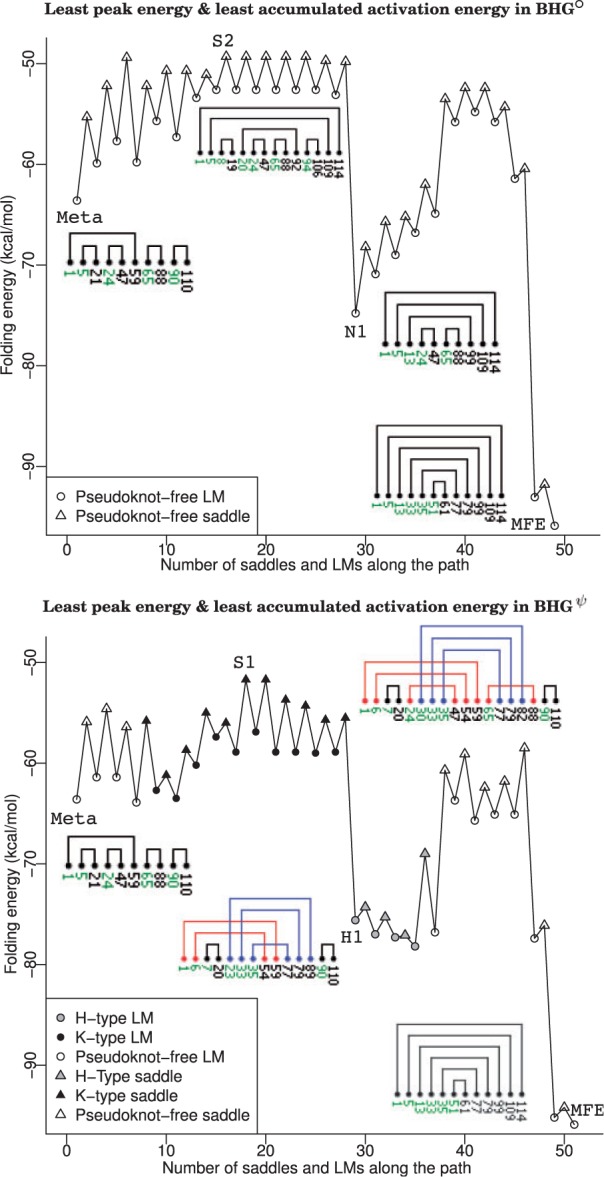
We generalize the BHG framework to include pseudoknotted RNA structures and systematically study the differences in predicted folding behavior depending on whether pseudoknotted structures are allowed to occur as folding intermediates or not. We observe that RNAs with pseudoknotted ground state structures tend to have more pseudoknotted folding intermediates than RNAs with pseudoknot-free ground state structures. The occurrence and influence of pseudoknotted intermediates on the folding pathway, however, appear to depend very strongly on the individual RNAs so that no general rule can be inferred.
The algorithms described here are implemented in C++ as standalone programs. Its source code and Supplemental material can be freely downloaded from http://www.tbi.univie.ac.at/bhg.html.
Supplementary data are available at Bioinformatics online.
RNA分子的功能不仅与其天然结构相关(通常将其视为折叠态势的基态),而且在许多情况下还关键取决于折叠途径的细节,例如稳定的折叠中间体或折叠过程本身的时间。为了对这些过程进行建模和理解,有必要超越基态结构。崎岖的RNA折叠态势研究是回答这些问题的关键。需要有效的粗粒化方法将难以处理的巨大能量态势简化为凝聚表示形式,如障碍树或盆地跳跃图(BHG),这些表示形式传达了折叠动力学的近似但全面的图景。到目前为止,精确和启发式的粗粒化方法大多局限于无假结的二级结构。假结是常见基序,并且多次被假设在引导折叠轨迹中起重要作用,但通常被排除在外。
我们将BHG框架推广到包括有假结的RNA结构,并系统地研究了根据是否允许有假结结构作为折叠中间体而预测的折叠行为差异。我们观察到,具有有假结基态结构的RNA往往比具有无假结基态结构的RNA有更多有假结的折叠中间体。然而,有假结中间体在折叠途径上的出现和影响似乎非常强烈地取决于单个RNA,因此无法推断出一般规则。
这里描述的算法用C++实现为独立程序。其源代码和补充材料可从http://www.tbi.univie.ac.at/bhg.html免费下载。
补充数据可在《生物信息学》在线获取。