Sun Xuezheng, Nichols Hazel B, Robinson Whitney, Sherman Mark E, Olshan Andrew F, Troester Melissa A
Department of Epidemiology, CB 7435, University of North Carolina at Chapel Hill, Chapel Hill, NC, 27599, USA.
Lineberger Comprehensive Cancer Center, University of North Carolina at Chapel Hill, Chapel Hill, NC, USA.
Cancer Causes Control. 2015 Dec;26(12):1803-11. doi: 10.1007/s10552-015-0673-6. Epub 2015 Oct 1.
Adiposity has been linked with increased breast cancer risk and mortality. It is established that etiologic associations for adiposity vary by tumor subtype, but the influence of adiposity on subtype-specific survival is unknown.
Study participants were 1,109 invasive breast cancer participants in the population-based Carolina Breast Cancer Study, diagnosed between 1993 and 2001, and with tissue blocks available for immunohistochemical subtyping. General and central adiposities were assessed by body mass index (BMI) and waist-to-hip ratio (WHR), respectively, based on in-person measurements after diagnosis. Vital status as of 2011 was determined using the National Death Index (median follow-up = 13.5 years). Cox proportional hazards models were used to calculate hazard ratios (HRs) and 95% confidence intervals (CIs) for breast cancer (BC)-specific and all-cause mortalities.
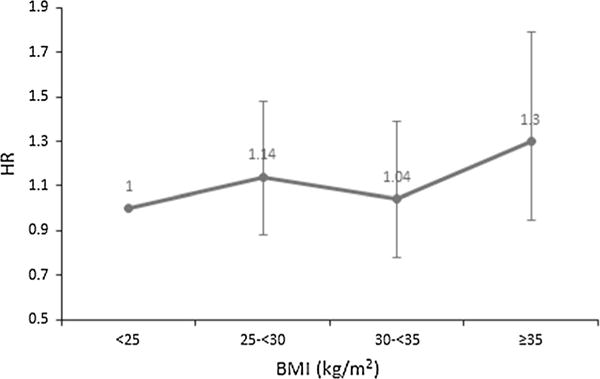
Among all patients, high WHR (≥0.84), but not BMI, was associated with all-cause mortality (adjusted HR 1.50, 95% CI 1.11-2.05, <0.77 as reference). No significant association between adiposity and BC-specific mortality was detected, although there was a suggestion of increased mortality risk among high-BMI (≥30 kg/m(2)) patients with basal-like tumors (adjusted HR 2.44, 95% CI 0.97-6.12, <25 kg/m(2) as reference). Quantitative differences in all-cause mortality were observed by subtype, with BMI associated with basal-like mortality and WHR associated with luminal mortality. The associations were attenuated by tumor characteristics.
Our study confirms the association of adiposity and unfavorable overall survival in breast cancer patients and suggests that this association may vary by intrinsic subtype and adiposity measure.
肥胖与乳腺癌风险及死亡率增加有关。已知肥胖的病因关联因肿瘤亚型而异,但肥胖对特定亚型生存率的影响尚不清楚。
研究参与者为基于人群的卡罗来纳乳腺癌研究中的1109例浸润性乳腺癌患者,于1993年至2001年确诊,且有组织块可用于免疫组化亚型分类。分别根据诊断后亲自测量的体重指数(BMI)和腰臀比(WHR)评估总体肥胖和中心性肥胖。使用国家死亡指数确定截至2011年的生命状态(中位随访时间 = 13.5年)。采用Cox比例风险模型计算乳腺癌(BC)特异性死亡率和全因死亡率的风险比(HR)及95%置信区间(CI)。
在所有患者中,高WHR(≥0.84)而非BMI与全因死亡率相关(调整后HR 1.50,95% CI 1.11 - 2.05,以<0.77为参照)。未检测到肥胖与BC特异性死亡率之间存在显著关联,尽管有迹象表明高BMI(≥30 kg/m²)的基底样肿瘤患者死亡风险增加(调整后HR 2.44,95% CI 0.97 - 6.12,以<25 kg/m²为参照)。按亚型观察到全因死亡率存在定量差异,BMI与基底样死亡率相关,WHR与管腔型死亡率相关。这些关联因肿瘤特征而减弱。
我们的研究证实了肥胖与乳腺癌患者不良总生存之间的关联,并表明这种关联可能因内在亚型和肥胖测量指标而异。