Kim Kyuhee, Son Daegu, Kim Jinhee
Department of Plastic and Reconstructive Surgery, Keimyung University Dongsan Medical Center, Keimyung University School of Medicine, Daegu, Korea.
Department of Radiation Oncology, Keimyung University Dongsan Medical Center, Keimyung University School of Medicine, Daegu, Korea.
Arch Plast Surg. 2015 Sep;42(5):588-95. doi: 10.5999/aps.2015.42.5.588. Epub 2015 Sep 15.
Radiotherapy treatment after keloidectomy is known to be an effective method for reducing the rate of recurrence. However, to date, the appropriate total radiation dose and fractionation have not yet been confirmed. The authors performed a retrospective analysis to identify the appropriate radiation dose and fractionation in post-keloidectomy radiotherapy.
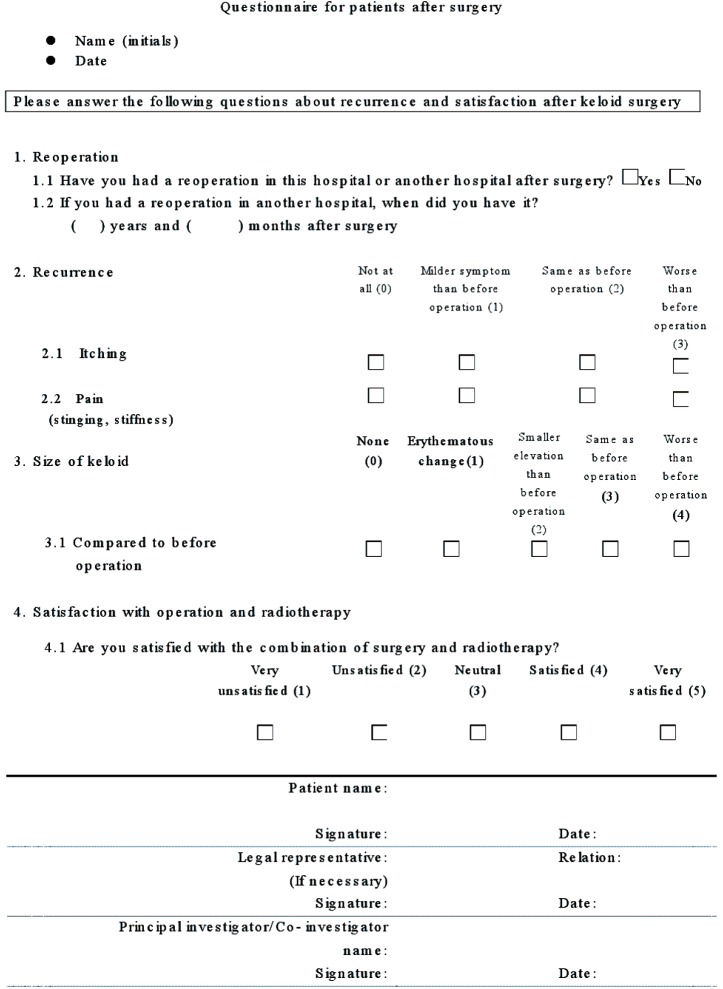
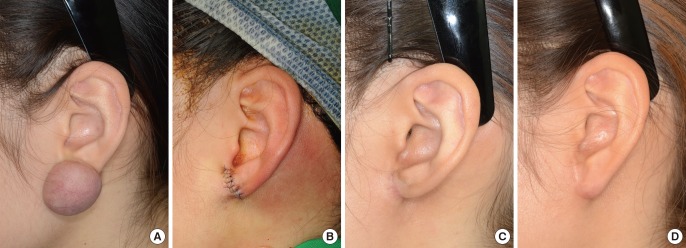
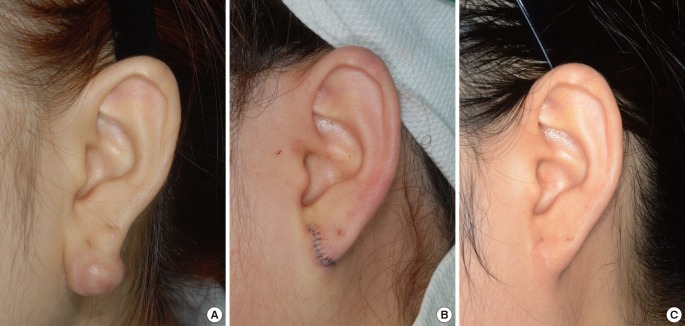
From May 2000 to February 2011, postoperative radiotherapy was performed on 39 lesions in 28 patients after total keloidectomy. The keloid lesions were confined to the ear lobes. Between May 2000 and May 2004, 14 keloids were treated with surgical excision, followed by a total radiation dose of 1,200 cGy in three fractions over four to five days (group 1). Between June 2004 to February 2011, 25 keloids were treated with surgical excision, followed by a total radiation dose of 1,500 cGy in three fractions over four to five days (group 2). Patients were given a survey asking them to report their experiences regarding reoperation, recurrence of symptoms, recurrence of the lesion, and satisfaction with the operation.
Of the 28 patients who were treated, 20 underwent follow-up. Group 2 had more cases showing elevation with erythematous changes, whereas group 1 had more cases showing progressive stages of elevation than group 2. These differences were statistically significant. Moreover, a correlation was observed between the level of keloid elevation and the extent of symptoms.
We suggest 1,500 cGy of radiation in three fractions following keloidectomy for ear lobe keloids. A further randomized study is needed to assess the recurrence of keloids after radiotherapy.
瘢痕疙瘩切除术后进行放射治疗是降低复发率的有效方法。然而,迄今为止,合适的总辐射剂量和分割方式尚未得到证实。作者进行了一项回顾性分析,以确定瘢痕疙瘩切除术后放射治疗的合适辐射剂量和分割方式。
2000年5月至2011年2月,对28例患者的39个瘢痕疙瘩病变进行了全切除术后放射治疗。瘢痕疙瘩病变局限于耳廓。2000年5月至2004年5月,14个瘢痕疙瘩采用手术切除,随后在4至5天内分3次给予总辐射剂量1200 cGy(第1组)。2004年6月至2011年2月,25个瘢痕疙瘩采用手术切除,随后在4至5天内分3次给予总辐射剂量1500 cGy(第2组)。对患者进行了一项调查,要求他们报告有关再次手术、症状复发、病变复发以及对手术满意度的经历。
在接受治疗的28例患者中,20例接受了随访。第2组出现红斑性改变隆起的病例更多,而第1组出现隆起进展期的病例比第2组更多。这些差异具有统计学意义。此外,观察到瘢痕疙瘩隆起程度与症状程度之间存在相关性。
我们建议对耳垂瘢痕疙瘩切除术后分3次给予1500 cGy的辐射。需要进一步进行随机研究以评估放射治疗后瘢痕疙瘩的复发情况。