Zhang Yiming, Zhang Ming, Yuan Xiaosong, Zhang Zhichen, Zhang Ping, Chao Haojie, Jiang Lixia, Jiang Jian
Department of Clinical Laboratory, Changzhou Maternal and Child Health Care Hospital Affiliated to Nanjing Medical University, Changzhou, Jiangsu, China (mainland).
Jing Jiang College Affiliated to Jiang Su University, Zhengjiang, Jiangsu, China (mainland).
Med Sci Monit. 2015 Oct 4;21:2986-96. doi: 10.12659/MSM.894010.
Breast cancer is one of the leading causes of cancer-related deaths for women. Numerous studies have shown that single-nucleotide polymorphisms (SNPs) on the ESR1 gene are associated to this disease. However, data and conclusions are inconsistent and controversial.
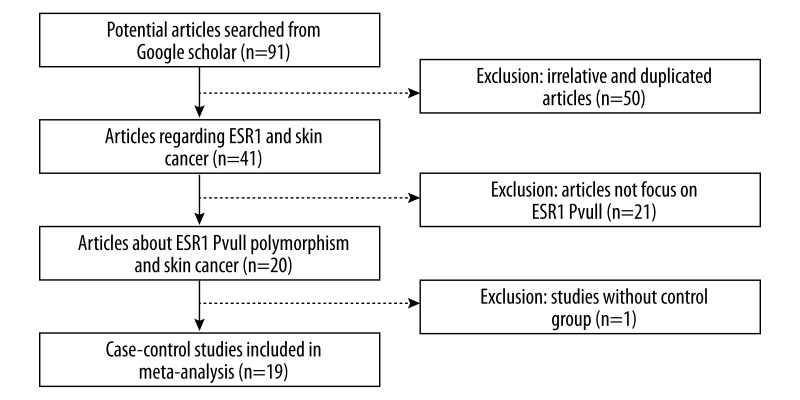
To investigate the association between PvuII (rs2234693), XbaI (rs9340799) and P325P (rs1801132) polymorphisms of ESR1 gene with the risk of breast cancer under different population categorizations, we searched multiple databases for data collection, and performed the meta-analysis on a total of 25 case-control studies. Three different comparison models - dominant model, recessive model, and homozygote comparison model - were applied to evaluate the association.
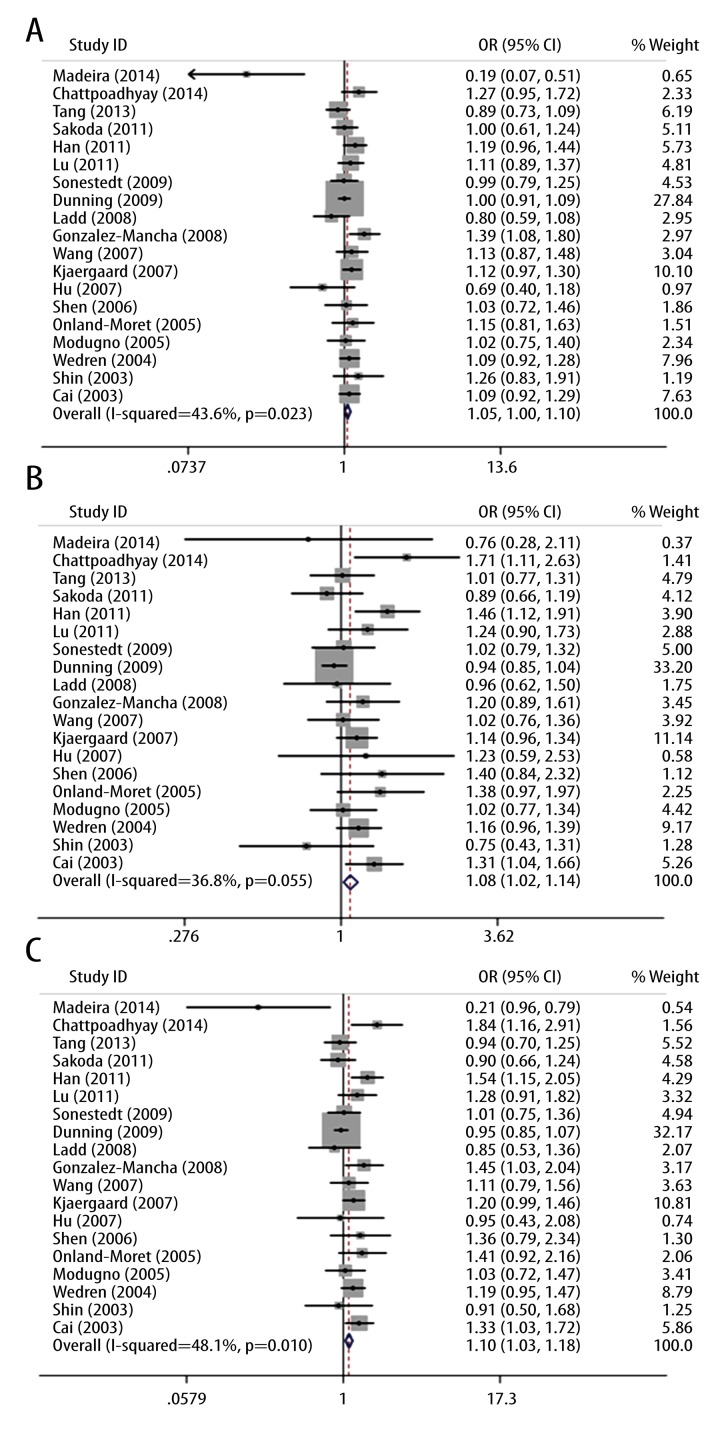
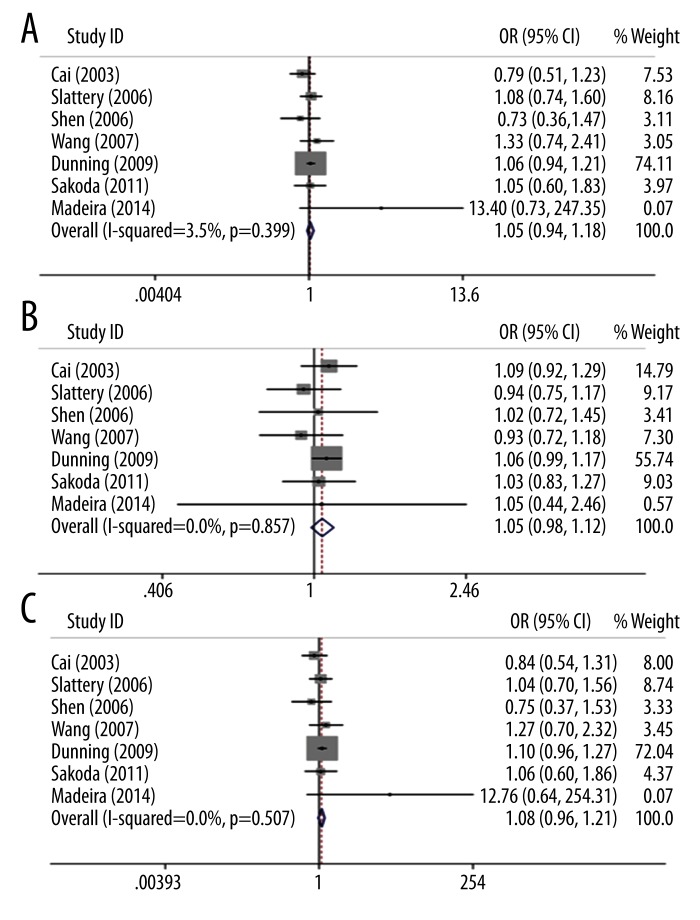
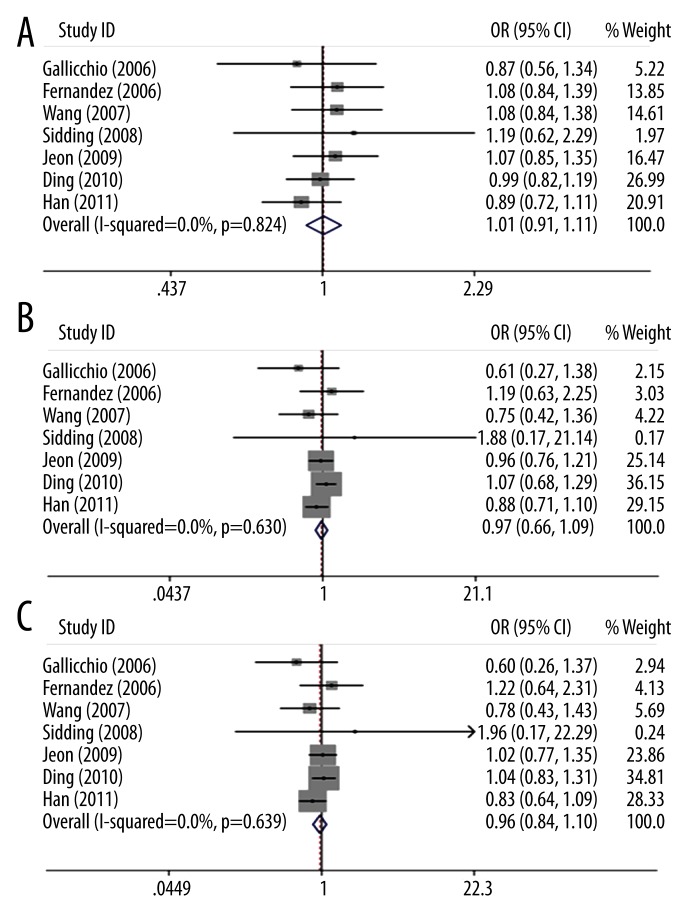
Our results indicated that people with TT+TC or TT genotype were at a greater risk of developing breast cancer than those with CC genotype in the PvuII polymorphism. While for XbaI and P325P polymorphisms, no significance was found using any of the 3 models. Furthermore, the data were also stratified into different subgroups according to the ethnicity (white or Asian) and source of controls (hospital-based or population-based), and separate analyses were conducted to assess the association. The ethnicity subgroup assessment showed that the higher risk of breast cancer for TT genotype of PvuII polymorphism than CC genotype only occurred in Asian people, but not in white populations. For the source-stratified subgroup analysis, significant association suggested that people with TT + TC genotype were at a greater risk of developing breast cancer than those with CC genotype in the hospital-based subgroup.
Thus, this meta-analysis clarified the inconsistent conclusions from previous studies, conducted analyses for the entire population as well as for different subgroups using diverse population categorization strategies, and has the potential to help provide a personalized risk estimate for breast cancer susceptibility.
乳腺癌是女性癌症相关死亡的主要原因之一。大量研究表明,雌激素受体1(ESR1)基因上的单核苷酸多态性(SNP)与该疾病相关。然而,数据和结论并不一致且存在争议。
为了研究ESR1基因的PvuII(rs2234693)、XbaI(rs9340799)和P325P(rs1801132)多态性与不同人群分类下乳腺癌风险之间的关联,我们检索了多个数据库进行数据收集,并对总共25项病例对照研究进行了荟萃分析。应用三种不同的比较模型——显性模型、隐性模型和纯合子比较模型——来评估这种关联。
我们的结果表明,在PvuII多态性中,TT + TC或TT基因型的人患乳腺癌的风险高于CC基因型的人。而对于XbaI和P325P多态性,使用这三种模型中的任何一种均未发现显著差异。此外,数据还根据种族(白人或亚洲人)和对照来源(基于医院或基于人群)分层为不同亚组,并进行单独分析以评估关联。种族亚组评估显示,PvuII多态性的TT基因型患乳腺癌的风险高于CC基因型仅在亚洲人群中出现,而在白人人群中未出现。对于来源分层亚组分析,显著关联表明,在基于医院的亚组中,TT + TC基因型的人患乳腺癌的风险高于CC基因型的人。
因此,这项荟萃分析澄清了先前研究中不一致的结论,使用不同的人群分类策略对整个人群以及不同亚组进行了分析,并且有可能有助于为乳腺癌易感性提供个性化的风险评估。