Ibelings Bas W, Backer Lorraine C, Kardinaal W Edwin A, Chorus Ingrid
Institute F.-A. Forel and Institute of Environmental Sciences University of Geneva, 10 Route de Suisse, 1290 Versoix, Switzerland.
National Center for Environmental Health, 4770 Buford Highway NE, MS F-57, Chamblee, GA 30341, USA.
Harmful Algae. 2015 Dec;49:63-74. doi: 10.1016/j.hal.2014.10.002.
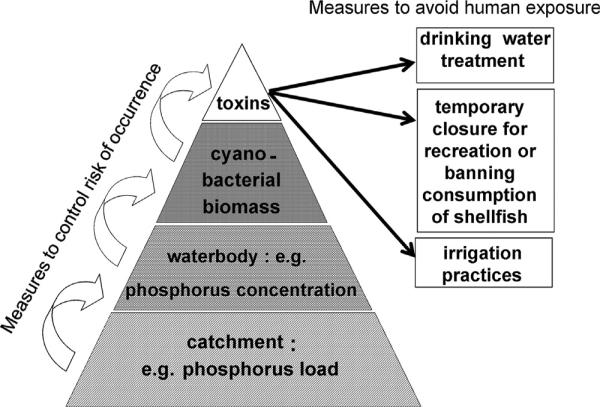
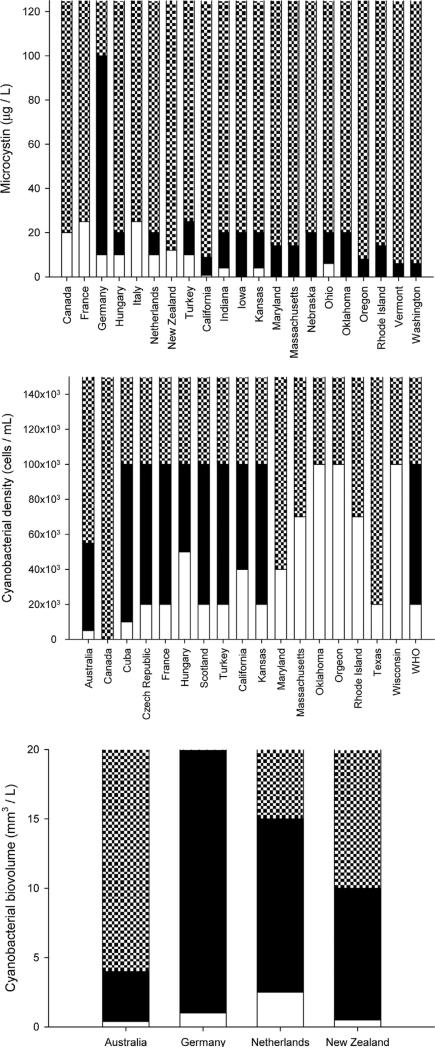
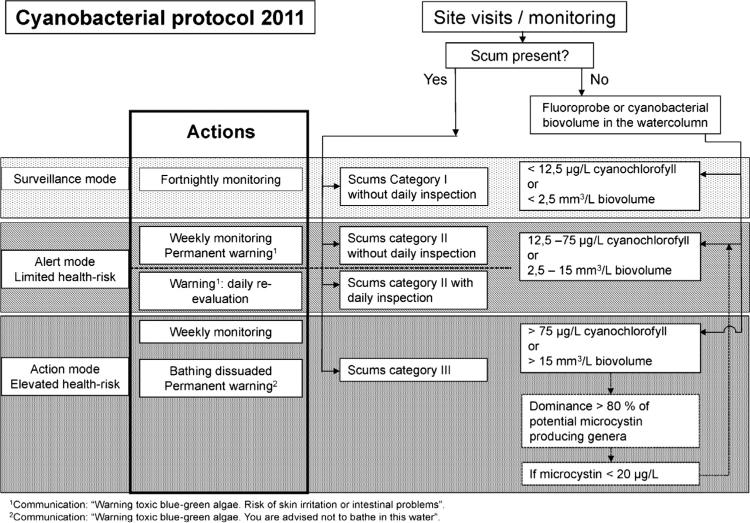
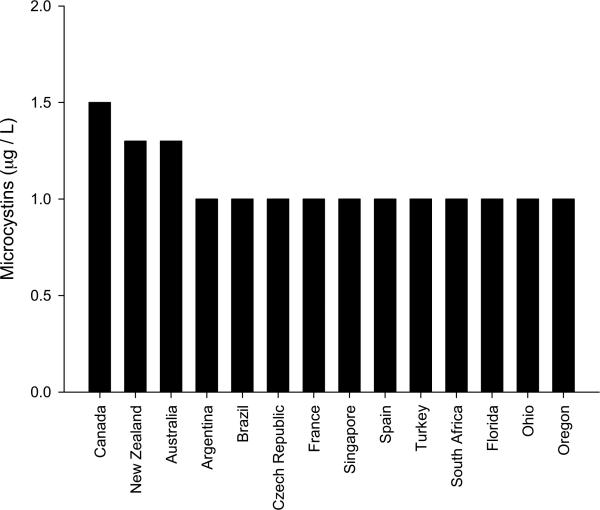
Toxic cyanobacteria became more widely recognized as a potential health hazard in the 1990s, and in 1998 the World Health Organization (WHO) first published a provisional Guideline Value of 1 μg L for microcystin-LR in drinking-water. In this publication we compare risk assessment and risk management of toxic cyanobacteria in 17 countries across all five continents. We focus on the three main (oral) exposure vehicles to cyanotoxins: drinking-water, water related recreational and freshwater seafood. Most countries have implemented the provisional WHO Guideline Value, some as legally binding standard, to ensure the distribution of safe drinking-water with respect to microcystins. Regulation, however, also needs to address the possible presence of a wide range of other cyanotoxins and bioactive compounds, for which no guideline values can be derived due to insufficient toxicological data. The presence of microcystins (commonly expressed as microcystin-LR equivalents) may be used as proxy for overall guidance on risk management, but this simplification may miss certain risks, for instance from dissolved fractions of cylindrospermopsin and cyanobacterial neurotoxins. An alternative approach, often taken for risk assessment and management in recreational waters, is to regulate cyanobacterial presence - as cell numbers or biomass - rather than individual toxins. Here, many countries have implemented a two or three tier alert level system with incremental severity. These systems define the levels where responses are switched from Surveillance to Alert and finally to Action Mode and they specify the short-term actions that follow. Surface bloom formation is commonly judged to be a significant risk because of the elevated concentration of microcystins in a scum. Countries have based their derivations of legally binding standards, guideline values, maximally allowed concentrations (or limits named otherwise) on very similar scientific methodology, but underlying assumptions such as bloom duration, average body size and the amount of water consumed while swimming vary according to local circumstances. Furthermore, for toxins with incomplete toxicological data elements of expert judgment become more relevant and this also leads to a larger degree of variation between countries' thresholds triggering certain actions. Cyanobacterial blooms and their cyanotoxin content are a highly variable phenomenon, largely depending on local conditions, and likely concentrations can be assessed and managed best if the specific conditions of the locality are known and their impact on bloom occurrence are understood. Risk Management Frameworks, such as for example the Water Safety Plan concept of the WHO and the 'bathing water profile' of the European Union are suggested to be effective approaches for preventing human exposure by managing toxic cyanobacteria from catchment to consumer for drinking water and at recreational sites.
有毒蓝藻细菌在20世纪90年代被更广泛地认为是一种潜在的健康危害,1998年世界卫生组织(WHO)首次发布了饮用水中微囊藻毒素-LR的临时准则值为1微克/升。在本出版物中,我们比较了五大洲17个国家对有毒蓝藻细菌的风险评估和风险管理。我们重点关注蓝藻毒素的三种主要(经口)暴露途径:饮用水、与水有关的娱乐活动和淡水海鲜。大多数国家已实施世卫组织的临时准则值,有些作为具有法律约束力的标准,以确保供应不含微囊藻毒素的安全饮用水。然而,监管还需要应对可能存在的多种其他蓝藻毒素和生物活性化合物,由于毒理学数据不足,无法得出这些物质的准则值。微囊藻毒素(通常以微囊藻毒素-LR当量表示)的存在可作为风险管理总体指导的替代指标,但这种简化可能会遗漏某些风险,例如来自柱孢藻毒素和蓝藻神经毒素溶解部分的风险。在娱乐用水的风险评估和管理中,通常采用的另一种方法是对蓝藻细菌的存在情况(以细胞数量或生物量表示)进行监管,而不是对个别毒素进行监管。在此,许多国家实施了两级或三级警报级别系统,其严重程度逐步增加。这些系统定义了应对措施从监测切换到警报并最终切换到行动模式的级别,并规定了随后的短期行动。表面水华的形成通常被认为是一个重大风险,因为浮沫中微囊藻毒素的浓度升高。各国在推导具有法律约束力的标准、准则值、最大允许浓度(或以其他名称命名的限值)时,所依据的科学方法非常相似,但诸如水华持续时间、平均体型以及游泳时消耗的水量等基本假设因当地情况而异。此外,对于毒理学数据不完整的毒素,专家判断的因素变得更加重要,这也导致各国触发某些行动的阈值之间存在更大程度的差异。蓝藻水华及其蓝藻毒素含量是一种高度可变的现象,很大程度上取决于当地条件,如果了解当地的具体条件及其对水华发生的影响,就能够最好地评估和管理可能的浓度。建议采用风险管理框架,例如世卫组织的水安全计划概念和欧盟的“沐浴水概况”,作为通过管理从集水区到消费者的饮用水和娱乐场所的有毒蓝藻细菌来预防人类接触的有效方法。