Varshney Gaurav K, Zhang Suiyuan, Pei Wuhong, Adomako-Ankomah Ashrifia, Fohtung Jacob, Schaffer Katherine, Carrington Blake, Maskeri Anoo, Slevin Claire, Wolfsberg Tyra, Ledin Johan, Sood Raman, Burgess Shawn M
Translational and Functional Genomics Branch, National Human Genome Research Institute, National Institutes of Health, Bethesda, MD 20892, USA.
Computational and Statistical Genomics Branch, National Human Genome Research Institute, National Institutes of Health, Bethesda, MD 20892, USA.
Nucleic Acids Res. 2016 Jan 4;44(D1):D822-6. doi: 10.1093/nar/gkv998. Epub 2015 Oct 4.
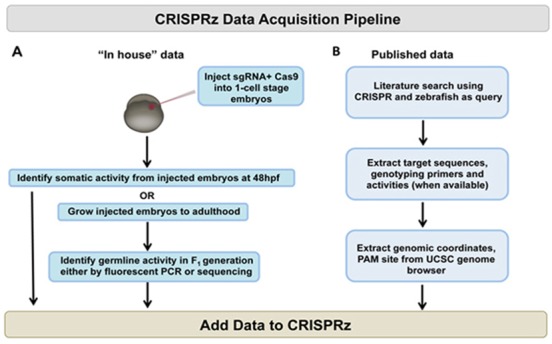
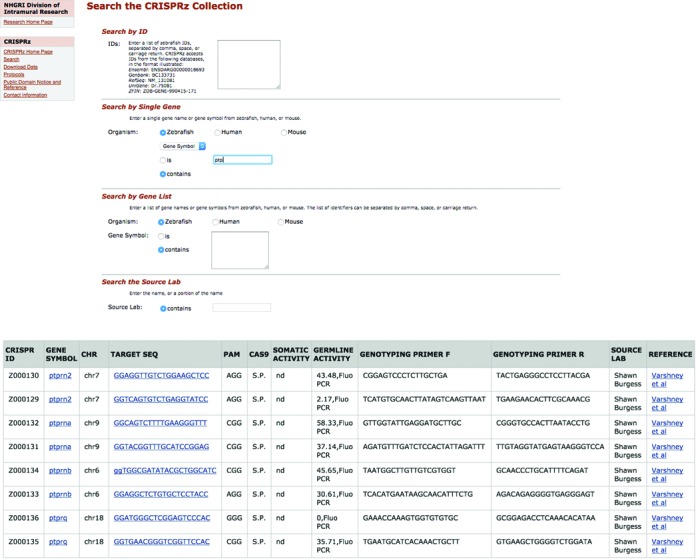
CRISPRz (http://research.nhgri.nih.gov/CRISPRz/) is a database of CRISPR/Cas9 target sequences that have been experimentally validated in zebrafish. Programmable RNA-guided CRISPR/Cas9 has recently emerged as a simple and efficient genome editing method in various cell types and organisms, including zebrafish. Because the technique is so easy and efficient in zebrafish, the most valuable asset is no longer a mutated fish (which has distribution challenges), but rather a CRISPR/Cas9 target sequence to the gene confirmed to have high mutagenic efficiency. With a highly active CRISPR target, a mutant fish can be quickly replicated in any genetic background anywhere in the world. However, sgRNA's vary widely in their activity and models for predicting target activity are imperfect. Thus, it is very useful to collect in one place validated CRISPR target sequences with their relative mutagenic activities. A researcher could then select a target of interest in the database with an expected activity. Here, we report the development of CRISPRz, a database of validated zebrafish CRISPR target sites collected from published sources, as well as from our own in-house large-scale mutagenesis project. CRISPRz can be searched using multiple inputs such as ZFIN IDs, accession number, UniGene ID, or gene symbols from zebrafish, human and mouse.