Rocque Rhea, Leanza Yvan
School of Psychology, Laval University, Quebec City, Quebec, Canada.
PLoS One. 2015 Oct 6;10(10):e0139577. doi: 10.1371/journal.pone.0139577. eCollection 2015.
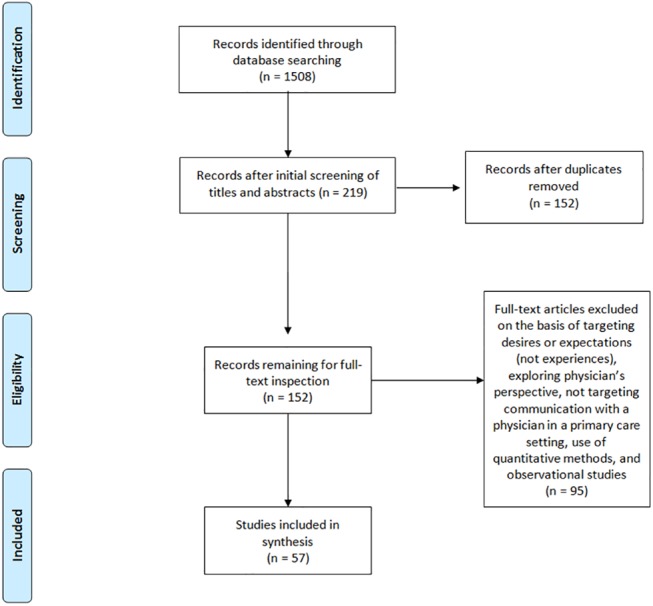
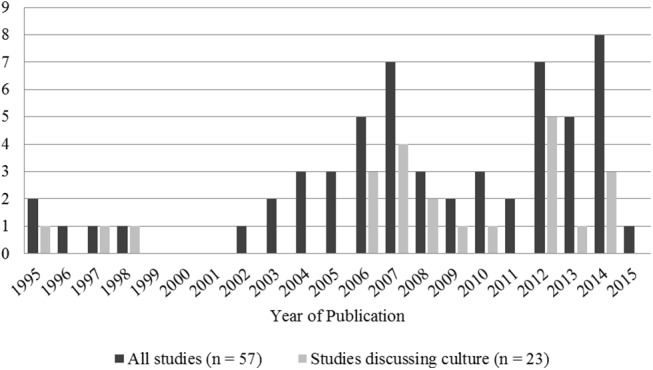
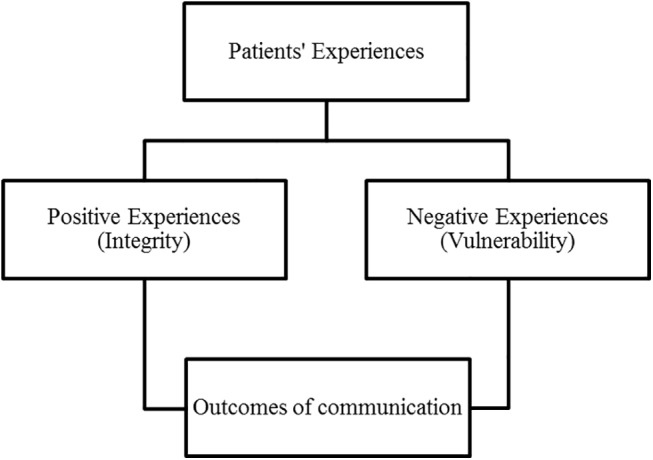
Communication difficulties persist between patients and physicians. In order to improve care, patients' experiences of this communication must be understood. The main objective of this study is to synthesize qualitative studies exploring patients' experiences in communicating with a primary care physician. A secondary objective is to explore specific factors pertaining to ethnic minority or majority patients and their influence on patients' experiences of communication. Pertinent health and social sciences electronic databases were searched systematically (PubMed, Cinahl, PsychNet, and IBSS). Fifty-seven articles were included in the review on the basis of being qualitative studies targeting patients' experiences of communication with a primary care physician. The meta-ethnography method for qualitative studies was used to interpret data and the COREQ checklist was used to evaluate the quality of included studies. Three concepts emerged from analyses: negative experiences, positive experiences, and outcomes of communication. Negative experiences related to being treated with disrespect, experiencing pressure due to time constraints, and feeling helpless due to the dominance of biomedical culture in the medical encounter. Positive experiences are attributed to certain relational skills, technical skills, as well as certain approaches to care privileged by the physician. Outcomes of communication depend on patients' evaluation of the consultation. Four categories of specific factors exerted mainly a negative influence on consultations for ethnic minorities: language barriers, discrimination, differing values, and acculturation. Ethnic majorities also raised specific factors influencing their experience: differing values and discrimination. Findings of this review are limited by the fact that more than half of the studies did not explore cultural aspects relating to this experience. Future research should address these aspects in more detail. In conclusion, all patients seemed to face additional cultural challenges. Findings provide a foundation for the development of tailored interventions to patients' preferences, thus ensuring more satisfactory experiences. Health care providers should be sensitive to specific factors (cultural and micro-cultural) during all medical encounters.
患者与医生之间的沟通困难依然存在。为了改善医疗服务,必须了解患者在这种沟通中的体验。本研究的主要目的是综合探索患者与初级保健医生沟通体验的定性研究。次要目的是探讨与少数族裔或多数族裔患者相关的具体因素及其对患者沟通体验的影响。系统检索了相关的健康和社会科学电子数据库(PubMed、Cinahl、PsychNet和IBSS)。基于针对患者与初级保健医生沟通体验的定性研究,57篇文章被纳入综述。采用定性研究的元民族志方法来解释数据,并使用COREQ清单来评估纳入研究的质量。分析得出了三个概念:负面体验、正面体验和沟通结果。负面体验包括受到不尊重的对待、因时间限制而感到压力以及在医疗互动中因生物医学文化的主导而感到无助。正面体验归因于某些关系技能、技术技能以及医生优先采用的某些护理方法。沟通结果取决于患者对会诊的评价。四类具体因素对少数族裔的会诊主要产生负面影响:语言障碍、歧视、价值观差异和文化适应。多数族裔也提出了影响其体验的具体因素:价值观差异和歧视。本综述的结果受到这样一个事实的限制,即超过一半的研究没有探讨与这种体验相关的文化方面。未来的研究应更详细地探讨这些方面。总之,所有患者似乎都面临着额外的文化挑战。研究结果为根据患者偏好制定针对性干预措施奠定了基础,从而确保更令人满意的体验。医疗服务提供者在所有医疗互动中都应敏感地关注具体因素(文化和微观文化因素)。