Taole Matsepo, Bihon Wubetu, Wingfield Brenda D, Wingfield Michael J, Burgess Treena I
Department of Biology National University of Lesotho P. O. 180 Roma Lesotho ; Department of Genetics Forestry and Agriculture Biotechnology Institute (FABI) University of Pretoria Pretoria 0002 South Africa.
Department of Genetics Forestry and Agriculture Biotechnology Institute (FABI) University of Pretoria Pretoria 0002 South Africa ; Agricultural Research Council Vegetable & Ornamental Plant Institute Pretoria South Africa.
Ecol Evol. 2015 Sep 4;5(18):4210-20. doi: 10.1002/ece3.1693. eCollection 2015 Sep.
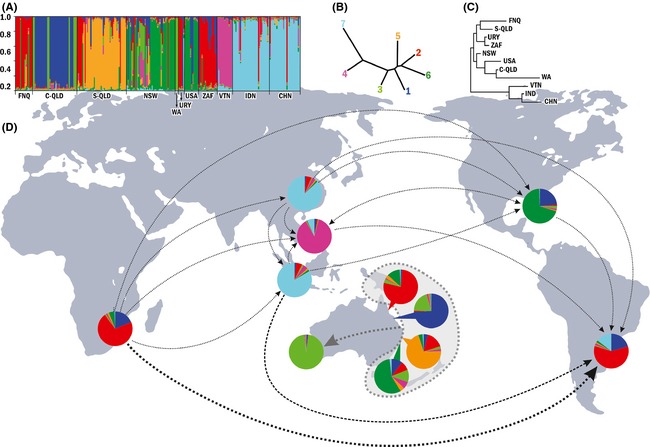
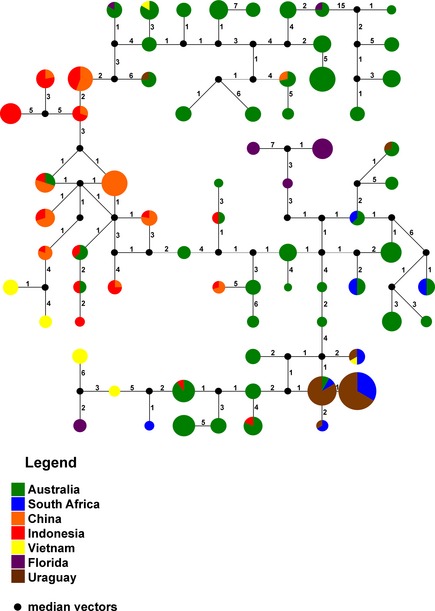
Many population studies on invasive plant pathogens are undertaken without knowing the center of origin of the pathogen. Most leaf pathogens of Eucalyptus originate in Australia and consequently with indigenous populations available, and it is possible to study the pathways of invasion. Teratosphaeria suttonii is a commonly occurring leaf pathogen of Eucalyptus species, naturally distributed in tropical and subtropical regions of eastern Australia where it is regarded as a minor pathogen infecting older leaves; however, repeated infections, especially in exotic plantations, can result in severe defoliation and tree deaths. Nine polymorphic microsatellite markers were used to assess the genetic structure of 11 populations of T. suttonii of which four where from within its native range in eastern Australia and the remaining seven from exotic Eucalyptus plantations. Indigenous populations exhibited high allele and haplotype diversity, predominantly clonal reproduction, high population differentiation, and low gene flow. The diversity of the invasive populations varied widely, but in general, the younger the plantation industry in a country or region, the lower the diversity of T. suttonii. Historical gene flow was from Australia, and while self-recruitment was dominant in all populations, there was evidence for contemporary gene flow, with South Africa being the most common source and Uruguay the most common sink population. This points distinctly to human activities underlying long-distance spread of this pathogen, and it highlights lessons to be learned regarding quarantine.
许多关于入侵性植物病原体的种群研究是在不知道病原体起源中心的情况下进行的。大多数桉树的叶部病原体起源于澳大利亚,因此有当地种群可供研究,从而有可能研究其入侵途径。苏铁叶点霉是桉树种常见的叶部病原体,自然分布于澳大利亚东部的热带和亚热带地区,在那里它被视为感染老叶的次要病原体;然而,反复感染,尤其是在异国种植园中,可能导致严重落叶和树木死亡。使用九个多态性微卫星标记来评估11个苏铁叶点霉种群的遗传结构,其中四个来自其在澳大利亚东部的原生范围内,其余七个来自异国桉树种植园。本地种群表现出高等位基因和单倍型多样性、主要为克隆繁殖、高种群分化和低基因流。入侵种群的多样性差异很大,但总体而言,一个国家或地区的种植产业越年轻,苏铁叶点霉的多样性就越低。历史上的基因流来自澳大利亚,虽然所有种群中自我繁殖占主导,但有当代基因流的证据,南非是最常见的来源地,乌拉圭是最常见的汇种群。这清楚地表明了人类活动是这种病原体远距离传播的基础,并突出了在检疫方面需要吸取的教训。