Zwinkels Maremka, Verschuren Olaf, Lankhorst Kristel, van der Ende-Kastelijn Karin, de Groot Janke, Backx Frank, Visser-Meily Anne, Takken Tim
Center of Excellence for Rehabilitation Medicine and Brain Center Rudolf Magnus, De Hoogstraat Rehabilitation and University Medical Center Utrecht, Utrecht, the Netherlands ; Partner of Shared Utrecht Pediatric Exercise Research (SUPER) Lab, Utrecht, the Netherlands.
Partner of Shared Utrecht Pediatric Exercise Research (SUPER) Lab, Utrecht, the Netherlands ; Research Group Lifestyle and Health, Institute of Human Movement Studies, University of Applied Sciences, Utrecht, the Netherlands.
BMC Sports Sci Med Rehabil. 2015 Oct 6;7:22. doi: 10.1186/s13102-015-0016-7. eCollection 2015.
Children and adolescents with a chronic disease or physical disability have lower fitness levels compared to their non-disabled peers. Low physical fitness is associated with reduced physical activity, increased cardiovascular diseases, and lower levels of both cognitive and psychosocial functioning. Moreover, children and adolescents with a chronic disease or physical disability participate less in both recreational and competitive sports. A variety of intervention studies have shown positive, but only temporary, effects of training programs. Next to issues related to the chronic condition itself, various personal and environmental factors play a key role in determining the extent to which they participate in sports or physical activities. Due to these barriers, sport participation in the immediate after-school hours seems to be a feasible solution to get these children and adolescents physical active structurally. To investigate if an after school sport program can sustain the positive effects of an intervention, a standardized interval training will be given to improve physical fitness levels. High-intensity Interval Training (HIT) is superior to moderate-intensity continuous training in improving physical fitness in patients with chronic diseases. Therefore, the Sport-2-Stay-Fit study will investigate whether after school sport participation can increase the sustainability of a HIT program in children and adolescents with a chronic disease or physical disability.
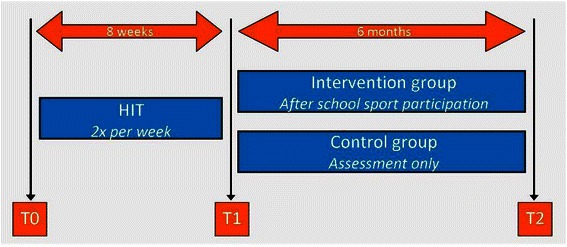
The Sport-2-Stay-Fit study is a clinical controlled trial. A total of 74 children and adolescents in the age of 6-19 years with a chronic disease or physical disability will be included. This could be either a cardiovascular, pulmonary, metabolic, musculoskeletal or neuromuscular disorder. Both children and adolescents who are ambulatory or propelling a manual wheelchair will be included. All participants will follow a HIT program of eight weeks to improve their physical fitness level. Thereafter, the intervention group will participate in sport after school for six months, while the control group receives assessment only. Measurements will take place before the HIT, directly after, as well as, six months later. The primary objective is anaerobic fitness. Secondary objectives are agility, aerobic fitness, strength, physical activity, cardiovascular health, cognitive functioning, and psychosocial functioning.
If effective, after school sport participation following a standardized interval training could be implemented on schools for special education to get children and adolescents with a chronic disease or physical disability active on a structural basis.
This trial is registered at the Dutch Trial Register #NTR4698.
与无残疾的同龄人相比,患有慢性疾病或身体残疾的儿童和青少年的健康水平较低。身体素质差与身体活动减少、心血管疾病增加以及认知和心理社会功能水平降低有关。此外,患有慢性疾病或身体残疾的儿童和青少年较少参与娱乐性和竞技性运动。各种干预研究表明,训练计划有积极作用,但只是暂时的。除了与慢性病本身相关的问题外,各种个人和环境因素在决定他们参与运动或体育活动的程度方面起着关键作用。由于这些障碍,放学后立即参与体育运动似乎是让这些儿童和青少年持续保持身体活跃的可行解决方案。为了调查课外体育项目是否能维持干预的积极效果,将进行标准化的间歇训练以提高健康水平。高强度间歇训练(HIT)在改善慢性病患者的身体素质方面优于中等强度持续训练。因此,“运动促健康”研究将调查课外体育活动是否能提高患有慢性疾病或身体残疾的儿童和青少年高强度间歇训练项目的可持续性。
“运动促健康”研究是一项临床对照试验。将纳入74名年龄在6至19岁之间患有慢性疾病或身体残疾的儿童和青少年。这可能是心血管、肺部、代谢、肌肉骨骼或神经肌肉疾病。能行走或推动手动轮椅的儿童和青少年都将被纳入。所有参与者将参加为期八周的高强度间歇训练项目以提高他们的健康水平。此后,干预组将在放学后参加六个月的体育运动,而对照组只接受评估。测量将在高强度间歇训练前、训练刚结束后以及六个月后进行。主要目标是无氧健康。次要目标是敏捷性、有氧健康、力量、身体活动、心血管健康、认知功能和心理社会功能。
如果有效,在特殊教育学校实施标准化间歇训练后进行课外体育活动,可让患有慢性疾病或身体残疾的儿童和青少年持续保持活跃。
该试验已在荷兰试验注册中心注册,注册号为#NTR4698。