López Myriam Consuelo, León Cielo M, Fonseca Jairo, Reyes Patricia, Moncada Ligia, Olivera Mario J, Ramírez Juan David
Departamento de Salud Pública, Facultad de Medicina, Universidad Nacional de Colombia, Bogotá, Colombia.
Grupo de Investigaciones Microbiológicas-UR (GIMUR), Facultad de Ciencias Naturales y Matemáticas, Universidad del Rosario, Bogotá, Colombia.
PLoS One. 2015 Oct 14;10(10):e0140302. doi: 10.1371/journal.pone.0140302. eCollection 2015.
Entamoeba histolytica, E. dispar and E. moshkovskii are the most frequent species described in human infection where E. histolytica is the only true pathogen. The epidemiology of this infection is complex due to the absence of a routine exam that allows a correct discrimination of the Entamoeba species complex. Therefore, molecular methods appear as the unique epidemiological tool to accomplish the species discrimination. Herein, we conducted a cross-sectional study to determine the frequency of Entamoeba species infections in a group of asymptomatic individuals from a rural area in central Colombia.
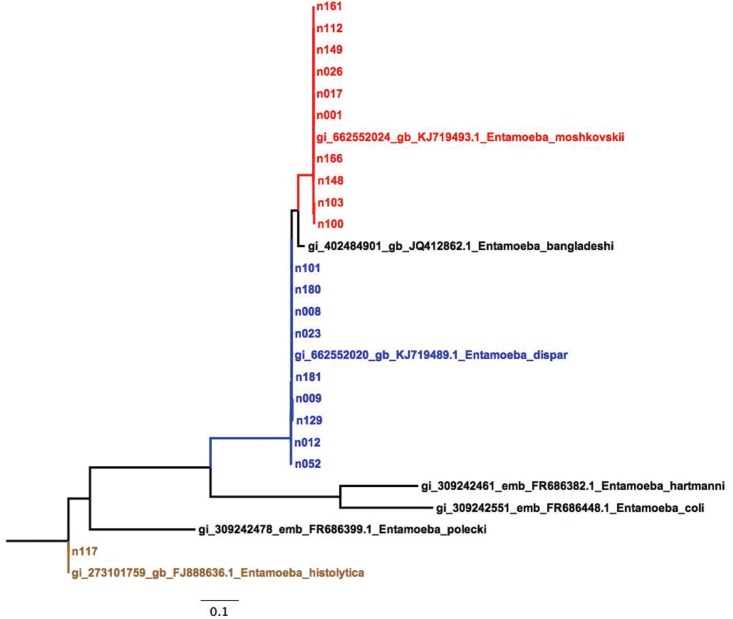
METHODOLOGY/PRINCIPAL FINDINGS: A total of 181 fecal samples from asymptomatic children under 16 years old from the hamlet La Vírgen, Cundinamarca (Colombia) that voluntarily accepted to participate in the study were collected. The fecal samples were examined by light microscopy and DNA-extracted, subsequently submitted to molecular discrimination of E. dispar/E. histolytica/E. moshkovskii infection based on a multiplex PCR assay targeting the 18S rRNA fragment. To confirm the species description, twenty samples were randomly submitted to DNA sequencing of the aforementioned fragment. By direct microscopic examination, frequency of the complex E. histolytica/E. dispar/E. moshkovskii was 18.8% (34/181). PCR showed a frequency of 49.1% (89/181), discriminated as 23.2% (42/181) that were positive for E. dispar, 25.4% (46/181) for E. moshkovskii and 0.55% (1/ 181) for E. histolytica. Also, mixed infections were detected between E. dispar and E. moshkovskii at 4.42% (8/181) of the samples. Molecular barcoding confirmed the diagnosis depicted by the multiplex PCR assay.
CONCLUSIONS/SIGNIFICANCE: This is the first description of E. moshkovskii in Colombia and the second report in South-America to our knowledge. Our results suggest the need to unravel the true epidemiology of Entamoeba infections around the world, including the real pathogenic role that E. moshkovskii may have.
溶组织内阿米巴、迪氏内阿米巴和莫斯科维奇内阿米巴是人类感染中最常见的种类,其中溶组织内阿米巴是唯一真正的病原体。由于缺乏能正确区分内阿米巴种类复合体的常规检查,这种感染的流行病学情况较为复杂。因此,分子方法成为实现种类区分的唯一流行病学工具。在此,我们进行了一项横断面研究,以确定哥伦比亚中部一个农村地区一组无症状个体中内阿米巴种类感染的频率。
方法/主要发现:总共收集了来自昆迪纳马卡省(哥伦比亚)拉维根村16岁以下自愿参与研究的无症状儿童的181份粪便样本。粪便样本先通过光学显微镜检查,然后进行DNA提取,随后基于针对18S rRNA片段的多重PCR检测对内阿米巴/溶组织内阿米巴/莫斯科维奇内阿米巴感染进行分子鉴别。为了确认种类鉴定结果,随机选取20个样本对上述片段进行DNA测序。通过直接显微镜检查,溶组织内阿米巴/迪氏内阿米巴/莫斯科维奇内阿米巴复合体的感染频率为18.8%(34/181)。PCR检测显示频率为49.1%(89/181),其中鉴定为迪氏内阿米巴阳性的占23.2%(42/181),莫斯科维奇内阿米巴阳性的占25.4%(46/181),溶组织内阿米巴阳性的占0.55%(1/181)。此外,在4.42%(8/181)的样本中检测到迪氏内阿米巴和莫斯科维奇内阿米巴的混合感染。分子条形码技术证实了多重PCR检测所描绘的诊断结果。
结论/意义:据我们所知,这是哥伦比亚首次对莫斯科维奇内阿米巴的描述,也是南美洲的第二篇相关报道。我们的结果表明,有必要弄清楚世界各地内阿米巴感染的真实流行病学情况,包括莫斯科维奇内阿米巴可能具有的真正致病作用。