Zimmer Vincent, Lammert Frank
Department of Medicine II, Saarland University Medical Center, Homburg/Saar, Germany.
Viszeralmedizin. 2015 Jun;31(3):166-72. doi: 10.1159/000430965. Epub 2015 Jun 11.
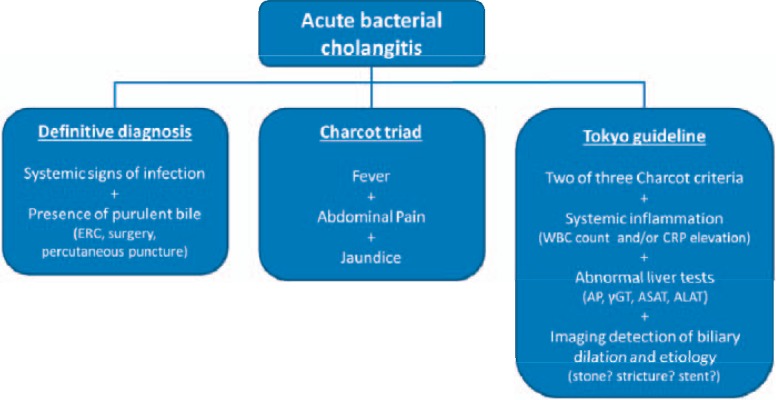
Acute bacterial cholangitis for the most part owing to common bile duct stones is common in gastroenterology practice and represents a potentially life-threatening condition often characterized by fever, abdominal pain, and jaundice (Charcot's triad) as well as confusion and septic shock (Reynolds' pentad).
This review is based on a systematic literature review in PubMed with the search items 'cholangitis' 'choledocholithiasis' 'gallstone disease' 'biliary infection', and 'biliary sepsis'.
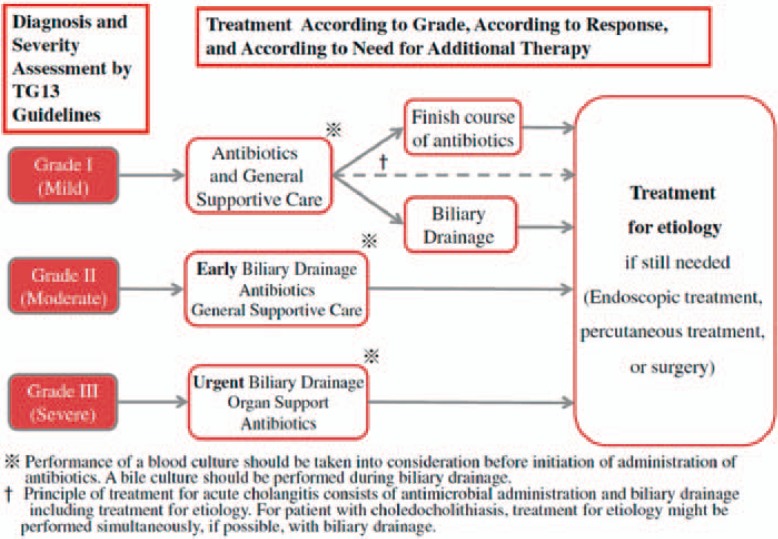
Although most patients respond to empiric broad-spectrum antibiotic treatment, timely endoscopic biliary drainage depending on the severity of the disease is required to eliminate the underlying obstruction. Specific recommendations have been derived from the Tokyo guideline working group consensus 2006 and its update in 2013, albeit poorly evidence-based, providing a comprehensive overview of diagnosis, classification, risk stratification, and treatment algorithms in acute bacterial cholangitis.
Prompt clinical recognition and accurate diagnostic workup including adequate laboratory assessment and (aetiology-oriented) imaging are critical steps in the management of cholangitis. Treatment is directed at the two major interrelated pathophysiologic components, i.e. bacterial infection (immediate antimicrobial therapy) and bile duct obstruction (biliary drainage). As for the latter, transpapillary endoscopic drainage by stent or nasobiliary drain and/or same-session bile duct clearance, depending on individual disease severity, represent first-line treatment approaches.
在胃肠病学实践中,大部分由胆总管结石引起的急性细菌性胆管炎很常见,是一种潜在的危及生命的疾病,通常表现为发热、腹痛和黄疸(夏科氏三联征)以及精神错乱和感染性休克(雷诺兹五联征)。
本综述基于在PubMed上进行的系统文献综述,检索词为“胆管炎”“胆总管结石病”“胆石症”“胆道感染”和“胆道败血症”。
尽管大多数患者对经验性广谱抗生素治疗有反应,但根据疾病严重程度及时进行内镜下胆道引流以消除潜在梗阻是必要的。特定建议源自2006年东京指南工作组共识及其2013年更新版,尽管证据不足,但全面概述了急性细菌性胆管炎的诊断、分类、风险分层和治疗算法。
及时的临床识别和准确的诊断检查,包括充分的实验室评估和(以病因学为导向的)影像学检查,是胆管炎管理中的关键步骤。治疗针对两个主要的相互关联的病理生理成分,即细菌感染(立即进行抗菌治疗)和胆管梗阻(胆道引流)。至于后者,根据个体疾病严重程度,通过支架或鼻胆管引流进行经乳头内镜引流和/或同期胆管清理是一线治疗方法。