Antony Benny, Venn Alison, Cicuttini Flavia, March Lyn, Blizzard Leigh, Dwyer Terence, Cross Marita, Jones Graeme, Ding Changhai
Menzies Institute for Medical Research, University of Tasmania, Hobart, Australia.
Department of Epidemiology and Preventive Medicine, Monash University, Melbourne, Australia.
Arthritis Res Ther. 2015 Oct 26;17:298. doi: 10.1186/s13075-015-0813-0.
Physical activity has been recommended to patients with knee osteoarthritis for improving their symptoms. However, it is still controversial if physical activity has effects on joint structures including cartilage volume. The aim of this study was to describe the associations between physical activity and performance measured 5 years prior and tibial cartilage volume and bone area in young adults.
Subjects broadly representative of the Australian population (n = 328, aged 31-41 years, female 47.3 %) were selected from the Childhood Determinants of Adult Health study. They underwent T1-weighted fat-suppressed magnetic resonance imaging (MRI) scans of their knees. Tibial bone area and cartilage volume were measured from MRI. Physical activity (measured using long international physical activity questionnaire (IPAQ)) and performance measures (long jump, leg muscle strength, physical work capacity (PWC170)) were measured 5 years prior.
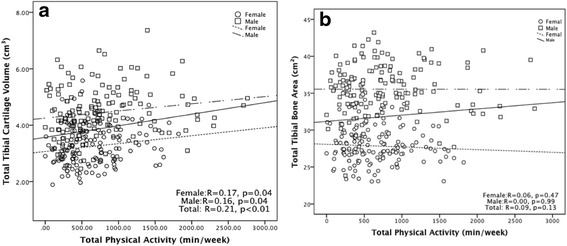
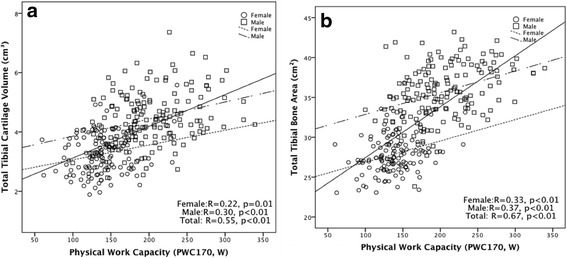
In multivariable analyses, total physical activity (min/week) (β: 0.30 mm(3), 95 % CI: 0.13,0.47), vigorous (β: 0.54 mm(3), 95 % CI: 0.13,0.94), moderate (β: 0.34 mm(3), 95 % CI: 0.01,0.67), walking (β: 0.40 mm(3), 95 % CI: 0.07,0.72) and IPAQ category (β: 182.9 mm(3), 95 % CI: 51.8,314.0) were positively associated with total tibial cartilage volume but not tibial bone area. PWC170, long jump and leg muscle strength were positively and significantly associated with both total tibial cartilage volume and total tibial bone area; and the associations with tibial cartilage volume decreased in magnitude but remained significant for PWC170 and long jump after further adjustment for tibial bone area.
While tibial bone area is affected only by physical performance, total tibial cartilage volume can be influenced by both physical activity and performance in younger adults. The clinical significance suggests a beneficial effect for cartilage but the bone area association was restricted to performance suggesting other factors rather than physical activity may be important.
已建议膝骨关节炎患者进行体育活动以改善症状。然而,体育活动是否会对包括软骨体积在内的关节结构产生影响仍存在争议。本研究的目的是描述体育活动与5年前测量的体能表现以及年轻成年人胫骨软骨体积和骨面积之间的关联。
从成人健康的儿童决定因素研究中选取了大致代表澳大利亚人群的受试者(n = 328,年龄31 - 41岁,女性占47.3%)。他们接受了膝关节的T1加权脂肪抑制磁共振成像(MRI)扫描。从MRI测量胫骨骨面积和软骨体积。5年前测量了体育活动(使用国际体力活动问卷(IPAQ)长表进行测量)和体能指标(跳远、腿部肌肉力量、体力工作能力(PWC170))。
在多变量分析中,总体育活动量(分钟/周)(β:0.30立方毫米,95%置信区间:0.13, 0.47)、剧烈活动(β:0.54立方毫米,95%置信区间:0.13, 0.94)、中等强度活动(β:0.34立方毫米,95%置信区间:0.01, 0.67)、步行(β:0.40立方毫米,95%置信区间:0.07, 0.72)和IPAQ类别(β:182.9立方毫米,95%置信区间:51.8, 314.0)与胫骨总软骨体积呈正相关,但与胫骨骨面积无关。PWC170、跳远和腿部肌肉力量与胫骨总软骨体积和胫骨总骨面积均呈显著正相关;在进一步调整胫骨骨面积后,PWC170和跳远与胫骨软骨体积的关联程度降低,但仍具有显著性。
虽然胫骨骨面积仅受体能表现影响,但年轻成年人的胫骨总软骨体积可同时受到体育活动和体能表现的影响。临床意义表明对软骨有有益作用,但骨面积的关联仅限于体能表现,这表明其他因素而非体育活动可能更为重要。