• 文献检索
  • 文档翻译
  • 深度研究
  • 学术资讯
  • Suppr Zotero 插件Zotero 插件
  • 邀请有礼
  • 套餐&价格
  • 历史记录
应用&插件
Suppr Zotero 插件Zotero 插件浏览器插件Mac 客户端Windows 客户端微信小程序
定价
高级版会员购买积分包购买API积分包
服务
文献检索文档翻译深度研究API 文档MCP 服务
关于我们
关于 Suppr公司介绍联系我们用户协议隐私条款
关注我们

Suppr 超能文献

核心技术专利:CN118964589B侵权必究
粤ICP备2023148730 号-1Suppr @ 2026

文献检索

告别复杂PubMed语法,用中文像聊天一样搜索,搜遍4000万医学文献。AI智能推荐,让科研检索更轻松。

立即免费搜索

文件翻译

保留排版,准确专业,支持PDF/Word/PPT等文件格式,支持 12+语言互译。

免费翻译文档

深度研究

AI帮你快速写综述,25分钟生成高质量综述,智能提取关键信息,辅助科研写作。

立即免费体验

SPEED(急诊科脓毒症患者评估)评分:一种风险分层和结局预测工具。

The SPEED (sepsis patient evaluation in the emergency department) score: a risk stratification and outcome prediction tool.

作者信息

Bewersdorf Jan Philipp, Hautmann Oliver, Kofink Daniel, Abdul Khalil Alizan, Zainal Abidin Imran, Loch Alexander

机构信息

Departments of aSurgery bMedicine, University Malaya Medical Centre, Kuala Lumpur, Malaysia cLaboratory of Experimental Cardiology, Department of Cardiology, Division of Heart and Lung, University Medical Center Utrecht, Utrecht, The Netherlands.

出版信息

Eur J Emerg Med. 2017 Jun;24(3):170-175. doi: 10.1097/MEJ.0000000000000344.

DOI:10.1097/MEJ.0000000000000344
PMID:26524675
原文链接:https://pmc.ncbi.nlm.nih.gov/articles/PMC5417572/
Abstract

OBJECTIVES

The aim of the study was to identify covariates associated with 28-day mortality in septic patients admitted to the emergency department and derive and validate a score that stratifies mortality risk utilizing parameters that are readily available.

METHODS

Patients with an admission diagnosis of suspected or confirmed infection and fulfilling at least two criteria for severe inflammatory response syndrome were included in this study. Patients' characteristics, vital signs, and laboratory values were used to identify prognostic factors for mortality. A scoring system was derived and validated. The primary outcome was the 28-day mortality rate.

RESULTS

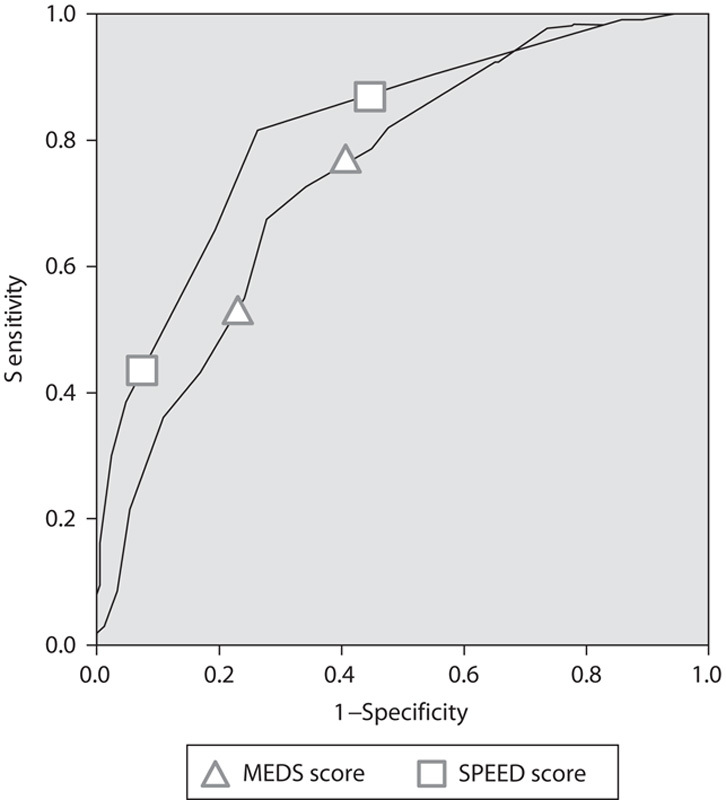
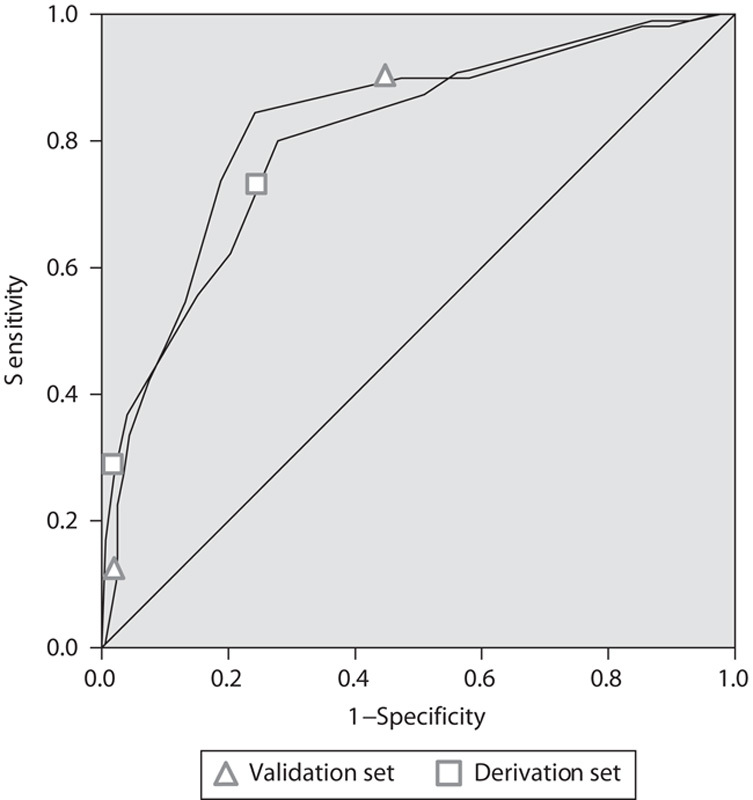
A total of 440 patients were included in the study. The 28-day hospital mortality rate was 32.4 and 25.2% for the derivation (293 patients) and validation (147 patients) sets, respectively. Factors associated with a higher mortality were immune-suppressed state (odds ratio 4.7; 95% confidence interval 2.0-11.4), systolic blood pressure on arrival less than 90 mmHg (3.8; 1.7-8.3), body temperature less than 36.0°C (4.1; 1.3-12.9), oxygen saturation less than 90% (2.3; 1.1-4.8), hematocrit less than 0.38 (3.1; 1.6-5.9), blood pH less than 7.35 (2.0; 1.04-3.9), lactate level more than 2.4 mmol/l (2.27; 1.2-4.2), and pneumonia as the source of infection (2.7; 1.5-5.0). The area under the receiver operating characteristic curve was 0.81 (0.75-0.86) in the derivation and 0.81 (0.73-0.90) in the validation set. The SPEED (sepsis patient evaluation in the emergency department) score performed better (P=0.02) than the Mortality in Emergency Department Sepsis score when applied to the complete study population with an area under the curve of 0.81 (0.76-0.85) as compared with 0.74 (0.70-0.79).

CONCLUSION

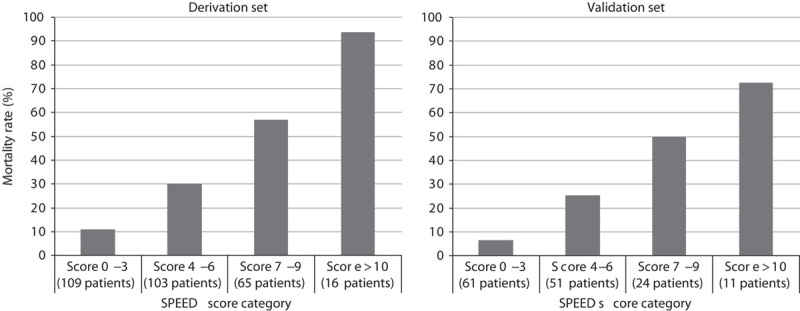
The SPEED score predicts 28-day mortality in septic patients. It is simple and its predictive value is comparable to that of other scoring systems.

摘要

目的

本研究旨在确定急诊科收治的脓毒症患者28天死亡率的相关协变量,并利用易于获取的参数得出并验证一个对死亡风险进行分层的评分系统。

方法

本研究纳入入院诊断为疑似或确诊感染且至少符合两条严重炎症反应综合征标准的患者。患者的特征、生命体征和实验室检查值用于确定死亡的预后因素。得出并验证了一个评分系统。主要结局为28天死亡率。

结果

本研究共纳入440例患者。在推导集(293例患者)和验证集(147例患者)中,28天医院死亡率分别为32.4%和25.2%。与较高死亡率相关的因素包括免疫抑制状态(比值比4.7;95%置信区间2.0 - 11.4)、入院时收缩压低于90 mmHg(3.8;1.7 - 8.3)、体温低于36.0°C(4.1;1.3 - 12.9)、氧饱和度低于90%(2.3;1.1 - 4.8)、血细胞比容低于0.38(3.1;1.6 - 5.9)、血液pH低于7.35(2.0;1.04 - 3.9)、乳酸水平高于2.4 mmol/L(2.27;1.2 - 4.2)以及肺炎作为感染源(2.7;1.5 - 5.0)。在推导集中,受试者工作特征曲线下面积为0.81(0.75 - 0.86),在验证集中为0.81(0.73 - 0.90)。当应用于完整研究人群时,SPEED(急诊科脓毒症患者评估)评分(曲线下面积为0.81(0.76 - 0.85))比急诊科脓毒症死亡率评分(曲线下面积为0.74(0.70 - 0.79))表现更好(P = 0.02)。

结论

SPEED评分可预测脓毒症患者的28天死亡率。它简单易行,其预测价值与其他评分系统相当。
https://cdn.ncbi.nlm.nih.gov/pmc/blobs/d484/5417572/327589665022/mej-24-170-g006.jpg
https://cdn.ncbi.nlm.nih.gov/pmc/blobs/d484/5417572/6781325f70f9/mej-24-170-g004.jpg
https://cdn.ncbi.nlm.nih.gov/pmc/blobs/d484/5417572/009277ea61a9/mej-24-170-g005.jpg
https://cdn.ncbi.nlm.nih.gov/pmc/blobs/d484/5417572/327589665022/mej-24-170-g006.jpg
https://cdn.ncbi.nlm.nih.gov/pmc/blobs/d484/5417572/6781325f70f9/mej-24-170-g004.jpg
https://cdn.ncbi.nlm.nih.gov/pmc/blobs/d484/5417572/009277ea61a9/mej-24-170-g005.jpg
https://cdn.ncbi.nlm.nih.gov/pmc/blobs/d484/5417572/327589665022/mej-24-170-g006.jpg

相似文献

1
The SPEED (sepsis patient evaluation in the emergency department) score: a risk stratification and outcome prediction tool.SPEED(急诊科脓毒症患者评估)评分:一种风险分层和结局预测工具。
Eur J Emerg Med. 2017 Jun;24(3):170-175. doi: 10.1097/MEJ.0000000000000344.
2
Poor performance of quick-SOFA (qSOFA) score in predicting severe sepsis and mortality - a prospective study of patients admitted with infection to the emergency department.快速序贯器官衰竭评估(qSOFA)评分在预测严重脓毒症及死亡率方面表现不佳——一项针对急诊科收治的感染患者的前瞻性研究。
Scand J Trauma Resusc Emerg Med. 2017 Jun 9;25(1):56. doi: 10.1186/s13049-017-0399-4.
3
The role of soluble thrombomodulin in the risk stratification and prognosis evaluation of septic patients in the emergency department.可溶性血栓调节蛋白在急诊科脓毒症患者危险分层和预后评估中的作用。
Thromb Res. 2013 Oct;132(4):471-6. doi: 10.1016/j.thromres.2013.08.011. Epub 2013 Aug 28.
4
Sepsis patient evaluation emergency department (SPEED) score & mortality in emergency department sepsis (MEDS) score in predicting 28-day mortality of emergency sepsis patients.脓毒症患者急诊科评估(SPEED)评分及急诊科脓毒症(MEDS)评分对急诊脓毒症患者28天死亡率的预测作用。
Chin J Traumatol. 2019 Dec;22(6):316-322. doi: 10.1016/j.cjtee.2019.10.004. Epub 2019 Nov 6.
5
The REDS score: a new scoring system to risk-stratify emergency department suspected sepsis: a derivation and validation study.REDS 评分:一种用于风险分层急诊科疑似脓毒症的新评分系统:一项推导和验证研究。
BMJ Open. 2019 Aug 26;9(8):e030922. doi: 10.1136/bmjopen-2019-030922.
6
Infection and systemic inflammatory response syndrome in older patients in the emergency department: a 30-day risk model.急诊科老年患者的感染和全身炎症反应综合征:30 天风险模型。
Emergencias. 2018;30(4):241-246.
7
Risk stratification of the potentially septic patient in the emergency department: the Mortality in the Emergency Department Sepsis (MEDS) score.急诊科潜在脓毒症患者的风险分层:急诊科脓毒症死亡率(MEDS)评分
J Emerg Med. 2009 Oct;37(3):319-27. doi: 10.1016/j.jemermed.2009.03.016. Epub 2009 May 8.
8
Hypoalbuminemia, Low Base Excess Values, and Tachypnea Predict 28-Day Mortality in Severe Sepsis and Septic Shock Patients in the Emergency Department.低白蛋白血症、低碱剩余值及呼吸急促可预测急诊科严重脓毒症和脓毒性休克患者的28天死亡率。
Yonsei Med J. 2016 Nov;57(6):1361-9. doi: 10.3349/ymj.2016.57.6.1361.
9
Mortality in Emergency Department Sepsis (MEDS) score: a prospectively derived and validated clinical prediction rule.急诊科脓毒症(MEDS)评分:一项前瞻性得出并经验证的临床预测规则。
Crit Care Med. 2003 Mar;31(3):670-5. doi: 10.1097/01.CCM.0000054867.01688.D1.
10
Severity Scores in Emergency Department Patients With Presumed Infection: A Prospective Validation Study.急诊科疑似感染患者的严重程度评分:一项前瞻性验证研究。
Crit Care Med. 2016 Mar;44(3):539-47. doi: 10.1097/CCM.0000000000001427.

引用本文的文献

1
Parsimonious Waveform-derived Features consisting of Pulse Arrival Time and Heart Rate Variability Predicts the Onset of Septic Shock.由脉搏到达时间和心率变异性组成的简约波形衍生特征可预测脓毒性休克的发作。
Biomed Signal Process Control. 2024 Jun;92. doi: 10.1016/j.bspc.2024.105974. Epub 2024 Feb 14.
2
Hierarchical Capability in Distinguishing Severities of Sepsis via Serum Lactate: A Network Meta-Analysis.通过血清乳酸区分脓毒症严重程度的分层能力:一项网状Meta分析
Biomedicines. 2024 Feb 17;12(2):447. doi: 10.3390/biomedicines12020447.
3
Head-to-head comparison of 19 prediction models for short-term outcome in medical patients in the emergency department: a retrospective study.

本文引用的文献

1
Mortality of patients infected with HIV in the intensive care unit (2005 through 2010): significant role of chronic hepatitis C and severe sepsis.重症监护病房中感染HIV患者的死亡率(2005年至2010年):慢性丙型肝炎和严重脓毒症的重要作用
Crit Care. 2014 Aug 27;18(4):475. doi: 10.1186/s13054-014-0475-3.
2
Epidemiology of severe sepsis.严重脓毒症的流行病学。
Virulence. 2014 Jan 1;5(1):4-11. doi: 10.4161/viru.27372. Epub 2013 Dec 11.
3
Whole blood lactate kinetics in patients undergoing quantitative resuscitation for severe sepsis and septic shock.
头对头比较 19 个预测模型在急诊科内科患者短期预后中的应用:一项回顾性研究。
Ann Med. 2023;55(2):2290211. doi: 10.1080/07853890.2023.2290211. Epub 2023 Dec 8.
4
Predictive models for short-term mortality and length of hospital stay among adults with community-onset bacteraemia before and during the COVID-19 pandemic: application of early data dynamics.预测模型用于评估 COVID-19 大流行前后成人社区获得性菌血症短期死亡率和住院时间:早期数据动态的应用。
BMC Infect Dis. 2023 Sep 15;23(1):605. doi: 10.1186/s12879-023-08547-8.
5
An Evaluation of the Predictive Value of Sepsis Patient Evaluation in the Emergency Department (SPEED) Score in Estimating 28-Day Mortality Among Patients With Sepsis Presenting to the Emergency Department: A Prospective Observational Study.急诊科脓毒症患者评估(SPEED)评分对急诊科脓毒症患者28天死亡率预测价值的评估:一项前瞻性观察研究
Cureus. 2022 Feb 25;14(2):e22598. doi: 10.7759/cureus.22598. eCollection 2022 Feb.
6
Display and perception of risk: Analysis of decision support system display and its impact on perceived clinical risk of sepsis-induced health deterioration.风险的呈现与认知:决策支持系统呈现方式及其对脓毒症所致健康恶化的感知临床风险的影响分析
Health Informatics J. 2022 Jan-Mar;28(1):14604582211073075. doi: 10.1177/14604582211073075.
7
The Available Criteria for Different Sepsis Scoring Systems in the Emergency Department-A Retrospective Assessment.急诊科不同脓毒症评分系统的可用标准——一项回顾性评估
Open Access Emerg Med. 2021 Mar 2;13:91-96. doi: 10.2147/OAEM.S280279. eCollection 2021.
8
FUTURES: Forecasting the Unexpected Transfer to Upgraded REsources in Sepsis.FUTURES:预测脓毒症中意外向升级资源的转移
Proc Int Symp Hum Factors Ergon Healthc. 2019 Sep;8(1):187-191. doi: 10.1177/2327857919081047. Epub 2019 Sep 15.
9
Rethinking animal models of sepsis - working towards improved clinical translation whilst integrating the 3Rs.重新思考脓毒症的动物模型 - 在整合 3R 的同时努力提高临床转化。
Clin Sci (Lond). 2020 Jul 17;134(13):1715-1734. doi: 10.1042/CS20200679.
10
Sepsis patient evaluation emergency department (SPEED) score & mortality in emergency department sepsis (MEDS) score in predicting 28-day mortality of emergency sepsis patients.脓毒症患者急诊科评估(SPEED)评分及急诊科脓毒症(MEDS)评分对急诊脓毒症患者28天死亡率的预测作用。
Chin J Traumatol. 2019 Dec;22(6):316-322. doi: 10.1016/j.cjtee.2019.10.004. Epub 2019 Nov 6.
严重脓毒症和感染性休克患者行定量复苏后全血乳酸动力学。
Chest. 2013 Jun;143(6):1548-1553. doi: 10.1378/chest.12-0878.
4
Immunosuppression in sepsis: a novel understanding of the disorder and a new therapeutic approach.脓毒症中的免疫抑制:对该疾病的新认识和新的治疗方法。
Lancet Infect Dis. 2013 Mar;13(3):260-8. doi: 10.1016/S1473-3099(13)70001-X.
5
Sepsis in AIDS patients: clinical, etiological and inflammatory characteristics.艾滋病患者中的败血症:临床、病因学和炎症特征。
J Int AIDS Soc. 2013 Jan 30;16(1):17344. doi: 10.7448/IAS.16.1.17344.
6
Surviving Sepsis Campaign: international guidelines for management of severe sepsis and septic shock, 2012.拯救脓毒症运动:严重脓毒症和脓毒性休克管理国际指南,2012 年。
Intensive Care Med. 2013 Feb;39(2):165-228. doi: 10.1007/s00134-012-2769-8. Epub 2013 Jan 30.
7
Immunosuppression in patients who die of sepsis and multiple organ failure.死于脓毒症和多器官衰竭的患者的免疫抑制。
JAMA. 2011 Dec 21;306(23):2594-605. doi: 10.1001/jama.2011.1829.
8
Lactate in the critically ill patients: an outcome marker with the times.危重症患者的乳酸:与时俱进的预后标志物。
Crit Care. 2011;15(6):1016. doi: 10.1186/cc10531. Epub 2011 Dec 5.
9
The value of the Mortality in Emergency Department Sepsis (MEDS) score, C reactive protein and lactate in predicting 28-day mortality of sepsis in a Dutch emergency department.荷兰急诊科中 MEDS 评分、C 反应蛋白和乳酸值对预测脓毒症 28 天死亡率的价值。
Emerg Med J. 2012 Apr;29(4):295-300. doi: 10.1136/emj.2010.109090. Epub 2011 Apr 21.
10
pROC: an open-source package for R and S+ to analyze and compare ROC curves.pROC:一个用于 R 和 S+的开源软件包,用于分析和比较 ROC 曲线。
BMC Bioinformatics. 2011 Mar 17;12:77. doi: 10.1186/1471-2105-12-77.