G. Eliava Institute of Bacteriophages, Microbiology, and Virology , Tbilisi , Georgia.
United States Army Medical Research Institute of Infectious Diseases (USAMRIID) , Fort Detrick, MD , USA.
Front Public Health. 2015 Oct 13;3:232. doi: 10.3389/fpubh.2015.00232. eCollection 2015.
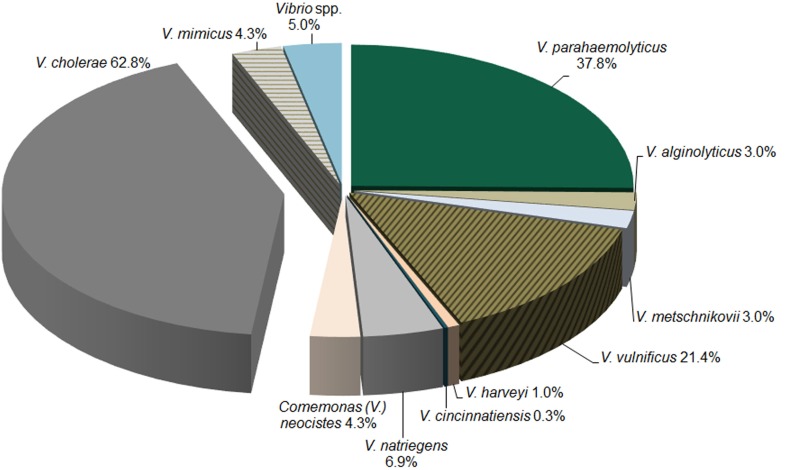
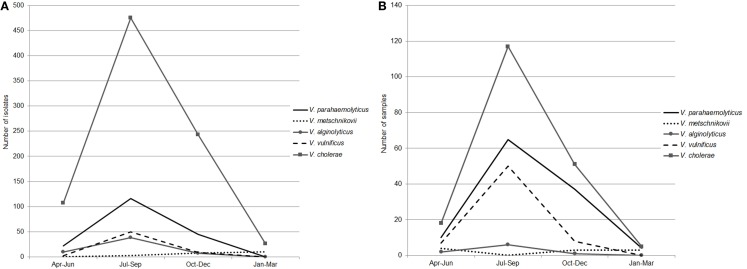
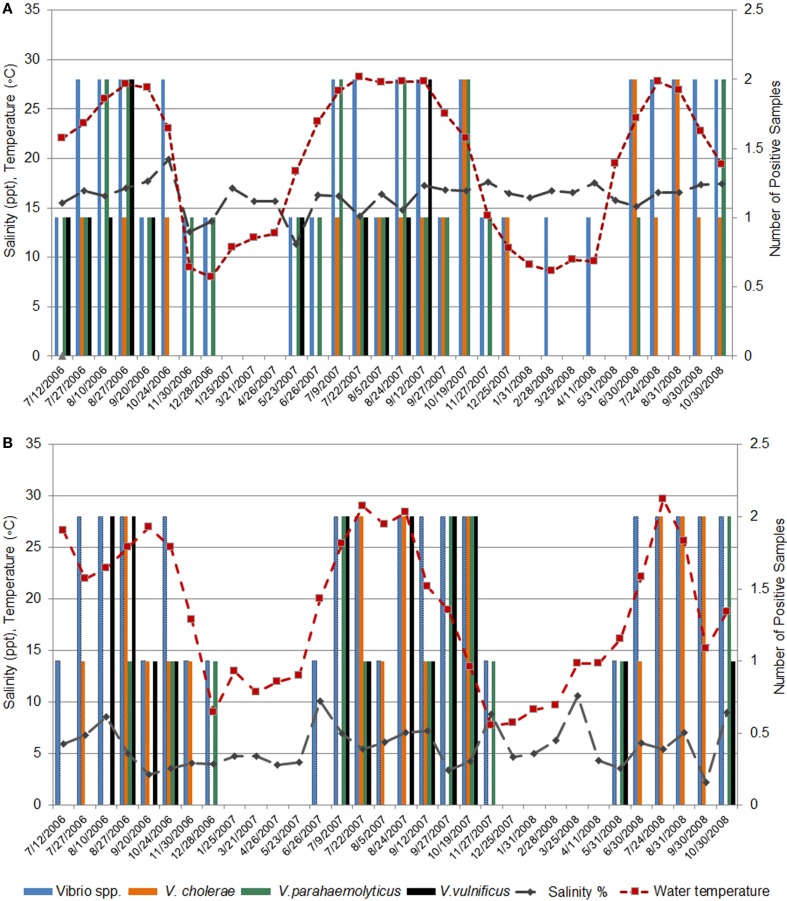
Among the more than 70 different Vibrio species inhabiting marine, estuarine, and freshwater ecosystems, 12 are recognized as human pathogens. The warm subtropical climate of the Black Sea coastal area and inland regions of Georgia likely provides a favorable environment for various Vibrio species. From 2006 to 2009, the abundance, ecology, and diversity of clinically important Vibrio species were studied in different locations in Georgia and across seasons. Over a 33-month period, 1,595 presumptive Vibrio isolates were collected from the Black Sea (n = 657) and freshwater lakes around Tbilisi (n = 938). Screening of a subset of 440 concentrated and enriched water samples by PCR-electrospray ionization/mass spectrometry (PCR-ESI/MS) detected the presence of DNA from eight clinically important Vibrio species: V. cholerae, V. parahaemolyticus, V. vulnificus, V. mimicus, V. alginolyticus, V. harveyi, V. metschnikovii, and V. cincinnatiensis. Almost 90% of PCR/ESI-MS samples positive for Vibrio species were collected from June through November. Three important human-pathogenic Vibrio species (V. cholerae, V. parahaemolyticus, and V. vulnificus) were detected in 62.8, 37.8, and 21.4% of samples testing positive for Vibrios, respectively. The results of these activities suggest that natural reservoirs for human-pathogenic Vibrios exist in Georgian aquatic environments. Water temperature at all sampling sites was positively correlated with the abundance of clinically important Vibrio spp. (except V. metschnikovii), and salinity was correlated with species composition at particular Black Sea sites as well as inland reservoirs.
在栖息于海洋、河口和淡水生态系统的超过 70 种不同的弧菌物种中,有 12 种被认为是人类病原体。黑海沿海地区和格鲁吉亚内陆地区温暖的亚热带气候可能为各种弧菌物种提供了有利的环境。从 2006 年到 2009 年,在格鲁吉亚的不同地点和不同季节研究了临床上重要的弧菌物种的丰度、生态学和多样性。在 33 个月的时间里,从黑海(n=657)和第比利斯附近的淡水湖中采集了 1595 株疑似弧菌分离株。通过聚合酶链反应-电喷雾电离/质谱(PCR-ESI/MS)对 440 份浓缩和富集水样的子集进行筛选,检测到来自 8 种临床上重要的弧菌的 DNA:霍乱弧菌、副溶血性弧菌、创伤弧菌、拟态弧菌、溶藻弧菌、哈维氏弧菌、梅奇尼科夫氏弧菌和辛辛那提弧菌。约 90%的 PCR/ESI-MS 阳性弧菌样本采集于 6 月至 11 月。在检测到的弧菌阳性样本中,有 3 种重要的人类病原体弧菌(霍乱弧菌、副溶血性弧菌和创伤弧菌)分别占 62.8%、37.8%和 21.4%。这些活动的结果表明,人类病原体弧菌的自然宿主存在于格鲁吉亚的水生环境中。所有采样点的水温与临床上重要的弧菌属丰度呈正相关(除梅奇尼科夫氏弧菌外),盐度与特定黑海地点以及内陆水库的物种组成有关。